

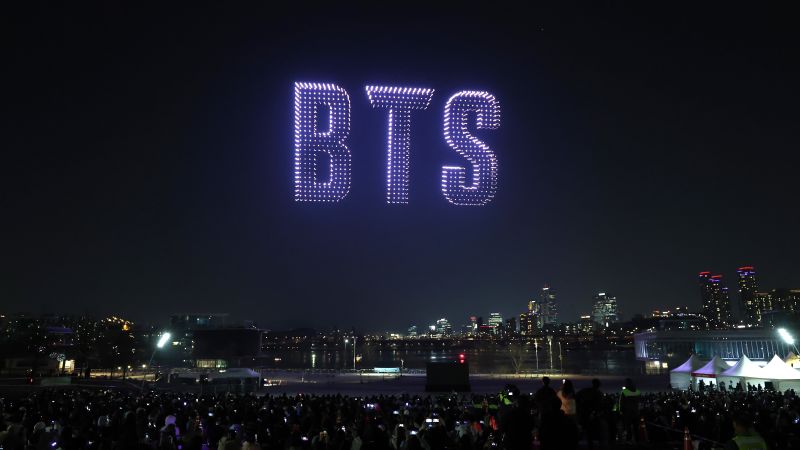
Tickets cost $9,000 each. Fans plant trees so their idols can be seen from airplanes. Believers who listen to music for up to 11 hours per day.
Few places are as passionate about K-pop as Latin America.
After an almost four-year hiatus, the preeminent Korean pop music group BTS has reunited for a world tour that includes several dates in Latin America, and the group’s return is highly anticipated.
In the band’s absence, the so-called “Korean wave” continued to flourish on a global scale, with successes exemplified by the Netflix film “KPop Demon Hunters” and the solo careers of Blackpink performers.
This dominance is especially emblematic in Latin America, where K-pop artists maintain passionate fandoms.
In 2021, social media platform X found that the countries with the most K-pop fans included Brazil, Mexico, Argentina, Peru, and Colombia. Spotify recently reported that Mexico is one of the genre’s biggest markets.
Perhaps no group embodies the genre’s success more than BTS. BTS is a hugely popular boy band with a wide fan base. The legions of followers surrounding the group are known as “ARMYs” and are symbolic of the loyal and organized nature of fandom.
Before taking leave for military service, the group achieved great success across borders and languages.
After kicking off their long-awaited tour in Seoul, the group will head to Latin America in the fall, performing in Bogota, Lima, Santiago, Buenos Aires, and São Paulo.
Throughout the region, anticipation for this group’s arrival is evident.

Due to the BTS craze, ticket resale prices have skyrocketed in Mexico, with ticket prices reaching as much as $9,000.
In Peru, fans are planting trees so the band can be “better seen” from airplanes.
Meanwhile, some Chileans have expressed concern that the venue for the two-day event in Santiago in October has not been confirmed.
Latin American fans seem to embrace the influence of K-pop artists, including their sophisticated aesthetic, flashy performances, and powerful messages of self-acceptance.
Throughout Latin America, K-pop fandom manifests itself in many different forms.
In Colombia, the competitive dance troupe movement is booming, building a community around music.
Fans in Mexico City flock to attend K-Pop-themed events at Furiki Plaza, a lively shopping center offering Korean and Japanese goods and food. BTS is so popular in Mexico that President Claudia Sheinbaum asked South Korea to schedule more tour dates.

Even in Cuba, which just officially established diplomatic relations with South Korea in 2024, this phenomenon is spreading at fan-organized dance events and other events.
However, Dr. Benjamin Min Hung, a professor of entertainment and media studies at the University of Georgia, told CNN that much of the community building is based on online platforms.
“The role of social media is important in promoting Latin American fandom,” he added.
Despite the genre’s growing popularity, the culture remains niche and relatively foreign to some communities, Han told CNN.
This can lead to alienation, which then strengthens the sense of community felt within fandoms, Han’s research found.
Depressed fans can find solace in the words of K-pop idols, some of whom preach the importance of acceptance and self-respect.
“There’s an element of care. They feel like they’re being cared for, not only by the community, but also by the artists who frequently participate in livestreams to establish connection and intimacy,” Han said.
The performance element also contributes to the activation of the fan base. K-pop performers are often noted for their sophisticated choreography and technically impressive concerts.
“K-pop has had a huge impact on Latin America due to its comprehensive approach. It’s not just the music, but also the combination of beauty, performance, storytelling and ongoing content,” Carolina Abalai, president of BTS’s official fan club in Chile, told CNN.

“This is an industry that pays close attention to detail, from visuals to concept, which appeals to audiences looking for something different from the traditional,” Abarei added.
Lo Julio, a choreographer and dancer based in Santiago, Chile, believes dance and performance are key elements of the genre’s worldwide popularity.
“I think it’s global. The rhythm, the music, everything is very flashy, very visual. The group work also involves very dynamic choreography. All of that has been in the spotlight for over a decade, but recently it’s become more mainstream with the number of groups that continue to perform,” she told CNN.
BTS fan and publicist Camila Pizarro, 32, told CNN that the group’s interdisciplinary talent is what makes them so appealing.
“They all sing very well, dance very well, act very expressively, and are so talented. They are the complete package as performers,” she said.
According to a 2025 report from the South Korean Ministry of Culture, Sports, and Tourism, K-pop is overall the leader in South Korean cultural exports, but notes that interest in other media is also increasing.

Throughout the early 2000s, Korean culture was introduced to large audiences in Latin America primarily through the broadcast of Korean drama series, or K-dramas.
Ahead of the 2002 World Cup, hosted by Japan and South Korea, Peru’s public broadcaster began broadcasting Korean dramas in partnership with the Korean embassy.
Other Latin American countries began broadcasting the show, and it was often dubbed in Mexico. Over time, K-dramas became popular throughout the region.
With the rise of social media in the 2010s, interest in Korean pop culture increasingly extended to music.
Han told CNN that many K-pop fans were introduced to the genre through anime or dance games at local arcades, and then discovered more online.
Latin America’s large youth population also plays a central role in the success of this music.
K-pop “mainly appeals to the younger generation, who use social media a lot,” Han said.
In 2025, Spotify reported that nearly 7 in 10 K-Pop listeners in Mexico will be under the age of 29.

In recent years, the big names behind K-pop’s global success have made a clear effort to capitalize on Latin America’s unique interest in the genre.
“The Korean music industry recognized the importance of the Latin American market,” Han said, and companies began allocating more resources to fostering a strong fan base in the region.
In 2023, HYBE, the multimedia giant behind BTS and Katseye, who achieved notable success in the United States, acquired record label Exile Music and created a Mexico-based subsidiary focused on Latin America.
Last year, HYBE Latin America debuted Santos Bravos, its first group targeting the Latinx demographic.
Tim Kim, the manager of popular K-pop groups Momoland and T1419, has begun working with Miami-based public relations firm Nevarez Communications to expand his clients’ influence in the region, Billboard reported.
T1419 covered Daddy Yankee’s song “Campeon” in 2022, highlighting the crossover appeal of this genre.
The language barrier also seems to be coming down. Some K-Pop groups incorporate Latin music styles and Spanish phrases into their songs, such as BTS’ “Airplane pt.2” and Ateez’s “THANXX.”

Members of the group NMIXX, which became a hot topic for their performance at Chile’s Viña del Mar Festival, talked about their efforts to learn Spanish.
BTS spoke about their love for Latin pop before going on hiatus, and their upcoming album features production from Spanish musician El Guincho, who has worked with artists such as Rosalía, J Balvin, and Ozuna.
On stage at his solo concert in Mexico City last year, BTS member J-Hope recognized the apparent intensity of his fans’ reactions.
“I’m really not kidding. You made tonight special,” he told the audience, adding, “Honestly, during the concert, I thought, ‘Wow, this is Mexico. This is why we have to come.'”
