

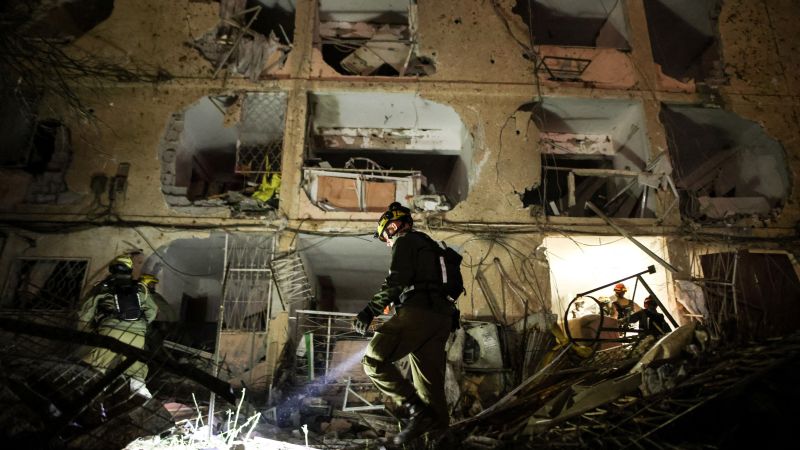
Both the United States and Israel are threatening to step up airstrikes against Iran after Iranian missiles hit a southern Israeli city, injuring dozens of people.
A growing number of countries are willing to help protect maritime traffic in the vital Strait of Hormuz, which Iran has effectively blocked for weeks.
Here are the latest developments:
What are the main headings?
Threat of attack: US President Donald Trump has threatened to “attack and destroy” Iranian power plants if Iran does not open the Strait of Hormuz, a critical waterway for the world’s energy resources, within 48 hours. The threat marks an escalation in rhetoric from President Trump, who had previously floated the option of attacking Iran’s infrastructure, which he warned would undermine the country’s ability to rebuild. It is also a tacit admission that closing the strait will give Iran significant leverage.
Israeli attack: The Israeli military said it failed to intercept a missile before it hit the central city of Dimona, injuring several people and destroying a small building in the headquarters of the country’s nuclear program. Meanwhile, in the south, a missile appears to have broken through defenses and landed in Arad, leading authorities to declare a mass casualty incident.
US and UK bases targeted: Britain condemned what it called a “reckless Iranian attack” after a missile was fired at the Diego Garcia military base in the Indian Ocean. The joint U.S.-British base is about 3,800 kilometers (2,360 miles) from Iran and can host long-range bombers from the U.S. military. The attempt raised new questions about Tehran’s military capabilities and how far its missiles could reach.

What is happening in Iran and Lebanon?
Israeli wave attacks: The Israeli military announced it had launched a “massive” wave of attacks against Iran and Lebanon’s Hezbollah simultaneously, hitting more than 200 targets so far this weekend. In Iran, the Israel Defense Forces said it had attacked dozens of facilities storing weapons and ballistic missiles. It also said it had completed two waves of attacks in Beirut and additional areas of Lebanon, hitting “hezbollah’s main headquarters.”
Rising death toll: More than 18,000 civilians have been injured in Iran and more than 1,330 people have been killed, including at least 200 children, since the war began three weeks ago, according to the latest figures from the Iranian Red Crescent Society and Iran’s ambassador to the United Nations. More than 1,000 people have lost their lives in Lebanon and more than 1 million people have been displaced, according to the Lebanese Ministry of Health.
Crackdown: Iranian authorities have arrested 25 people for “spreading rumors, filming damages and sending them to counterrevolutionary networks,” the state-run Tasnim news agency reported. The arrests came days after Iran executed three men in connection with nationwide anti-regime protests earlier this year.

Protecting safe navigation: The United Arab Emirates and Australia are the latest countries to express their willingness to contribute to efforts to ensure safe navigation through the Strait of Hormuz, joining a statement that now includes 22 countries. It was not immediately clear what efforts would be made to secure the vital waterway.
The Blast: An unknown projectile caused an explosion at “close range” of a bulk carrier off the central north coast of the United Arab Emirates, the UK Maritime Trade Operations (UKMTO) announced early Sunday. “All crew members are reported to be safe,” it added. Since the war began, Iran has attacked several ships friendly to the United States in the strait.
History repeats itself: U.S. Navy ships escorting oil tankers through the Straits bring to mind the so-called Tanker Wars of the late 1980s, which involved some of the same weapons and problems that U.S. escort forces would face today. This provides a lesson that in war things can go awry quickly and in unexpected ways, with potentially deadly consequences.
