

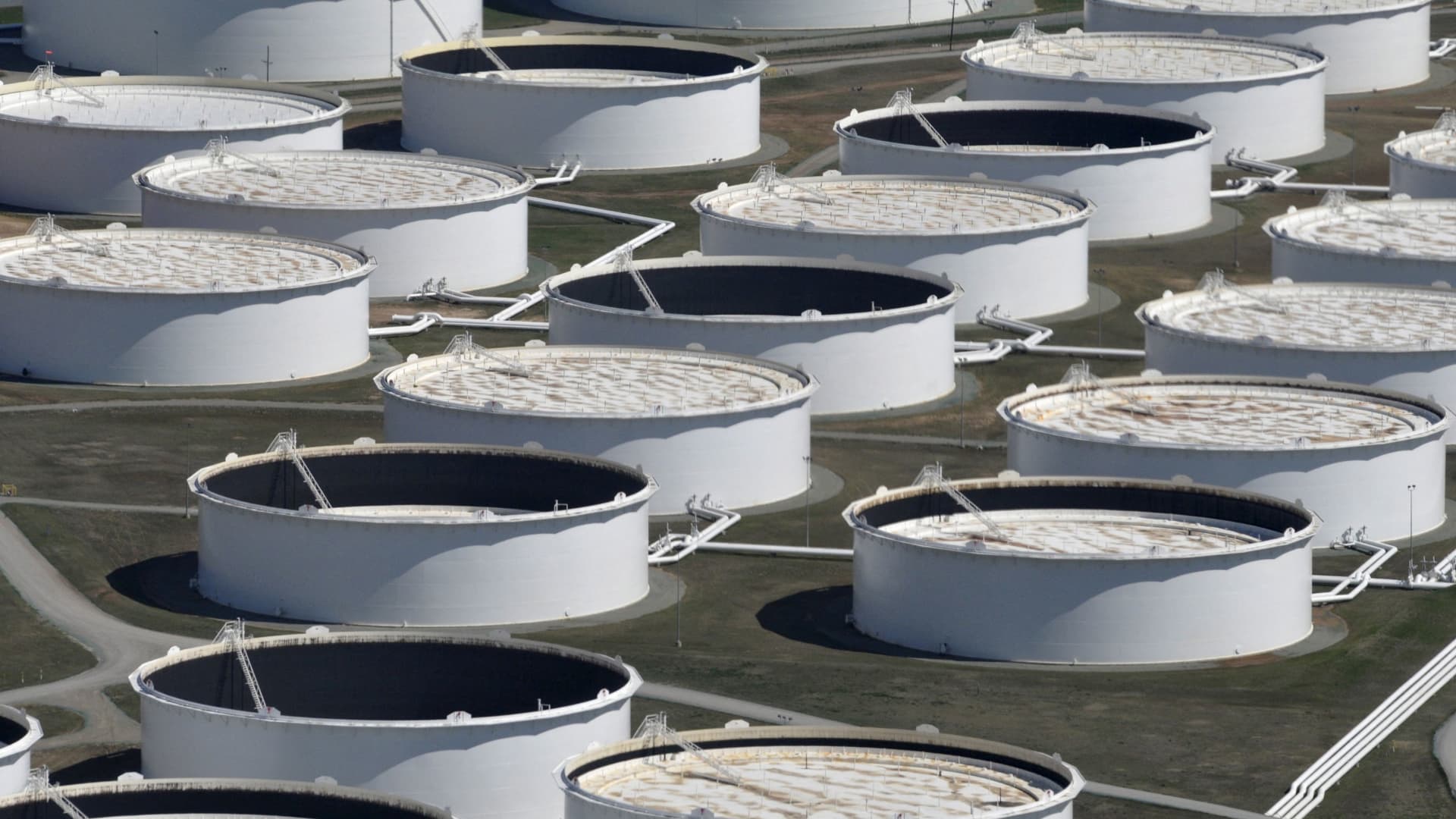
File photo: Crude oil storage tanks seen from above at the Cushing Oil Hub on March 24, 2016 in Cushing, Oklahoma. There appears to be no more room for the historic oversupply that has driven down prices. Photographed on March 24, 2016.
Nick Oxford | Reuters
The International Energy Agency warned on Friday that supply measures alone will not be enough to alleviate “the largest supply disruption in the history of the global oil market” as conflict in the Middle East escalates.
Rather than waiting for disrupted production to recover, lowering demand could reduce pressure on consumers and bring prices down faster.
Minimizing road and air transport, working from home where possible and switching to electric cookers could go a long way in cushioning the shock to consumers, the agency said.
Rising geopolitical risks are not only spooking traders and pushing up oil prices, but also sharply increasing the cost of refined products such as diesel and jet fuel, directly impacting transportation, logistics and consumer prices.
Oil prices have soared more than 40% since the US-Iran war began on February 28, reaching their highest level since 2022, largely due to severe supply disruptions caused by the de facto closure of the Strait of Hormuz.

The strait is a narrow maritime corridor off the coast of Iran that connects the Persian Gulf and the Gulf of Oman, and typically transports about one-fifth of the world’s oil consumption.
Countries have already begun developing their strategic oil reserves, with hundreds of millions of barrels scheduled for release.
The IEA last week agreed to release 400 million barrels of oil to deal with supply disruptions caused by the Iran war, the largest such move in its history, without saying when the shares would be put on the market.
Decline in oil demand
While policymakers continue to grapple with supply disruptions, concerted efforts to reduce consumption may lead to the quickest relief.
“Addressing demand is an important and immediate measure to reduce pressure on consumers by improving affordability and supporting energy security,” the IAE said on Friday, setting out a series of steps households and businesses can take to reduce demand.
The most impactful measures include encouraging remote work wherever possible, increasing carpooling and public transportation use, and reducing non-essential air travel.
The measures mainly focus on road transport, which accounts for about 45% of global oil demand.
The agency said working from home where possible would reduce fuel demand during commuting, while lowering speed limits, shifting from private cars to public transport and alternating private cars in urban areas could further reduce congestion and fuel consumption.
Measures to shift the use of liquefied petroleum gas (LPG) from transportation to essential uses such as cooking will also help lower prices, as will adopting alternative, clean cooking solutions that reduce reliance on LPG.
tax
Countries are also looking to fiscal measures to ease pressure on consumers and prevent sharp rises in fuel prices that could increase inflationary pressures.
Spain plans to reduce value-added tax (VAT) on fuel from 21% to 10%, local media reported, citing sources familiar with the matter. According to the report, the government also plans to abolish the 5% tax on electricity.
Italy cut excise taxes on fuel on Wednesday, but Germany’s finance ministry said it was considering ways to protect consumers from higher fuel prices, including introducing a windfall tax on oil companies.
Early Friday morning, international Brent crude oil futures for May delivery rose 1.3% to $109.93 a barrel, while U.S. West Texas Intermediate futures for April delivery were trading almost flat at $96.20.
— CNBC’s Sam Meredith contributed to this report
