

Beijing/Hong Kong
—
China’s top diplomat has cast his country as a champion of peace and stability as the war in Iran escalates, while taking a conciliatory stance toward the United States ahead of a long-awaited summit between the two countries’ leaders.
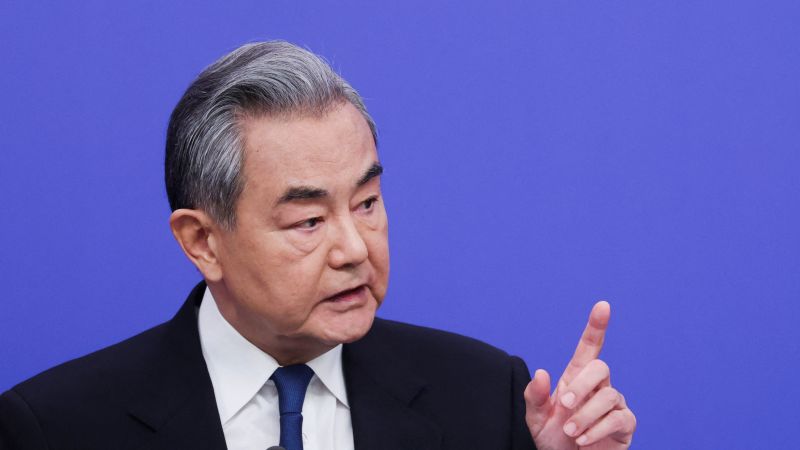
“This is a war that should never have happened and was in no one’s interest,” Chinese Foreign Minister Wang Yi said at a press conference on Sunday on the sidelines of the China Rubber Stamp Congress’s annual meeting.
Wang touted China as “the world’s most important force for peace, stability and justice” and reiterated Beijing’s call for an immediate ceasefire to “prevent the situation from deteriorating and avoid the spread and spread of war.”
“All parties should return to the negotiating table as soon as possible and resolve their differences through equal dialogue.”
China’s growing concerns about war with Iran come as Supreme Leader Xi Jinping prepares to welcome US President Donald Trump to Beijing for key talks between the world’s two largest economies towards the end of this month. The summit is expected to cover a wide range of important issues, from trade tensions to Taiwan.
Adding a new complication to the impending negotiations is the rapidly escalating war in the Middle East.
Iranian leaders have long had close ties with the Chinese government. China, like many other countries, is watching with alarm the soaring oil prices and damage to the global economy caused by the killing of Iranian leader Ayatollah Khamenei and the escalation of the conflict.
More than a week has passed since the United States and Israel launched attacks on Iran, and the war shows no signs of abating. President Trump said Friday that there is no deal with Iran other than “unconditional surrender,” without elaborating on specific demands.
Beijing sees an opportunity to project an image of a reliable and responsible superpower in contrast to the United States, which has created uncertainty in the world through new wars, the detention of Venezuelan President Nicolas Maduro, and the launch of a global trade war against its close ally China.
The Chinese government “provides the most valuable source of stability and certainty in a turbulent world and has become an irreplaceable anchor amid global turmoil,” Wang asserted on Sunday.
But at the same time, Wang welcomed the upcoming summit between Xi and Trump and called for continued engagement with Washington to address key differences. He said the two countries’ leaders had set an example in achieving overall stability in bilateral relations despite the turmoil.
“What is needed now is for both sides to make thorough preparations, foster a favorable environment, manage existing differences, and eliminate unnecessary interference,” Wang said in response to a question from CNN’s Stephen Jiang on Sunday.
“China and the United States are both great powers, and neither can change the other, but they can change the way they interact,” he added, urging the United States to move in the same direction.
At the same venue last year, shortly after President Trump launched the new administration’s first salvo of tariffs on China, Mr. Wang warned the United States against a “two-pronged approach” in relations with China and emphasized that Beijing “resolutely opposes authoritarian politics and hegemonism.”
If last year’s message was a warning amid uncertainty, this year’s message was one of confidence. China has largely weathered President Trump’s tariff attacks and validated its hard-line strategy, while increasing China’s global standing as the US president wreaks havoc around the world.
Traditionally close allies of the United States, from French President Emmanuel Macron to British Prime Minister Keir Starmer to German Chancellor Friedrich Merz, have visited China in recent months, a sign of Beijing’s success in courting allies. Mr. Wang nodded at this development.

“We’re noticing that more and more smart people in Europe are recognizing China as a global partner, not a competitor,” he said, urging greater cooperation and trade between the two countries.
China’s foreign minister also appeared to react to President Trump’s attempts to position the peace commission as an alternative to the United Nations, pledging to defend multilateralism and protect the world organization.
“Attempts to bypass the United Nations and start fresh, pursue a different system, or bring together small blocs or exclusive circles are unpopular and unsustainable,” Wang said.
But Wang’s press conference did not address many of the issues that are roiling other countries and China’s neighbors amid rising tensions in the Indo-Pacific region.
China is flooding global markets with exports and leveraging its dominance in rare earth production, putting it at risk of major disruption to global supply chains. In addition to maritime conflicts with the Philippines and Japan, China is also increasing military pressure on Taiwan.
Wang also made no mention of Ukraine, which has entered its fifth year of war with Moscow, and stressed that relations between China and Russia are “unaffected by wind and rain and are as stable as a mountain.”
Since Russia launched a full-scale invasion of Ukraine in 2022, China has refused to criticize Russia and remains an important partner of Russia, providing an important economic and diplomatic lifeline.
“China and Russia share a high level of political mutual trust. Standing back to back is a characteristic of China-Russia relations. We are not afraid of any provocation or pressure from outside,” Wang said.
