

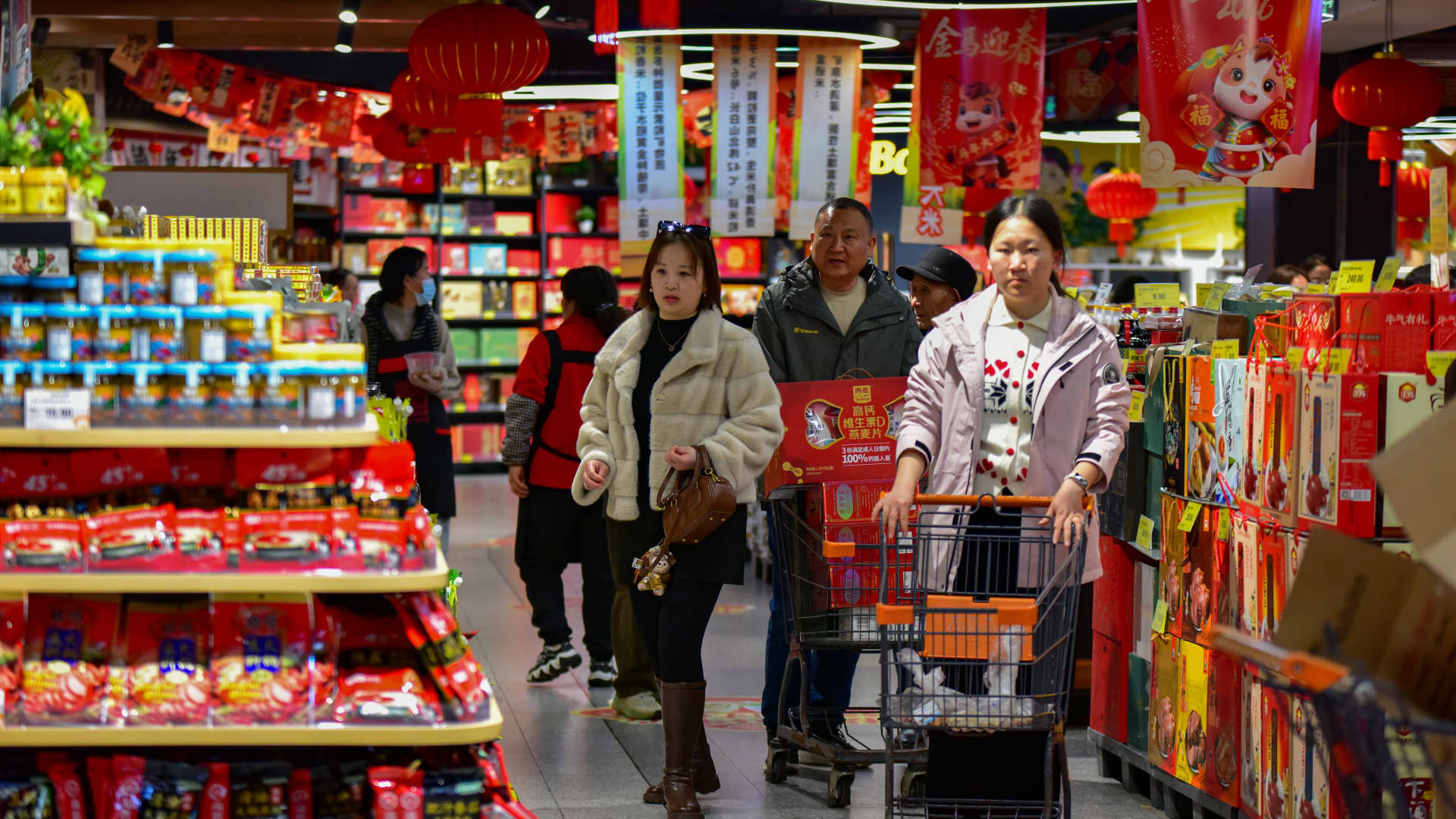
Fuyang, China – 02/14/2026: Shoppers push carts through festively decorated supermarket aisles with red lanterns and “Golden Horse Welcoming Spring” banners hanging overhead.
Sheldon Cooper | SOPA Images | Light Rocket | Getty Images
China’s consumer inflation rate rose by the most in more than three years, as long holidays boosted spending and deflation in factory prices eased.
China’s National Bureau of Statistics reported on Monday that the consumer price index rose 1.3% in February from a year earlier, beating the 0.8% rise expected by economists polled by Reuters. The rise followed a 0.2% rise in January and was the biggest rebound since January 2023, according to LSEG data.
On a monthly basis, prices rose 1% in February, beating economists’ expectations for a 0.5% rise.
Core CPI, which excludes volatile food and energy prices, rose 1.8% year-on-year last month, matching the pace last seen in March 2019, according to official data compiled by Wind Information.
“The price increase in the service sector during the Lunar New Year is stronger than market expectations (and) it is not clear at this stage whether this impact will continue beyond the holiday,” Zhiwei Zhang, president and chief economist at Pinpoint Asset Management, said in a note on Monday.
According to official data, service prices rose 1.1% year-on-year last month, contributing 0.54 percentage points to the Composite Consumer Price Index (CPI), driven by demand for holiday travel, pet care, vehicle maintenance, movies, food and beverage services, etc.
This year’s Lunar New Year holiday will run from February 15th to February 23rd, making it the longest holiday on record, compared to last year’s eight-day holiday from late January to early February.
China’s producer price index fell 0.9% from a year earlier, beating economists’ expectations for a 1.2% decline and marking the slowest pace of deflation in more than a year, as soaring prices for metals and primary goods secured a temporary floor for factory gate prices.
At an economic policy meeting held last week, China kept its annual consumer inflation target for 2026 at “around 2%.” The target, first set for 2025, was the lowest level in more than 20 years as Chinese policymakers sought to shore up domestic demand and curb fierce price competition spreading across many industries.
Inflation targeting acts as a ceiling rather than a target to be achieved. Consumer prices were generally flat in 2025, but core inflation rose 0.7% as consumer confidence remained weak.
Beijing also lowered its GDP growth target for this year to a range of 4.5% to 5%, the most ambitious target on record since the early 1990s, as officials acknowledged persistent deflationary pressures and rising geopolitical uncertainty.
To shore up domestic spending, Chinese authorities allocated 250 billion yuan ($36.2 billion) in subsidies for consumer trade-in programs in this year’s fiscal budget (down from 300 billion yuan in 2025), as well as 100 billion yuan in government funds to support private investment and consumer spending.
“The pace of[stimulus]will remain gradual,” said Larry Hu, chief China economist at Macquarie. Policymakers see weak consumption as a structural problem to address, but exports and manufacturing are expected to continue to drive growth, making “the need for aggressive consumption stimulus is low.”
“The main variable is exports,” Hu said in a memo last Thursday. “If exports remain strong, policymakers may continue to tolerate weak domestic consumption. Conversely, weak exports may prompt them to ramp up domestic stimulus to meet gross domestic product (GDP) targets.”
Chinese gold jewelry and gasoline prices rose 6.2% and 3.1%, respectively, in February as geopolitical tensions worsened due to ongoing conflicts in the Middle East. Factory gate prices for silver and gold refining rose 16.9% and 8.4%, while oil and gas extraction prices rose 5.1%.
Zhang said the Middle East war showed little sign of easing and could continue to push up Chinese producer prices until at least March, warning that prolonged conflict risks pushing the global economy into stagflation.
Zhang said China may need to implement more aggressive fiscal policy than last week’s budget proposal if it fails to ease tensions in the Middle East in the second quarter.

