

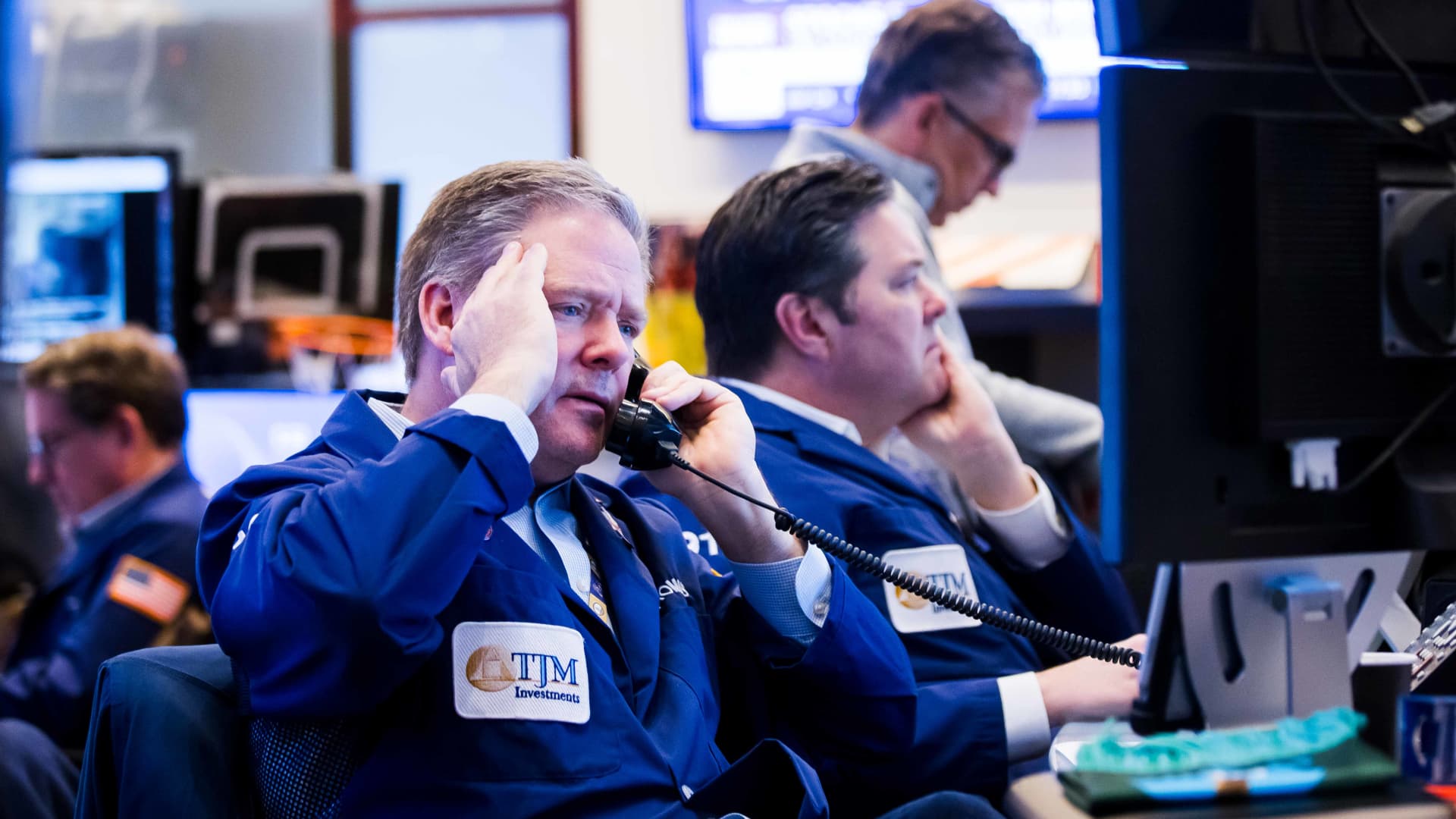
Traders at work at the New York Stock Exchange on March 2, 2026.
new york stock exchange
What you need to know today
Oil prices finally did what analysts had been warning about last week, as Iran continues to blockade the vital Strait of Hormuz. On Sunday, oil prices exceeded $100 per barrel. This is the first time oil prices have crossed the $100 mark since Russia invaded Ukraine in 2022. By early Monday, West Texas Intermediate had come off its highs but was still up 12% to $102 a barrel. Brent, the global benchmark, was trading about 15% higher at $106.
The market reacted quickly, with Dow futures now down about 900 points. Meanwhile, S&P 500 futures and Nasdaq 100 futures are down about 1.6% and 1.7%, respectively, although they are still off their previous lows. Asian markets also fell on Monday, but pared losses slightly after reports that Saudi Arabia offered to release crude onto the market.
As oil prices began to soar, US President Donald Trump said on Truth Social that “short-term oil prices” were “a very small price to pay.” It remains unclear whether this surge is temporary, as the war shows little sign of easing. According to reports, Iran has named Khamenei’s son Mojtaba as its new supreme leader. On Monday, the U.S. embassy in Riyadh also issued the first-ever departure order for government employees to leave Saudi Arabia for non-emergency situations.
For now, U.S. Energy Secretary Chris Wright is cautiously optimistic, saying on Sunday that it is “not long” before the strait reopens after the U.S. destroyed Iran’s ability to threaten oil tankers. Wright told CNN in an interview that the “worst case scenario” is that the strait closure will last “for weeks,” “not months.”
The geopolitical turmoil is testing global diplomacy, with President Trump scheduled to meet with Chinese President Xi Jinping from March 31 to April 2 amid disagreements over the Iran war and trade tariffs. On Sunday, China’s top diplomat, Wang Yi, signaled that preparations were underway for talks, repeating his country’s call for a ceasefire, saying “this is a war that should not happen” and “no one wins.”
Meanwhile, G7 countries are also scheduled to convene an emergency meeting in the coming days to deal with the Middle East crisis. The group, which is made up of the United States, Canada, France, Germany, Italy, Japan and the United Kingdom, has been under tension during both of U.S. President Donald Trump’s terms. The group is reportedly discussing a joint release of emergency oil reserves, according to the Financial Times.
And finally…
Why the world’s best-performing stock market is experiencing historic volatility in 2025
South Korea’s stock market has been volatile in recent days as investors reassess the risks of escalating Middle East wars.
While the global risk-off mood is a major factor, experts point out that the South Korean market is particularly vulnerable to sudden fluctuations because it is concentrated in two major memory companies and is sensitive to energy shocks.
Another factor amplifying the market movement is South Korea’s large retail investor base and active derivatives market, market veterans said.
— Li Yingshan
