

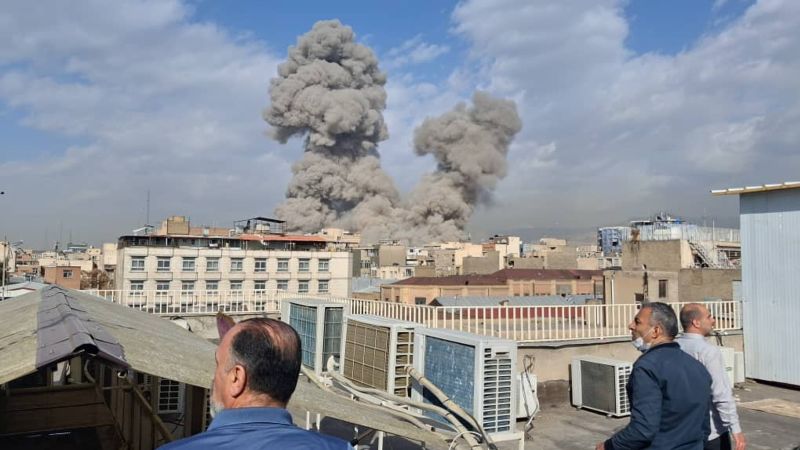
The streets of Tehran are eerily quiet until the bomb arrives.
“It’s like a ghost town. No one comes and goes. It’s like a city without a soul. Every time you see someone on the street, there’s a zombie – like on The Walking Dead,” a 30-year-old Tehran resident told CNN on Friday morning, hours after six days of heavy airstrikes hit the Iranian capital.
“People were panicking, but some were looking out their windows at the jets as if they were watching a movie,” he said.
“These are really strange and unknown days we are living in,” another Tehran resident told CNN on Wednesday. “We are all caught in the middle, not knowing whether to be happy or sad.”
The United States and Israel have been carrying out coordinated attacks against Iran since February 28, prompting retaliatory attacks and escalating war across the Middle East.
For many Iranians, the war stirs up mixed emotions.
There is hope for those who have long hoped to see Ayatollah Khamenei’s brutally repressive regime disappear. For pro-regime supporters, the days of mourning have only just begun as the future of the regime is cast into doubt following promises by US President Donald Trump and Israeli Prime Minister Benjamin Netanyahu to target Khamenei’s successor.
The situation is even more complicated for Iranians, who long for regime change but never imagined that it would come through foreign military intervention.
“The enemy is attacking us and carpet bombing us, but we are not upset,” said a second Tehran resident. Many of the Iranians quoted in this article spoke to CNN on condition of anonymity due to safety concerns.

“It was much more difficult to continue doing what we were doing before. Myself and my friends have always (said) that of course this war and this attack is dangerous, there is uncertainty and danger, but other situations were more mentally difficult and more dangerous than now,” a second Tehran resident said, referring to the regime’s decades of repression. Most recently, authorities killed thousands of protesters during anti-government protests in January, and an internet blackout plunged the entire country into international isolation.
However, not everyone wants a change of government.
In an audio memo sent by a second Tehran resident on Wednesday night, pro-regime demonstrators gathered for the first day of official mourning for Khamenei can be heard chanting in the background.

“This is life now. They (regime supporters) come out every night. It’s not just a few people. These people also drove us crazy over this,” they said.
The long-standing divisions among the Iranian people were further amplified by the turmoil caused by the war.
But across the political divide, the bombing has been horrifying for many Iranians, and civilian casualties are mounting. Human rights groups have reported that US and Israeli attacks have killed more than 1,000 people, including children, since Saturday.
At least 168 children and 14 teachers were killed in an attack on a girls’ primary school in the southern Iranian city of Minab on Saturday, according to state media, prompting UN human rights envoy Volker Türk to call for a “prompt, impartial and thorough” investigation and warn that the “indiscriminate attack” was a “grave violation” of international humanitarian law. The White House on Wednesday did not rule out the possibility that U.S. military personnel carried out the airstrikes, but insisted the United States was “not targeting civilians.”

On Thursday, Iran’s Foreign Ministry announced that dozens of civilian centers were targeted in U.S. and Israeli attacks, including residential areas, hospitals, schools, emergency centers, and historical sites.
For those who have suffered under Khamenei’s rule, the destruction of some facilities, including detention centers and morality police outposts, brings a mixed sense of relief and vindication.
Tehran’s Gisha Street complex, which houses the Morality Police building and one of the country’s most notorious detention centers, was hit by a strike on Sunday. Satellite images obtained by CNN on March 3 confirmed that the building was destroyed.
“Tens of thousands of people were detained and humiliated” in the building, a 23-year-old Iranian student and former detainee told CNN via activist news agency IranWire.
The student said he hoped no innocent people were injured in the bombing.
“But I’m crying because I’m so happy to know it doesn’t exist, and I’m crying because I remember being insulted and pushed around in that building,” they said.
Another former detainee, a musician, told CNN that his time at the center was “deeply traumatic.” He said he felt “conflicting emotions” as he watched the building collapse.
“I always thought about how I would take revenge if the government fell,” the musician said.
Amid explosions, internet blackouts and uncertainty, some Iranians are looking for a way out.


“People are happy that police stations are being attacked,” a 30-year-old Tehran resident said on Friday, adding: “Police are still present at the toll plazas and if you want to leave Tehran, your car trunks will be searched.”
In the coastal city of Bushehr, a resident told CNN on Wednesday that people in the small village felt the effects of a bomb aimed at military infrastructure.
“People I know have left,” they said, adding that villages with only one road were also under attack.
However, unlike in previous conflicts, many Iranians also choose to remain abroad. This is not only because of the logistical barriers to leaving the country, but also because some people see leaving the country as succumbing to psychological pressure, and others fear that if they leave, they may never return.
In the capital, one woman described the strange mix of panic and daily life in the city’s shops and markets, suggesting it was a sign that the regime was trying to maintain a semblance of normalcy in the midst of war and despite years of devastating economic decline caused by sanctions, corruption and misgovernment.
“When it comes to groceries and goods, that first day I went to the store across the street. Everything is very expensive and most people can’t afford to stock up. But the next day, we saw that all the markets were well stocked and prices were going down, the bakeries were all open and baking bread… We don’t know what will happen in the future,” the woman said.
Meanwhile, the regime continues to severely restrict all means of communication in Iran, with the internet restricted to about 1% of normal traffic since February 28, and nearly 90 million people cut off from independent news and social media, according to independent watchdog Netblox.
In the south-central city of Shiraz, a resident described the disruption of life amid shelling and with little access to news or warning systems.
“There is no internet, we can’t get news. If you want news, the phone only connects every few minutes… There are no sirens, they don’t even give people time to evacuate… All we know is that something is coming towards us in the sky. We don’t know if it’s ours or theirs,” they said.

On Thursday, US and Israeli airstrikes hit a playground and emergency center in Shiraz, killing 20 people, including two Red Crescent paramedics, the association said.
Back in Tehran, where there was heavy shelling in multiple locations, including residential areas, late Thursday night, residents said they had also received no warning of an impending attack.
“There’s no warning. My apartment doesn’t have a basement, so I’m taking shelter in a parking lot. I’m stocking up on canned goods, drinking water and flashlights in case there’s a power outage,” a 30-year-old Tehran resident told CNN on Friday.
As the war continues to rage with no end in sight, Iranians are being forced into a new reality.
When asked on Wednesday evening how they were doing, one Tehran resident simply said: “I’m still alive.”
