

As the Middle East conflict intensifies across the region, multiple sporting events around the world, particularly in the Gulf, are being hit by uncertainty at one of the busiest times of the year on the global sporting calendar.
After the United States and Israel attacked Iran on Saturday, killing Supreme Leader Ayatollah Khamenei, Iran responded with missile and drone strikes against several military bases in the Middle East where Israeli and U.S. forces operate.
Recommended stories
list of 4 itemsend of list
Iranian missiles and drones have repeatedly targeted Doha, Dubai, Abu Dhabi, Manama, and various areas of Saudi Arabia.
The ensuing conflict has thrown sport in the region and around the world into turmoil, forcing the cancellation of several tournaments and suspending leagues, leaving athletes wondering what will happen next.
Sports organizations and event organizers are scrambling to protect athletes, officials and fans from the attack and its aftermath.
A tennis tournament in the United Arab Emirates was at the center of the storm on Tuesday, with an ATP Challenger-level tournament in Fujairah canceled after falling debris from an intercepted drone sparked a fire in an oil field some 13 kilometers away.
Video posted on social media showed two players on court during the match, Belarusian Daniil Ostapenkov and Japan’s Hayato Matsuoka, scrambling for shelter.
“Just finished the second round match in Fujairah, but today’s match is suspended,” Ukrainian player Vladislav Orlov said on Instagram.
“While we were playing, we could hear jets everywhere. And there’s smoke here next to the mountains, so it’s not very safe right now.”
The tournament has since been canceled, and the first email sent to players by the Professional Tennis Players Association appears to have floated the idea of taking a chartered flight home at a cost of $5,800 each way.
There is no indication of how the players reacted. But then Belarusian player Ilya Ivashka posted on Instagram: “We just received confirmation that all participants in the tournament in Fujairah will be evacuated free of charge. Everything is fully covered. What a great gesture. @atptour.”

Soccer, the region’s most popular sport, is also facing disruption.
The Asian Football Confederation (AFC) announced on Wednesday that next week’s Asian Champions League matches scheduled in the Middle East have been postponed until further notice.
“AFC’s priority is the safety and security of all parties, including players, teams, officials, partners and fans, and we remain steadfast in our commitment to ensuring a safe environment for everyone,” the continental committee said in a statement.
Earlier this week, the Qatar Football Association also canceled all matches in the country.
Qatar was also due to host the Finalissima soccer match between Argentina and Spain this month, but European soccer body UEFA said a decision on whether and where it would take place would not be taken until next weekend.
The high-profile match between the Copa America winners and the European champions is scheduled for March 27 at Doha’s Lusail Stadium, with Lionel Messi’s team lifting the 2022 FIFA World Cup trophy.
“Talks continue with the local organizers, who have made significant efforts to ensure the match is a success. A final decision is expected to be taken by the end of next week. No alternative venues are being considered at this stage,” UEFA said in a statement to Reuters.
In addition to the ongoing and immediate impact on the tournament, Iran’s participation in the 2026 FIFA World Cup remains in doubt.
It remains unclear whether Iraq will be able to travel to the playoffs, which could secure a spot in the June 11-July 19 tournament co-hosted by Canada, Mexico and the United States.
Iran is scheduled to play the winner of Bolivia vs. Suriname on March 31 in Mexico.
Motorsport season comes to a halt
The opening round of the World Endurance Motorsport Championship (WEC) in Qatar has also been postponed to later this year.
The 1,812km (1,126 mile) race was scheduled for March 26-28 at the Lusail International Circuit, which is also used for MotoGP and Formula 1.
“The safety and security of competitors, officials and fans is of paramount importance, so the decision has been made to postpone the event,” the WEC said in a statement.
F1’s new season, which begins with Friday’s Australian Grand Prix, has faced logistical challenges as teams were forced to charter flights to transport hundreds of key personnel to Melbourne ahead of Sunday’s race.
Reports suggest that a quarter of F1’s workforce was scheduled to travel to locations in the Middle East for the Grand Prix.
The race moves to the Gulf in April, with Bahrain and Saudi Arabia hosting Grand Prix in Sakhir and Jeddah respectively.
Jeddah Circuit, located on Jeddah’s waterfront, has dealt with serious safety issues in the past.
In 2022, just days before the Saudi Grand Prix, an oil storage facility 11 kilometers (7 miles) from the circuit came under drone and missile attack by the Houthis. Smoke was seen billowing from the circuit as drivers, teams and F1 organizers held an emergency meeting before the race ultimately continued.
Racing will once again be under intense scrutiny, but Mohammed Ben Sulayem, president of global motorsport governing body the FIA, said safety will be the main concern when deciding whether to go ahead with the race.
“The FIA continues to monitor developments across the region and our thoughts remain with all those affected by recent events as we hope for a return to peace, security and stability,” he said in a statement on Monday.
All grandstand tickets for both races had sold out in the week before the dispute began, and both races were rescheduled to later dates, another logistical nightmare for organizers.
“With 40 days until the race, it is too early to assess the impact the local situation will have on the race weekend,” Bahrain International Circuit (BIC) authorities said in a statement.
“From an operational perspective, BIC continues to plan for the race weekend and our dedicated teams and offices at the circuit are working towards this.”
F1 works closely with local authorities, the UK Foreign Office and the US State Department.
Stranded athletes ‘just want to go home’
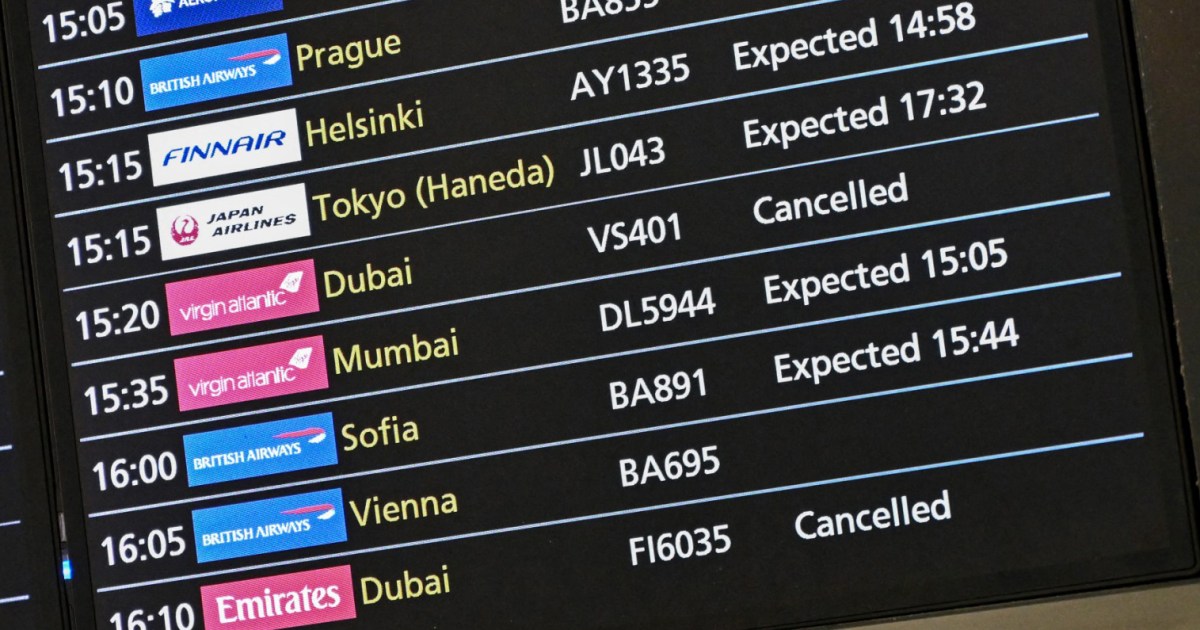
The Gulf region serves as a major air transport hub, with millions of passengers connecting East and West via airports in Doha, Dubai and Abu Dhabi. But with much of that airspace now closed, the future of sporting events outside the region is also in doubt.
The travel disruptions have spread further afield, leaving some athletes, teams and officials stranded, unable to travel to competitions or return home.
Two-time Olympic medalist PV Sindhu of India was stranded at Dubai airport for several days and finally returned home on Tuesday before withdrawing from the British Open badminton tournament.
“I’m back at my home in Bangalore and I’m safe. The past few days have been intensely anxious, but I’m so grateful to be home,” Sindhu wrote to X, using the old name of the southern Indian city.
Meanwhile, the cricket team, which was recently eliminated from the ongoing ICC Men’s T20 World Cup, has also faced delays in its return from India, which is co-hosting the tournament with Sri Lanka.
Zimbabwe, West Indies and South Africa withdrew from the tournament this week but are stuck in India due to the suspension of flights via the Middle East.
Some members of the Zimbabwe team were able to return home on Wednesday, three days after their last match, while the remaining two teams remain in India.
West Indies coach Darren Sammy took to social media to express his frustration, indicating that his team had not received any updates regarding his return for five days. “I just want to go home,” his post from early Thursday said. But then he posted: “I got an update. That’s all WI wanted.”
South Africa were eliminated late Wednesday after losing to New Zealand in the first semi-final.
England, who face India in the second semi-final on Thursday, could face a similar fate if they lose.
