

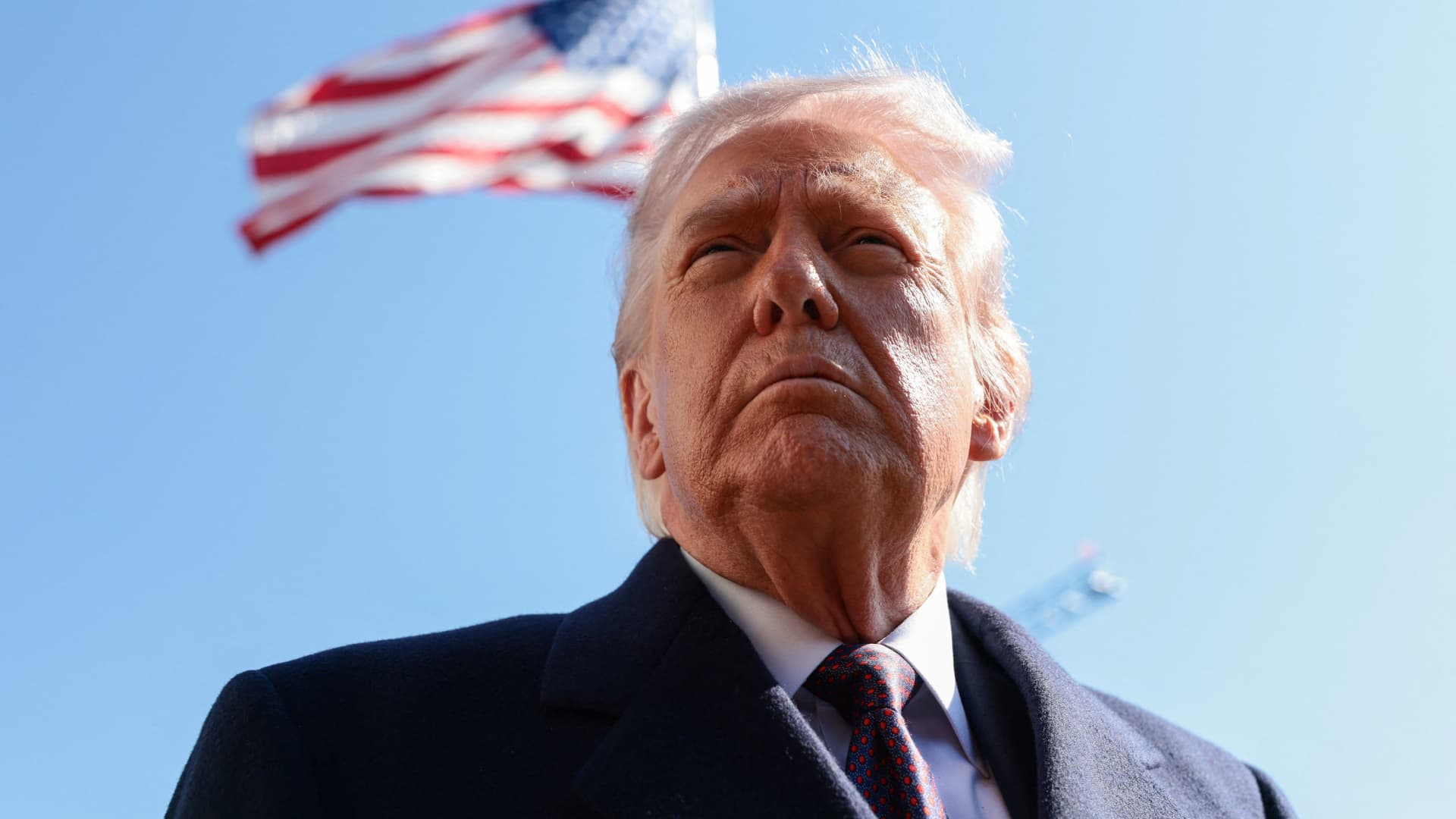
President Donald Trump on Wednesday signed a pledge to bring big technology companies to the White House and provide their own power to artificial intelligence data centers, as anger grows across the country over soaring power prices ahead of the midterm elections.
President Trump has embraced the artificial intelligence industry as a driver of economic growth and a pillar of national security in the United States’ conflict with China. But his alliance with industry also poses political risks as Democrats focus on the cost of living in their bid to take back Congress.
Grassroots opposition to data centers is growing in communities across the country, with residents decrying the facilities’ high utility bills. President Trump has promised to cut electricity rates in half in his first year in office. Instead, home prices rose by an average of 6% nationally in 2025, according to federal data.
The president said Wednesday that the data center “needs public relations support.”
“People think that when a data center is built, the electricity bill will go up, but that’s not the case,” President Trump said. “It’s not going to happen, and it’s not going to happen in the areas where it did happen.”
power duty
Executives representing Amazon, Google, Metaplatform, Microsoft, xAI, Oracle, and Open AI signed President Trump’s pledge on Wednesday. Signatories include AWS CEO Matt Garman, Oracle CEO Clay Magowyk, Google President Ruth Porat, Meta President Dina Powell, Microsoft President Brad Smith, OpenAI COO Brad Lightcap, and xAI’s Gwynne Shotwell.
“These companies have committed to providing or paying for all the generation and power needed for AI projects, which is huge,” President Trump said. “Where possible, we will build new power plants to increase grid capacity.”
However, the agreement does not appear to include any concrete, binding commitments. Peter Navarro, Trump’s trade and manufacturing adviser, previously said the White House would “force” tech companies to “internalize” costs associated with data centers.
Rob Gramlich, president of the consulting firm Grid Strategies and a former economic adviser to the Federal Energy Regulatory Commission, said the administration faces an uphill battle to translate pledges into policies that are actually implemented on the ground.
decentralized rules
The rules governing the power grid are spread across all 50 states, and each state has its own public utility commission and different laws. Gramlich said states would need to approve rules that would require data center developers to pay for new generation costs.
“The White House can’t do it alone,” he said. “There’s no jurisdiction there, and of course technology companies can’t do it alone.”
Democrats quickly criticized the pledge as an empty promise.
“A handshake deal with Big Tech over data center costs is not enough,” Arizona Sen. Mark Kelly said in a Feb. 24 social media post. “Americans need assurance that energy prices will not skyrocket and that communities will have a voice.”
Implementation challenges
Political consensus is growing across the United States that data center developers should pay for new transmission facilities and power plants, but such demands may already prove to be too little, too late. A report released last month by Goldman Sachs predicted that electricity prices will rise 6% by 2026 and another 3% in 2028 as demand for data centers grows faster than electricity supply.
The problem is most acute at the PJM interconnector, the nation’s largest power grid, covering 13 states, mostly in the Mid-Atlantic and Midwest. The cost of providing power in PJM has exploded in recent years, with costs attributable to data centers at $23 billion, according to watchdog Monitoring Analytics. Those costs are passed on to consumers.
This amounts to a “huge wealth transfer,” the watchdog group told PJM in a letter in November.
In January, the Trump administration and a bipartisan group of governors asked PJM to hold an emergency auction for tech companies to bid to bring new power plants online.
In October, Energy Secretary Chris Wright asked the Federal Energy Regulatory Commission to take jurisdiction over connecting large data centers to the power grid and allow FERC to require data centers to pay for new transmission costs, Gramlich said. But that doesn’t address the issue of new power generation, which is primarily regulated at the state level, he said.
Gramlich said “new federal legislation would be needed” for the Trump administration to directly address bringing more generations online.
political influence
But as Trump’s strongest ally, he has unique political influence over the AI industry. He has not shied away from putting pressure on independent institutions and has frequently used the bully pulpit of the White House to pressure companies to do what he wants.
“This is clearly a maximalist policy administration,” said Abe Silverman, who served as general counsel for the New Jersey Public Utilities Commission from 2019 to 2023. “There is reason to think this administration will be able to assert its will more directly than past administrations.”
Various politicians are targeting data centers. In his February 18 State of the State address, Illinois Governor JB Pritzker proposed suspending tax incentives for data centers for two years. Sen. Bernie Sanders of Vermont is calling for a moratorium on data centers. Florida Governor Ron DeSantis has proposed legislation to regulate data centers and protect families from price gouging.
Energy Secretary Wright told reporters last week that the administration had warned tech companies that they would face backlash if they were “considered to be raising the price of electricity.”
“We would like to see the data center developed,” Wright said. “We want the community to welcome them, but that requires upfront investment in the additional grid infrastructure needed.”
