

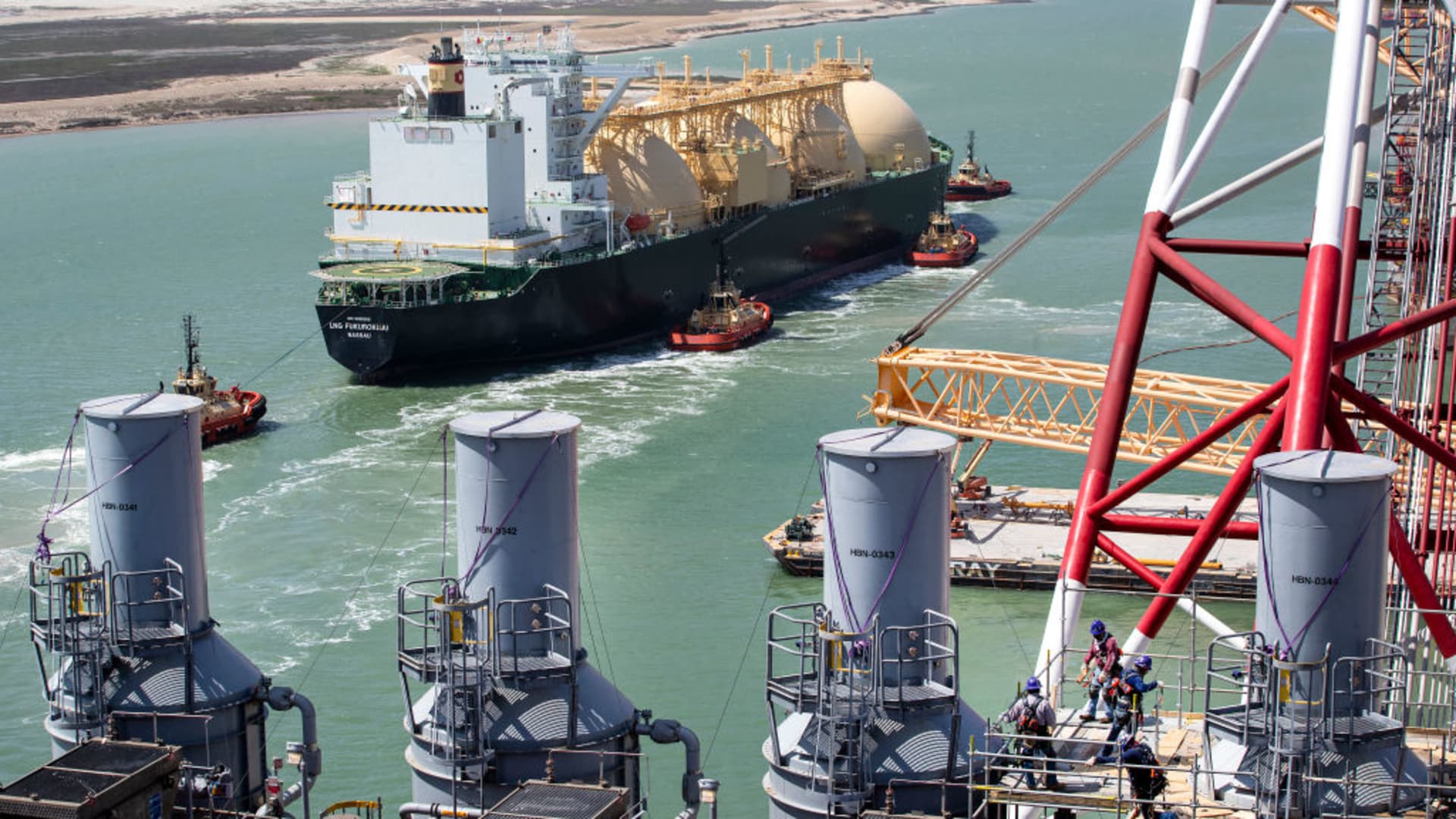
U.S. natural gas exporters are poised to benefit from significant disruptions to global supplies due to the escalation of war in the Middle East. Qatar halted production of liquefied natural gas on Monday after Iran attacked two major facilities in retaliation for a massive airstrike by the United States and Israel that killed the Islamic Republic’s head of state Ayatollah Khamenei. The closure leaves a huge gap. Qatar is the world’s second-largest LNG exporter after the United States, accounting for about 20% of global supply, according to energy consulting firm Kpler. “Global LNG supplies are shrinking rapidly,” said Alex Manton, a natural gas market expert at consulting firm Rapidan Energy. “The world is now 20% lower than it was before, leaving a shortage in the world.” LNG is a type of natural gas that is supercooled at minus 260 degrees Fahrenheit into a liquid that is loaded into tankers and shipped around the world. Used for power generation and heating. Shares in Cheniere and Venture Global, two of the largest U.S. producers, rose about 7% and 24%, respectively, this week following Qatar’s production suspension. “The United States, with the world’s largest available incremental LNG capacity, will play a key role in this historic disruption in the market,” Venture Global CEO Michael Sabel told analysts on the company’s fourth-quarter earnings call on Monday. “Venture Global stands ready to help maintain market stability and supply,” Seibel said. Iran also ordered the closure of the Strait of Hormuz, the world’s most important chokepoint for oil and LNG exports. Tanker traffic had already come to a halt as shipowners took precautions as war escalated in the Middle East. On Tuesday, President Donald Trump said the United States would provide insurance for tankers transiting the Strait of Hormuz and a naval escort if necessary. “Effective immediately, I have ordered the Development Finance Corporation (DFC) to provide political risk insurance and guarantees for the financial security of all maritime trade, particularly energy, that transit the Gulf at very reasonable prices,” Trump said in a social media post. US LNG Flexibility The US exported approximately 108 million tons of LNG last year. Manton said U.S. producers cannot increase LNG production beyond current levels. “They’re basically running at full capacity,” he said. However, he said the LNG could be rerouted depending on demand because the customer contract does not have a fixed destination. The analyst said the flexible capacity of U.S. LNG producers such as Venture and Cheniere will play a key role in moments of crisis. This is a unique feature of the U.S. LNG industry, he added. “We can reroute volume to where the demand is greatest,” Manton said. “We saw this in 2022 after the Russian invasion of Ukraine. All of a sudden, Europe was in a situation of scarcity and could rely on U.S. LNG and take advantage of the flexibility inherent in U.S. LNG.” U.S. LNG cannot replace the loss of supply from Qatar, but buyers who really need the gas and are willing to pay a high enough price will get it, Manton said. Kpler said nearly 90% of Qatar’s LNG exports go to Asia, with the rest mostly going to Europe. European natural gas futures soared more than 80% this week after losing supplies from Qatar. “The reason European natural gas prices are so high is because they have to compete with LNG being shipped to Asia to compensate for the decline in natural gas supplies from Qatar,” said Kepler oil analyst Matt Smith. Supplies from Russia It is unclear how long Qatar’s closure will last. Manton said production could only resume if the Strait of Hormuz opens and LNG can be loaded onto ships. Rapidan Energy said it expected the strait to remain closed for the next two to four weeks. “It will be a phased reopening, so realistically it will take many weeks,” Manton said. “The war will not end soon. As far as we know, it will continue for several weeks,” Jan-Eric Fernrich, a senior analyst at Rystad Energy, said in a note on Tuesday.Russian LNG could also enter the discussion if supply losses from Qatar become prolonged. “However, the reintroduction of Russian production will depend on all sanctions being lifted and Europe purchasing most of its Russian LNG to support transport logistics,” Fernrich said. That is highly unlikely, he said, because it is diametrically opposed to U.S. national interests. Russian supplies will undermine U.S. expansion plans, analysts said. Manton said Europe is currently facing almost a worst-case scenario when it comes to energy. Russia’s legislative ban on pipeline gas and LNG will come into effect on March 18 and will be phased in throughout the year. Now Europe is also facing the loss of Qatari supplies. Manton said Europe “has not fully emerged from the massive energy crisis” caused by Russia’s invasion of Ukraine. “Now it’s up against something else,” he said.
