

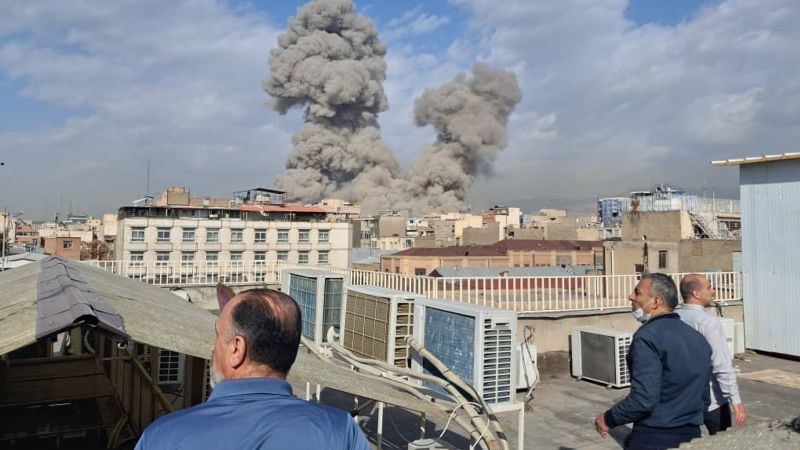
The United States and Israel launched a major joint attack on Iran on Saturday, killing Iran’s longtime supreme leader Ayatollah Khamenei and plunging the country into uncertainty as US President Donald Trump calls on his people to rise up against the government.
Trump said in a video on Truth Social that the move was taken after Iran rejected “every opportunity to abandon its nuclear ambitions.”
The strike began in the middle of the day on Saturday morning, the first day of the week in Iran, as millions of people headed to work or school.
In response, the Iranian regime launched an unprecedented series of attacks across the Middle East, targeting several countries that host U.S. military bases, including Bahrain and the United Arab Emirates.
The scale of the damage in Iran and the region as a whole is not yet clear. Here’s what we know so far:

The Iranian government has been under intense pressure since the beginning of the year. The government, already weakened by last summer’s war with Israel that briefly included the United States, is grappling with a deep economic crisis that sparked nationwide protests in January.
After the crackdown left thousands of protesters dead, President Trump promised to help them. He warned that the United States was “locked and loaded” for an attack and began shipping large quantities of supplies to the region.
Despite the military buildup, the United States has also resumed efforts toward a new nuclear deal with Iran. The final round of talks concluded in Switzerland on Thursday, with Iran “never” agreeing to stockpile enriched uranium. Oman’s foreign minister, who has been mediating the talks, said “significant” progress had been made.
However, that progress was not enough to deter U.S. military action. In his 2:30 a.m. speech, President Trump said the primary purpose of the attack, which the Pentagon is calling “Operation Epic Fury,” was “to protect the American people by eliminating an imminent threat from the Iranian regime.”
Those threats include Iran’s nuclear program, he said, and the White House claimed the June attack had “completely” eliminated that program.

President Trump offered no evidence that Iran was even remotely close to acquiring a nuclear weapon, saying, “It has always been the policy of the United States, and particularly of my administration, that this terrorist regime will never have a nuclear weapon.” “They have rejected every opportunity to abandon their nuclear ambitions. We can’t take it anymore.”
The president also reiterated recent claims that Iran is building ballistic missiles that could reach the U.S. mainland. President Trump said in Tuesday’s State of the Union address that Iran “has already developed missiles that could threaten our bases in Europe and abroad, and we are working on building missiles that could soon reach the United States.”
However, these claims are not corroborated by US intelligence agencies, CNN previously reported. An unclassified assessment released by the Defense Intelligence Agency (DIA) in 2025 found that Iran could develop a “militarily viable” intercontinental ballistic missile (ICBM) by 2035 “if Iran decides to pursue that capability.”
Claims that Iran soon has missiles capable of attacking the United States are not substantiated by intelligence agencies, two sources said. There is currently no information to suggest that Iran is pursuing an intercontinental ballistic missile program to attack the United States, the officials said.

Prime Minister Benjamin Netanyahu has long considered Iran to be Israel’s most dangerous enemy. Israel launched a war against Iran last summer after annihilating Iranian proxies Hamas in Gaza and Hezbollah in Lebanon.
Israel suspended the conflict after the United States attacked Iran’s nuclear facilities, but analysts have long suspected that Prime Minister Benjamin Netanyahu would seize the opportunity to resume attacks on Iran. Prime Minister Netanyahu, who is up for election in October, may also see a return to war as an opportunity to strengthen his position at home.
In a video statement on Saturday, Prime Minister Netanyahu explained why Israel would renew its attack on Iran, and also reiterated his insistence that the Islamic regime should not be allowed to acquire nuclear weapons.
Are the US and Israel seeking regime change?
In their statements, Trump and Netanyahu made clear their hopes for regime change in Iran.
President Trump addressed the Iranian people directly, saying, “The time for freedom is at hand.”
“When we’re done, take over your government. It’ll be yours. This will probably be your only chance for generations,” he said.
Prime Minister Netanyahu also called on “all segments of the Iranian people” to “throw off the yoke of tyranny and realize a free and peaceful Iran.” He said the actions of the United States and Israel “will create the conditions for the brave Iranian people to take their destiny into their own hands.”
However, Israeli military officials stressed that the main focus of the operation remained on military targets.

The explosion was heard in Tehran’s heavily guarded Pasteur district, which includes Khamenei’s residence and office. It was there that the supreme leader was killed, according to Iran’s state news agency. Several other cities were also affected.
Images from the aftermath of the attack showed severe damage and plumes of black smoke at Khamenei’s compound.
Two Israeli officials told CNN that the airstrikes targeted key figures, including Ayatollah Khamenei, President Massoud Pezeshkian, and military chief of staff Abdulrahim Mousavi.
Earlier, an Iranian government spokesperson insisted that Khamenei and Pezeshkian were “safe and sound.”
Cheers and celebrations erupted in parts of Tehran on Saturday night following news of Khamenei’s death.
The US and Israeli attacks killed at least 200 people and injured more than 700 across Iran, state media reported.
The dead included 118 students who died after a strike at a girls’ school in the southern city of Minab, Iranian state media reported, citing local officials.
Israel has been preparing attacks against Iran for several days, “and more if necessary,” an Israeli official told CNN.
Iran retaliated with a series of unprecedented attacks across the Middle East, targeting not only Israel but also neighboring countries that host U.S. military bases.
The United States and Israel last attacked Iran in June, targeting Iranian stockpiled ballistic missiles and hampering Iran’s ability to retaliate. Iran may be trying to utilize its weapons while it still has them.
One person was killed and 121 injured across Israel, according to the country’s national emergency service.
Explosions were reported in the United Arab Emirates, Jordan, Qatar and Bahrain, as well as Iran’s main regional rival Saudi Arabia, which has vowed to take “all necessary measures” to protect itself.
Drone attacks caused damage and minor injuries at Kuwait International Airport, and one person was killed and seven injured at Abu Dhabi’s Zayed International Airport.
Qatar and Jordan intercepted missiles targeting their countries. One person was reportedly killed by falling debris after air defense forces intercepted a missile targeting a facility in Abu Dhabi.
Iranian Shahid drones struck a densely populated area of Dubai, damaging the Fairmont Hotel in the city’s upscale Palm Jumeirah development.

The collision disrupted traffic in the Strait of Hormuz, a key shipping lane between the Persian Gulf and the Gulf of Oman.
U.S. Central Command said in a statement that there were no combat-related casualties in the U.S. operation against Iran, and damage to U.S. military facilities was kept to a minimum.
Iranian Foreign Minister Abbas Araghchi called the attack baseless and illegal.
Iranian Foreign Ministry spokesman Esmail Baghaei accused the Trump administration of being “drawn into” the conflict in which it is the “sole beneficiary.”
The spokesperson also defended Iran’s retaliatory attacks across the region as part of its “inherent and legitimate right to self-defense.”
Iran “did not welcome this war. It was imposed on us,” Baghai said.
