

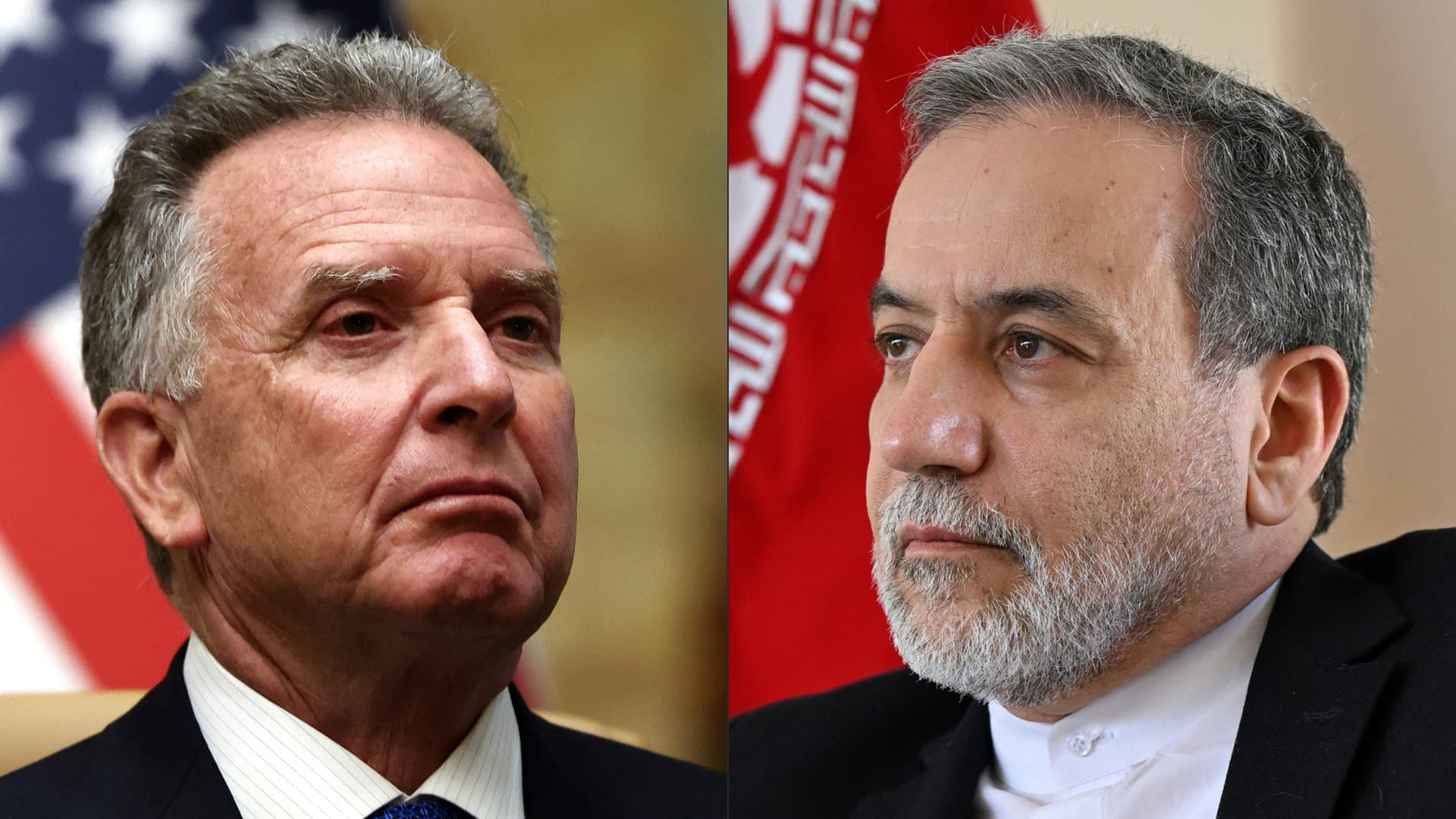
This photo combination made on April 9, 2025 shows U.S. Middle East envoy Steve Witkoff (left) after meeting with Russian officials at Diriyah Palace in Riyadh, Saudi Arabia, on February 18, 2025. Iranian Foreign Minister Abbas Araghchi tells AFP during an interview at the Iranian Consulate General in Jeddah on March 7, 2025.
Evelyn Hochstein Amer Hirabi | AFP | Getty Images
A third round of talks between the United States and Iran began Thursday in Geneva, with Iran under intense pressure to agree to a nuclear deal with the United States and curb its nuclear and ballistic missile programs.
The United States has built up a major military presence in the Middle East ahead of the talks, and President Donald Trump last week warned that “bad things” would happen if Iran did not agree to a new nuclear deal.
On the eve of the latest round of talks in Switzerland, US Secretary of State Marco Rubio warned that Iran’s reluctance to discuss its intercontinental ballistic missile program was also a major obstacle.
“The negotiations (Thursday) are going to be primarily focused on the nuclear program, and we’re hopeful that we’ll see some progress… But it’s also important to remember that Iran refuses, refuses, to talk to us or anyone about its ballistic missiles, and that’s a big problem,” he told reporters Wednesday.
Rubio said that beyond its nuclear program, Iran’s conventional weapons are “designed for the sole purpose of attacking the United States and attacking Americans if they want to. We need to address these things.”

President Trump claimed in Tuesday’s State of the Union address that Iran is working on a rocket that could reach the United States “soon,” but offered no evidence for that claim.
Asked how close Iran is to developing a weapon that poses a direct threat to U.S. territory, Rubio said, “It’s clear that Iran is on a path to being able to one day develop a weapon that can reach the U.S. mainland…and that range continues to grow exponentially every year,” calling this an “unsustainable threat.”
The latest talks on Thursday were led by US special envoy Steve Witkoff and President Trump’s son-in-law Jared Kushner, with Iranian Foreign Minister Abbas Araghchi leading the Tehran delegation. Oman is reportedly mediating the talks, with the residence of the Omani ambassador to the United Nations being the venue for the talks.
To be sure, pressure is mounting on Iran to agree to a deal that yields to U.S. demands to halt efforts to enrich uranium for nuclear weapons. But Iran has previously insisted that its missile program has never been on the agenda for talks with the United States and that it is “non-negotiable.”
Great breakthrough?
Iran has so far rejected U.S. demands to stop enriching uranium on its territory, saying it is necessary for energy production. Araghchi insisted that Iran “will not develop nuclear weapons under any circumstances.” But the Iranian government instead signaled it was willing to compromise to appease the United States.
Araghchi said on Wednesday that a “fair, balanced and fair agreement” was within reach, and Iranian Foreign Ministry spokesman Esmail Baghaei told Iranian state television that “Iran came here with very reasonable flexibility.” He added that Iran “has the right to use nuclear energy for peaceful purposes, and that is a recognized right.”
Iranian Foreign Minister Abbas Alagussi speaks at a press conference at the Lutfi Kurdar Conference Center on the sidelines of the 51st Foreign Ministers’ Council of the Organization of Islamic Cooperation (OIC) in Istanbul, June 22, 2025.
Yuzan Kose | AFP | Getty Images
Arraguchi told CBS’ “Face the Nation” last Sunday that he was still considering a proposal that included elements that addressed the “concerns and interests” of both sides. He said the proposal would be discussed in Geneva and both sides would work on a document to reach a “quick agreement.”
Iran’s government is desperate for sanctions relief as anti-government protests over its domestic economy and autocratic leadership continue to undermine the regime. Those protests continued Thursday, with students leading the latest demonstrations across Iranian universities.
Analysts are skeptical that there will be a significant breakthrough in the deadlock between the two countries in the next 24 hours, but they say impending U.S. military action could cause disruption across the Middle East and oil markets, but does not presently pose an immediate threat.
Paul Musgrave, an associate professor of government at Georgetown University in Qatar, told CNBC that the two sides will “reaffirm their core interests” in the next 24 hours.
“I have to say it’s a no-brainer for the Iranian side to ensure the regime’s security, to make sure it has legitimate options to pursue nuclear weapons, and to ensure that its conventional ballistic missile program remains intact,” he told CNBC’s Dan Murphy on Thursday.

“On the American side, there are a variety of stated goals, from protecting protesters to removing Iranian missiles to banning Iran from acquiring nuclear weapons, some of which are at odds with other goals. If you were the Iranian government, you would probably be looking at this and trying to figure out exactly what the Americans want from this,” he added.
“We don’t expect any major developments in the next 24 hours, but we also don’t foresee a military attack in the next 24 hours,” he said.
