

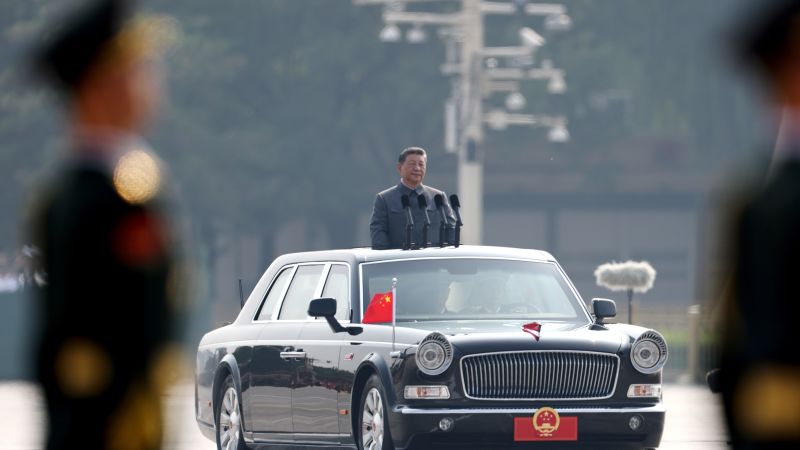
Last month, Chinese leader Xi Jinping took a surprising move to take the purge of his country’s military to the highest level, targeting his highest-ranking general. However, Mr Xi’s reforms cover a wider range of the military, with the possibility of the expulsion of more than 100 officers from 2022 onwards.
A new report released by a prominent Washington-based think tank reveals just how deep the anti-corruption movement has run and why it could operationally have significant unintended consequences for Xi Jinping.
A report released Tuesday by the Center for Strategic and International Studies found that 36 generals and lieutenant generals have been formally purged since 2022, and a further 65 officers are listed as missing or at risk of purge.
The sweep is part of a long-standing effort to wipe out China’s military as Mr. Xi continues to tighten his grip on power and push for a major military modernization.
But the scope of this “unprecedented purge of China’s military” raises questions about whether China is prepared to carry out complex operations, the report’s authors said.
Taking into account positions that were purged multiple times, 52% of the People’s Liberation Army (PLA)’s 176 top leadership positions were affected, the report said.
“These numbers are surprising and unusual, demonstrating the depth of Mr. Xi’s campaign and the unprecedented disarray within the PLA leadership,” wrote M. Taylor Froebel, head of the Security Studies Program at the Massachusetts Institute of Technology and one of the report’s nine authors.
Rooting out rampant corruption within China’s military has been a cornerstone of Mr. Xi’s rule since he took power more than a decade ago. However, a new wave of these purges in recent years has resulted in the ouster of people close to the leader or those appointed by the leader himself.
Official notices typically accuse these officers of corruption and violations of “discipline and law,” but it is difficult to determine the forces behind these moves within the notoriously opaque People’s Liberation Army.
While the targeting of top leaders such as General Zhang Youxia, the highest-ranking officer investigated in January, and Liu Zhenli, the head of joint operations, has made headlines, the report says the purge’s extension to lower-ranking officers means Mr. Xi will have to rely on officers with far less leadership experience and no combat experience to lead military operations.
This could limit the scope of military operations that the People’s Liberation Army can conduct, the report said.
The gap remaining in the PLA’s top ranks can be seen in the number of officers slated to take over one of the military’s five theater commands. According to the report, the purge of 56 deputy theater commanders has eliminated more than 33% of the personnel capable of taking over one of these five commands.
Bonnie Lin, one of the report’s authors, said the purge may have already been reflected in the People’s Liberation Army’s preparedness.
He noted that PLA exercises around Taiwan in response to “questionable” actions by the autonomous island took significantly longer to conduct in 2025, at 19 and 12 days, compared to just four days in 2024.
The loss of top leadership calls into question whether the People’s Liberation Army leadership is capable of carrying out an “incredibly complex and dangerous” invasion of Taiwan in the coming years, the report said, with particular attention to U.S. and Japanese moves to counter such a scenario.
China’s ruling Communist Party claims the self-governing island democracies as its own territory and has not ruled out the possibility of ruling them by force.
“Xi’s apparent distrust of the military is a good thing from the U.S. and Taiwanese perspectives in deterring invasion,” wrote John Culver, nonresident senior fellow at the Brookings Institution.
However, the authors caution that despite the purges, the People’s Liberation Army still retains considerable influence.
In the Taiwanese scenario, less complex operations such as blockades are still likely to be easily carried out, the report said.
“If Taiwan or the United States crosses a military red line, China has many options to punish, teach a lesson, and declare its own ‘victory,'” but “highly coherent command coordination is not required,” Culver wrote.
“China is still very likely to take actions that attack Taiwan and ruin America’s day in the process,” CSIS analyst Thomas Christensen wrote.
But Christensen believes there is reason for Xi to be cautious even in less complex scenarios. Will Mr. Xi receive honest and straightforward advice?
Newly promoted leaders may refrain from delivering bad news for fear of suffering the same fate as their predecessors, the report said.
“This is dangerous for crisis management because it could give Xi Jinping unrealistic confidence in the military’s capabilities in future emergencies,” Christensen wrote.
But experts also argue that Mr. Xi believes now is a good time for some spring cleaning, as he is not specifically focused on the Taiwan issue and is dealing with U.S. counterparts whose security focus is elsewhere in the world.
And while this purge raises many questions about the PLA’s readiness in the short term, China’s adversaries may need to be more cautious toward the end of the decade, said author Joel Woonow, a senior fellow at the National Defense University.
By then, the newly promoted officers will have gained experience using China’s cutting-edge hardware in exercises and in cooperation with President Xi, potentially increasing their confidence and expectations for success, Ussonow wrote.
