

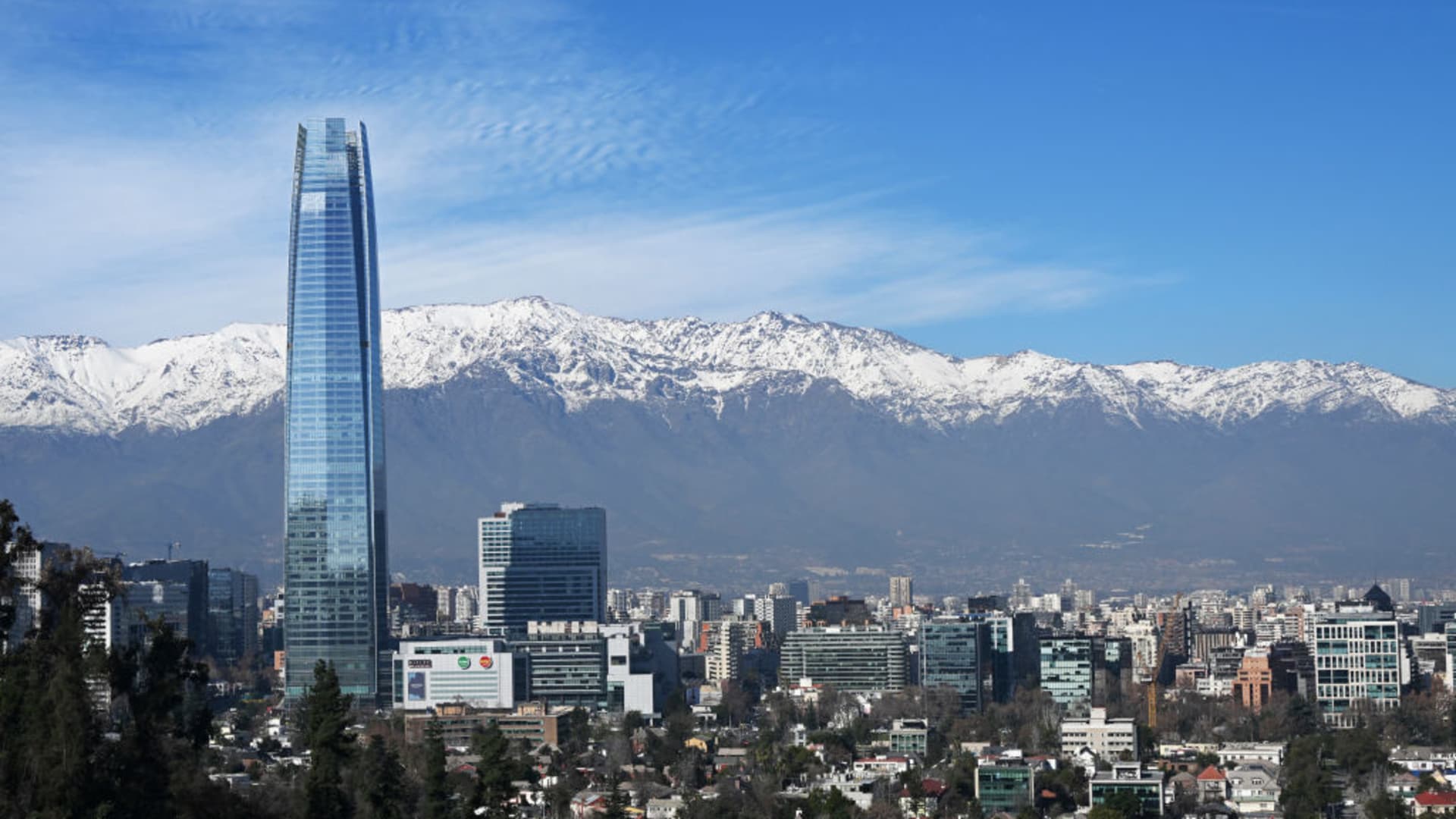
View of Santiago city and Andes Mountains taken from Metropolitan Park on July 2, 2024.
Rodrigo Arangua | AFP | Getty Images
Chile is the latest Latin American country to become embroiled in the power struggle between the United States and China.
The country, which counts Washington as its largest foreign investor and Beijing as its largest trading partner, is facing pressure from the White House over an undersea cable project with links to China.
U.S. Secretary of State Marco Rubio announced late last week that the United States would impose visa restrictions on three Chilean government officials involved in a digital cable project proposed by a Chinese company, citing security threats.
Chilean President Gabriel Borich, who will step down from office on March 11, condemned the visa sanctions and rejected the idea that his country was “facilitating any actions that threaten the security of our country or the region.”
Chile’s outgoing leftist government later announced that one of the officials sanctioned was the country’s Transport and Communications Minister, Juan Carlos Muñoz, but did not comment on the identities of the other two.
Brandon Judd, the U.S. ambassador to Chile, defended the visa restrictions on Monday, telling reporters, “It is the sovereign right of the United States to take action when we feel regional security is threatened,” according to the Associated Press.
The altercation occurred just days before the Latin American Summit was to be held in Miami, Florida, and two weeks before Chile’s next right-wing government was to take office in Santiago.
Chile’s President-elect José Antonio Casto speaks to journalists after meeting with the Italian Prime Minister at Palazzo Chigi in Rome, February 5, 2026.
Filippo Monteforte | AFP | Getty Images
This will also be a major test for the government of President Jose Antonio Casto, following the election victory of a right-wing candidate late last year.
Analysts say US President Donald Trump is sending a clear message to Latin American countries as he seeks to counter China’s strategic influence in the region.
“Adjusted Alert”
More than anything, the U.S.-Chile tensions were a “coordinated warning” to the Casto government that strategic infrastructure decisions would be treated as geopolitical adjustment options rather than neutral bids, said Mariano Machado, lead analyst for the Americas at risk intelligence firm Verisk Maplecroft.
Indeed, digital submarine cables are the backbone of the world’s internet and communications infrastructure, enabling everything from international phone calls to financial transactions. By some estimates, 95% of international traffic passes through these nearly invisible data superhighways.
Map of the world’s submarine communication cables.
CNBC | Jason Reginato
Machado said: “The short-term external impact will be Kast’s upcoming engagements with Washington, chief among them the Shield of the Americas summit, which will be an early test of how Chile balances with its partners under pressure.”
He continued: “As US-China competition intensifies in the region, Chile’s ‘digital hub’ ambitions will only be viable if geopolitical concerns are addressed proactively, rather than as an afterthought after a crisis.” “Successful transactions will ensure clear governance and reliable security guarantees early enough to maintain bankability.”
The Chinese embassy in Chile has accused the US of “clear disrespect for Chile’s sovereignty, dignity and national interests” following the Trump administration’s visa restrictions on Chilean officials, according to reports.
China’s strategic and economic influence in Latin America is well established and is considered a target of President Trump’s so-called “Donroe Doctrine” (a term coined from a combination of Donald Trump and the Monroe Doctrine). The Monroe Doctrine refers to a 19th century foreign policy position that asserted Washington’s influence in the Western Hemisphere.
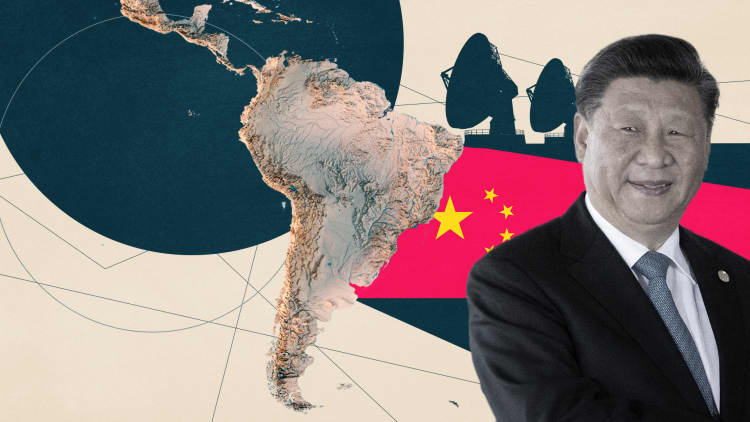
For example, in recent weeks Panama’s Supreme Court ruled against Hong Kong-based CK Hutchison that the interests held by its subsidiaries in operating ports at either end of the Panama Canal were unconstitutional. The result was widely seen as a victory for President Trump’s regional security ambitions.
The United States has also ramped up pressure on Cuba’s communist regime, threatening to impose tariffs on countries that supply oil to Havana and recently carrying out an unprecedented military operation to oust Venezuelan President Nicolás Maduro.
