

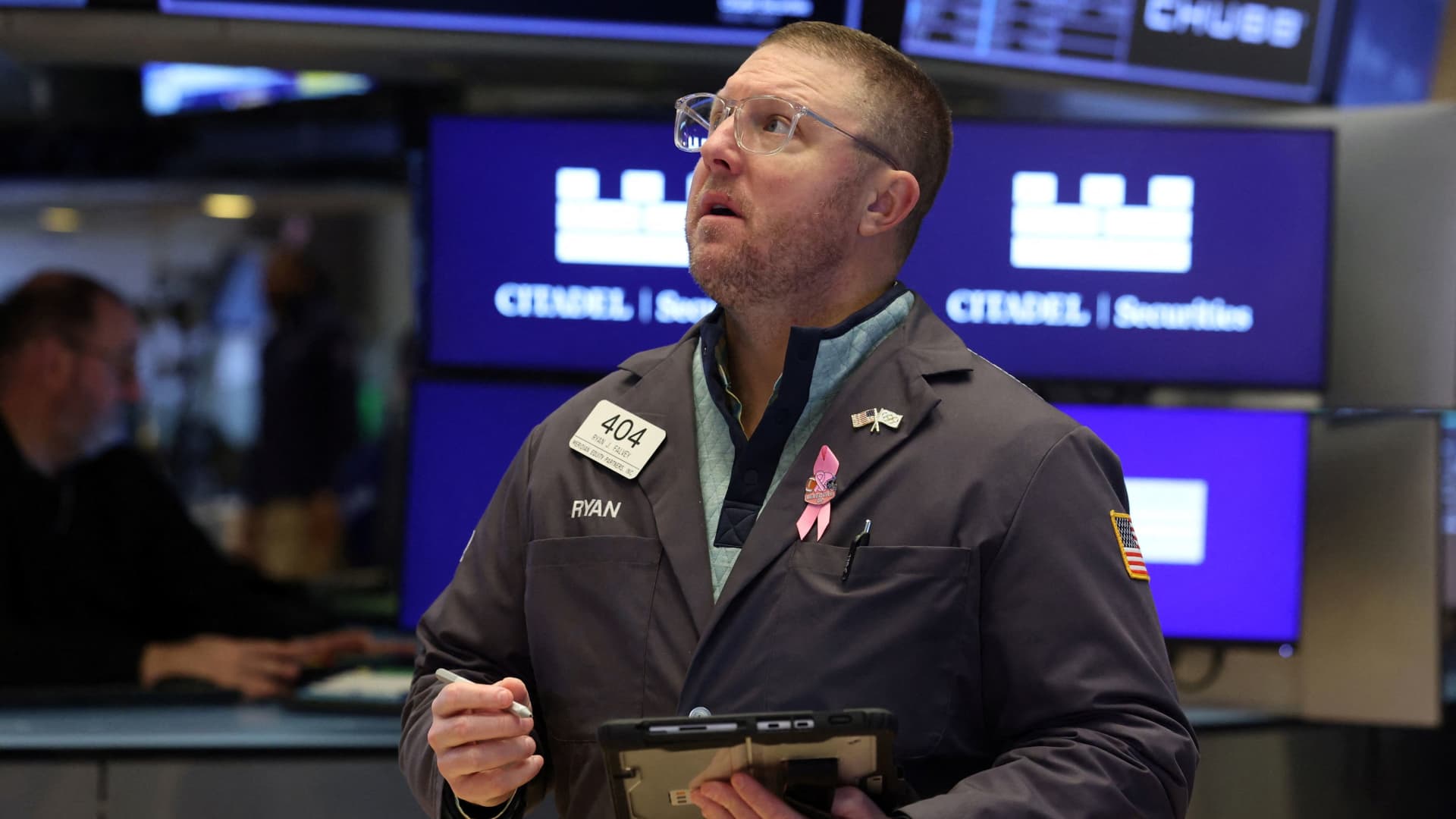
Traders work on the floor of the New York Stock Exchange (NYSE) on February 20, 2026 in New York City, USA.
Brendan McDiarmid | Reuters
Stocks rose on Friday after the Supreme Court ruled against President Donald Trump’s tariffs, potentially providing relief to companies burdened by higher costs and allaying concerns about the persistent inflation still plaguing the U.S. economy.
of S&P500 It rose 0.69% to close at 6,909.51. Nasdaq Composite It rose 0.9% to settle at 22,886.07. of Dow Jones Industrial Average It added 230.81 points (0.47%) and finished at 49,625.97. The 30-stock index recovered from an early drop of 200 points due to disappointing economic data.

Dow Jones Industrial Average, 1 day
The Supreme Court struck down much of President Trump’s far-reaching tariff policy under the International Emergency Economic Powers Act, ruling in a majority decision that the law “does not authorize the President to impose tariffs.” In response, President Trump announced that he would impose a new 10% global tariff.
“We’re going to go in a different direction now, which is probably the direction we should have gone in the first place,” the president said at a White House press conference after the high court’s ruling. “I’m going to continue on the path that I was able to take in the beginning, which is even stronger than the one we originally chose.”
Shares of “Magnificent Seven” members Amazon The company, which sources up to 70% of its products from China and where tariffs have already begun to impact prices on certain items, soared more than 2% after the ruling, according to Wedbush Securities. Other items that could benefit from this result were similarly high. home depot and Five Below.
“For Amazon in particular, the tariffs will make Amazon more expensive for customers because a lot of the products are imported from China. When prices go up, people won’t buy those products,” said Jed Ellerbrook, portfolio manager at Argent Capital Management. “I think the excitement comes from not having to face that problem anymore.”
The Supreme Court’s rebuke was largely expected by Wall Street, but some questions remain, including whether tariffs paid under the higher tax rate should be returned. The Supreme Court’s decision was silent on this issue.
“Lower courts will need to clarify what happens to those who paid the tariffs and those for whom the government paid large rebates,” said Michael Brenner, senior research analyst and asset allocation strategist at FBB Capital Partners. “If that happens, it will effectively be a stimulus package.”
Traders had expressed pessimism about U.S. economic growth earlier in the day after gross domestic product (GDP) rose 1.4% in the fourth quarter. This was well below the 2.5% rise expected by economists compiled by Dow Jones. The 4.4% growth in the third quarter was significantly higher than expected.
The Commerce Department said the record government shutdown was the main cause. The suspension, which lasted into the first half of the fourth quarter, reduced economic growth by about 1 percentage point, the ministry estimated.
In addition to GDP data, the Federal Reserve’s recommended inflation measure, the Personal Consumption Expenditures Price Index report, showed that inflation was stable in December. Core PCE, which excludes volatile food and energy prices, was 3%, in line with expectations but still well above the Fed’s 2% target.
Friday’s move pushed the Dow Jones Industrial Average up 0.3% for the week. The S&P 500 rose 1.1%, and the tech-heavy Nasdaq ended a five-week losing streak and rose 1.5%.
—CNBC’s Jeff Cox contributed reporting.
