

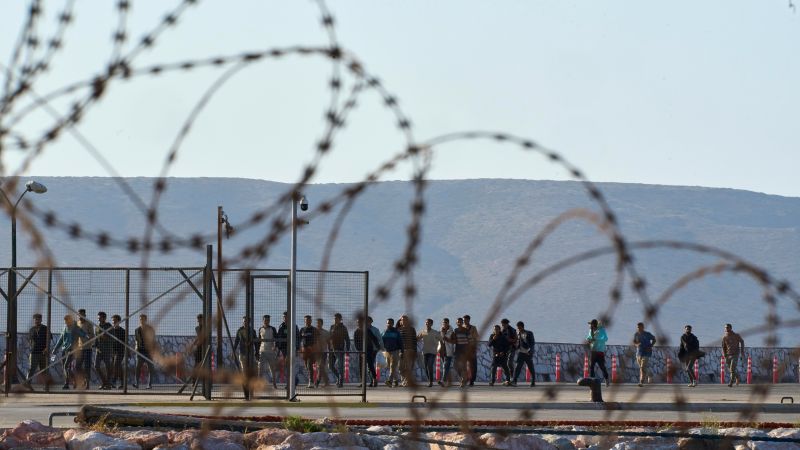
athens, greece
AP
—
Greece’s immigration minister announced Wednesday that Greece will join four other European countries to set up deportation centers in third countries, possibly in Africa, for migrants whose asylum claims have been rejected.
Thanos Prevris told Greek state broadcaster ERT TV that Greece was working with Germany, the Netherlands, Austria and Denmark to create a so-called repatriation hub “preferably in Africa.” He said ministers from the five countries had already met to discuss the issue and a technical team was expected to meet next week.
“We are no longer talking theoretically, we are talking practically,” Plevris said. He did not specify which countries were being considered as a return point, saying the choice of the African continent was “not binding”.
He added that European powers are in direct talks with countries where return points can be established, but “we are also involved.”
Prevris explained that the repatriation hub will be used by people whose asylum claims have been rejected and whose countries of origin will not accept them. He said their presence would act as a deterrent to future migrants who are unlikely to be granted asylum. The minister said it was not clear when such return centers would be operational, but the aim was to develop initial plans in the coming months.
Greece, on the southeastern tip of Europe, has for decades been one of the main points of entry into the European Union for people fleeing conflict and poverty in the Middle East, Africa and Asia.

Tens of thousands of people enter the country each year, mostly via dangerous sea routes from the Turkish coast to the nearby Greek islands in the Aegean Sea, or from North Africa across the much longer Mediterranean Sea to Gavdos and Crete in southern Greece.
Athens has taken an increasingly tough stance on migrants, with its coast guard often accused of so-called pushbacks, where new arrivals are deported en masse without being allowed to apply for asylum. The government strongly denies doing so.
Prevris said there will be a 21% decrease in illegal immigration in 2025 compared to 2024, with 13,000 fewer people entering the country last year compared to the previous year and a 40% decrease over the past five months.
Last week, European lawmakers voted to approve a new migration policy that would allow countries to reject and deport asylum seekers because they are from a country designated as safe or because they are likely to seek asylum in a country outside the 27-nation bloc.
Plevris said the government is now focused on returning people whose asylum claims have been rejected.
The country already processes about 5,000 to 7,000 repatriations a year, but about 40,000 to 50,000 new people enter the country each year, and about half of them have their asylum applications rejected. Prevris said the current rate of return is not sufficient.
The Greek minister said he planned to travel to Rome next week to meet with his Italian and Spanish ministers. He said he would also meet with Pakistan’s “comparable ministers” as part of talks with countries of origin to strengthen cooperation on repatriation.
