

The footage of Lindsey Vonn screaming in pain on the snow after her Olympic accident and then being airlifted off the course by helicopter was a stark reminder of the dangers of downhill skiing.
The same goes for this. Her skis didn’t come off.
Recommended stories
list of 4 itemsend of list
After her fall on a windmill at the 2026 Milan-Cortina Winter Olympics, Vonn’s boots remained attached to her skis, awkwardly pointing in different directions as the American four-time world champion and 2010 Olympic gold medalist skidded to a stop in apparent agony.
It is impossible to know whether Vonn would have suffered less serious injuries had she hung up her skis, with a complex tibia fracture that has already required multiple surgeries. But this devastating injury has brought renewed attention to the importance of bindings, which secure boots to skis and are some of the sport’s oldest technology.
Officials told The Associated Press that a binding system designed to automatically release skis when racers like Vonn lose control is still under consideration after years of deadlocked discussions.
“Unfortunately, sometimes it takes a horrific accident to shed more light on what’s possible,” said Sophie Goldschmidt, president and CEO of the U.S. Ski and Snowboard Association. “This is an area where we are not competitive. We all have to work together with our national stakeholders and the FIS (International Ski and Snowboard Federation) in this area.”
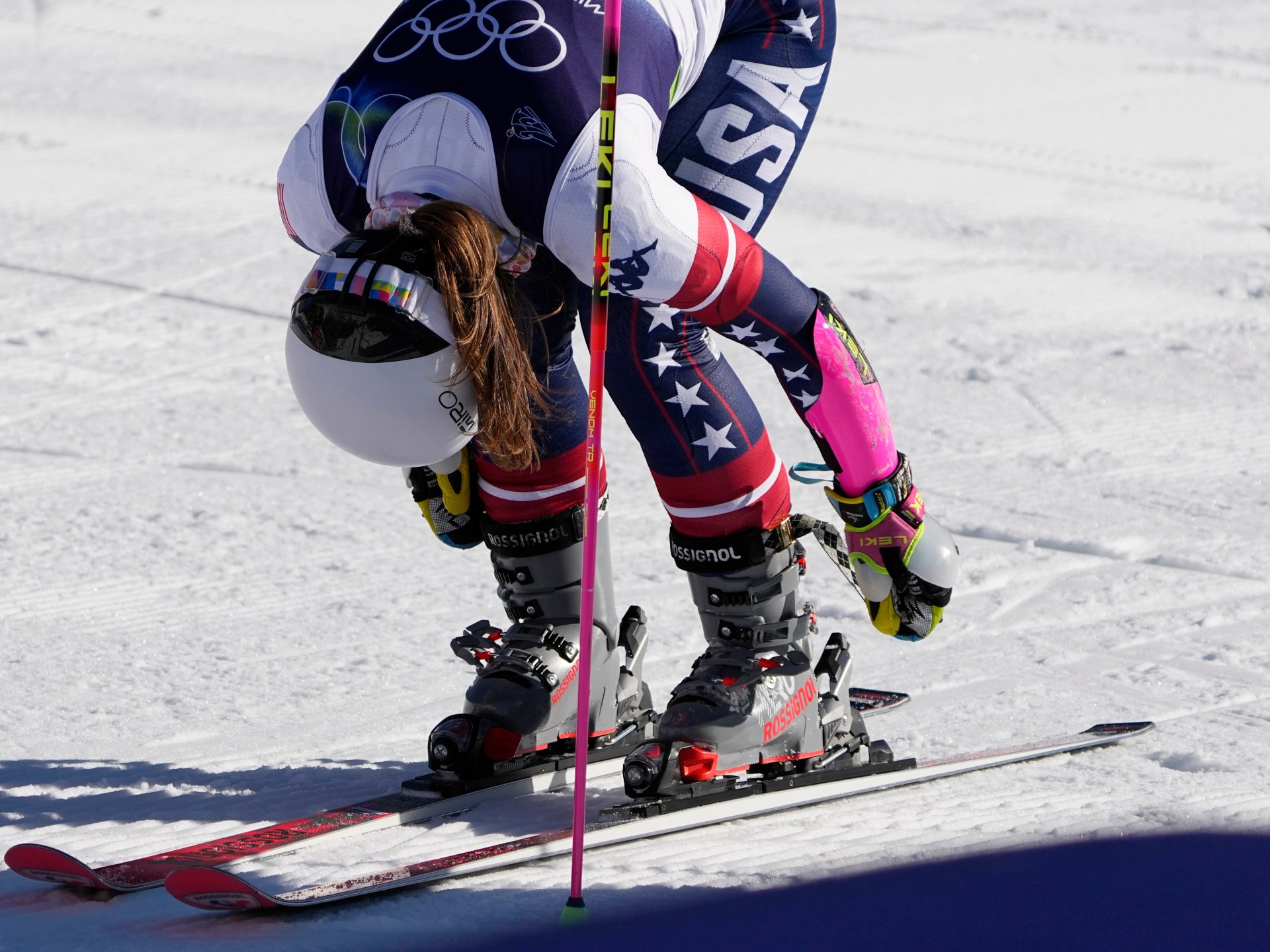
The basic design of bindings has remained largely unchanged for half a century. When a skier steps in first with the toe and then with the heel to lock in, pressure must be applied to the system to release the boot. Less skilled skiers use bindings that are easier to remove to avoid foot injuries. As skill levels increase and skiing becomes more serious, the level of bindings that elite racers keep on their skis decreases.
Few were surprised that Vonn’s skis were never released. The question is whether you should.
“Smarter” binding
Peter Geldl, FIS women’s race director for the Olympic and World Cup circuits, said a “smart binding” system based on algorithms and designed to automatically release when a skier loses control “could definitely have prevented” Vonn’s broken leg.
“That’s exactly what this system was designed for,” Geldl told The Associated Press. “Her skis definitely would have come off. … We’ve seen many other cases where the binding won’t open and that causes knee problems, especially when the skis that are still attached act as levers on nets, on snow, on gates or other obstacles. It blocks the foot and breaks the knee.”
Nine days before the Olympic accident in Italy, Vonn tore the anterior cruciate ligament in her left knee in an accident in Crans-Montana, Switzerland. She remained in the safety net with her skis on.
The smart binding system could borrow technology from the safety airbag systems required for skiers in speed events this season.
“The idea is that the binding is triggered by the same algorithm that prompts airbag inflation, although it still takes some time to develop,” Geldl said. “The heel slides backwards and the player’s ski comes off.”
Algorithms need to be adapted
After developing a similar system for motorcycle racing, Dainese and its sister company D-Air Lab spent years developing an algorithm to inflate airbags under skiers’ racing suits.
Dainese, in collaboration with FIS, shares its airbag algorithm with top binding suppliers such as Look, Tyrolia, Salomon, Atomic and Marker to adapt the formula to ski release.
Removing skis is potentially more dangerous than inflating an airbag. Elite skiers can show impressive recoveries after being launched into the air, and are also able to use their skis to brake before crashing into a safety barrier.
“This is a very complex project,” said Dainese representative Marco Pastore, who attended the airbag system circuit. “If you’re going to remove a binding, you have to do it at the right time. With an airbag, you can look at rotation and overall body position. But with a binding, you have to consider how the foot moves, what the trajectory of the ski is, and a whole series of other variables.”

Funding complex safety projects
FIS wants to coordinate the project, but questions remain about who will pay for it.
“These are very expensive projects, and to be honest, Dainese doesn’t make much money from the airbags,” Pastore said. “Right now, there’s money at stake. Everyone wants these nice things, but at the end of the day, someone has to pay for it.”
Sasha Rearick, head coach of the U.S. men’s ski team from 2008 to 2018, recalled a discussion about bindings nearly a decade ago when she was head of the World Cup coaches working group.
“The problem is that Dainese has the money and all the investments,” Rearick said. “So if you were to share it with the bookbinder, the bookbinder would have to invest a lot of money and it would probably cost (a lot of) money.”
Head racing director Rainer Salzgeber, who is involved in the project through Tyrolia, added: “A lot is already happening.” He proposed a simpler and faster solution to crashes like Bong: a gate panel to give way.
Men’s World Cup and Olympic race director Markus Waldner said earlier this season that the FIS is “working with biomechanics and manufacturers to improve boot and binding standards to reduce the possibility of fatal edge catches at high speeds.”
Still, Geldl suggested the project could take two to six years to be implemented.
Will ski racers use this technology?
Ski technicians tighten the racer’s bindings so that they are effectively locked in place to avoid the skis flying out.
Leo Mussi, ski technician for American downhillers Bryce Bennett and Sam Morse, said he sets the racers’ bindings to a maximum of 200 kg (440 lb) of pressure. This is said to be more than twice the pressure of commercially available bindings.
Austrian racer Marco Schwarz suffered a serious knee injury after falling while downhill at the Bormio Alpine Ski World Cup in Italy in December 2023. When he slipped into the safety net, his skis did not come off.
“I can’t say whether he would have been able to survive without injury if his ski came off,” he said, adding that he doesn’t know if it would have changed the situation.
“The best thing to do is to keep it simple,” says Schwartz. “We don’t want to push the technology too far.”
American Nina O’Brien, who suffered a tragic compound fracture at the 2022 Beijing Olympics and required four surgeries, said her fall was not caused by a problem with the equipment, but by the technicians.
“Whether I put my skis on in the morning and went out and had a cup of coffee or not, when I step back on my skis he makes sure they’re perfect,” O’Brien said.
Ski racing safety progress is slow
The airbag system was first tested on the World Cup circuit in 2013 and only became mandatory in downhill and super-G speed events this season. In the meantime, some skiers said the bags interfere with aerodynamics, are uncomfortable to wear, and can actually cause injury.
The recent death of Italian skier Matteo Franzoso from head injuries sustained in an accident during pre-season training in Chile made safety issues more pressing.
“Unfortunately, it always takes something serious to happen for people to say, ‘No, we need to do something now,'” Pastore said.
This season also marks the first time that cut-resistant underwear will be compulsory at all World Cup and Olympic events.
There is plenty of room to improve safety. While the smart binding system was being developed, Rearick (currently director of Apex 2100, an international ski academy in Tignes, France) suggested working on a racing suit.
“Make everyone a suit that’s a little warmer, a little slower, and made of cut-resistant material,” Rearick said. “That would make the sport safer for everyone.”
