

Beijing
—
Minutes after top diplomat Marco Rubio declared in his conciliatory speech at the Munich Security Conference that the United States and Europe “belong as one,” a Chinese diplomat took to the stage to make his case.
“China and the EU are partners, not rivals,” Chinese Foreign Minister Wang Yi told the audience on the same stage on Saturday.
“To the extent that we firmly understand this point, we will be able to make the right choices when faced with challenges, prevent the international community from drifting toward fragmentation, and promote the continued progress of human civilization.”
Rubio and King’s double bill comes as an overhaul of U.S. foreign policy has shaken America’s long-standing ties with its Western allies and now openly declares that the era of U.S.-backed global security and rules is over.
A race is currently underway to shape what happens next.
Rubio used his address to the annual security agencies meeting to reassure European leaders that President Donald Trump’s administration remains fully committed to the alliance and that the current international system should be “restructured,” even though he believes more efforts are needed to support the alliance.
And Mr. Wang, a veteran diplomat who has been the face of leader Xi Jinping’s foreign policy for more than a decade, was poised for a carefully orchestrated rejoinder.
The problem with the current international system, he said, lies not primarily with the United Nations, but with “some countries that are widening their differences, pursuing a nation-first approach, creating bloc conflicts, and reviving Cold War thinking.”
He added that China and Europe should together reject “unilateral practices,” uphold free trade and oppose bloc rivalry, as a clear remonstrance to US policy and national strategy.
However, Mr. Wang made his pitch for China at a time when the Chinese government is also trying to stabilize relations with the United States ahead of President Trump’s expected visit to China later this spring.
The stakes are high for the landmark meeting, which could cement the relative stability between the world’s two largest economies that emerged after Mr. Xi and Mr. Trump met in South Korea last fall.
Asked about the trip, Wang told a Munich audience that he was “confident” about the prospects for China-US relations, but warned of how relations between the two countries could deteriorate.
There were “two different prospects” for bilateral relations. One is that the United States will be able to “reasonably understand China” and cooperate with it, and the other is that the United States will seek decoupling, confronting China in a “knee-jerk manner,” and treading on China’s “red lines that should not be crossed,” including Taiwan.
The latter path is likely to “pull China and the United States into conflict,” he said.

Rubio also addressed U.S.-China relations at Saturday’s meeting, with the known China hawk telling the audience during a question-and-answer session that it would be a “geopolitical injustice” for “the two great powers on earth” to not communicate to manage areas where their interests do not align.
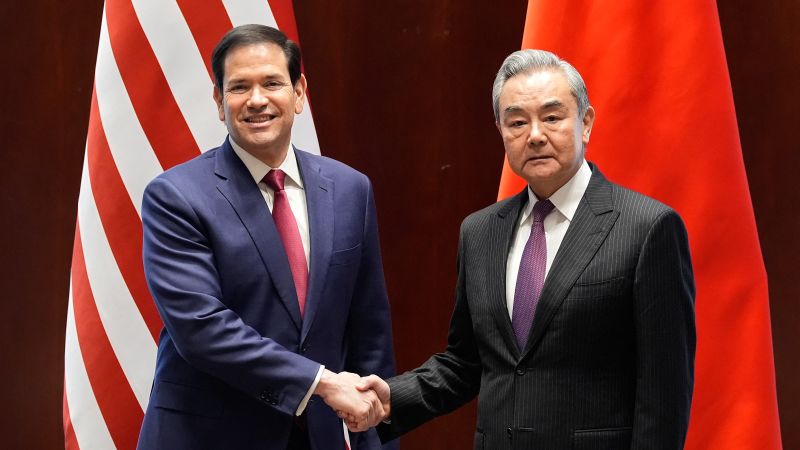
Mr. Rubio and Mr. Wang also met on the sidelines of the conference on Friday, appearing to further prepare for Trump’s expected visit.
After Friday’s sit-in, Wang said top diplomats held “positive and constructive” talks and that their respective leaders “will jointly implement the important agreements reached.”
A key question that Wang and his delegation may be pursuing in Munich is how deeply Europe is listening to its broader views.
Beijing has long sought to promote its own vision for a world no longer dominated by U.S.-led alliances and organizations and more friendly to its interests. And it sees Europe as an important pole that should not easily take sides with the United States.
China is a “steady force for peace” and a “reliable force for stability,” Wang said in a message to the gathering, presenting President Xi’s initiative to reshape global governance as the answer to this moment.
But Beijing’s message has found a tough audience as European leaders worry about the country’s large trade deficit with China and its control over strategic supply chains.
Relations have been strained in recent years over China’s support for Russia in its war with Ukraine, and European leaders have grown wary of Chinese military aggression in the South China Sea and around Taiwan, an autonomous democracy that Beijing claims as its own territory.
On Sunday, Taiwan’s Foreign Minister Lam Chia-lung said Taiwan’s recent “military provocations” were contrary to United Nations principles and challenged Mr. Wang’s positioning of China as a peaceful power. (China insists that the military exercises are to protect its “national sovereignty,” and in remarks on stage in Munich, Wang accused some countries of “trying to separate Taiwan from China,” framing Japan rather than China as a regional threat.)
Despite these concerns, Beijing sees opportunities as Western leaders recalibrate their foreign policies in the face of changing relations with the United States.
Already in recent months, many leaders of US allies have visited Beijing with the aim of deepening cooperation and dialogue with China, which faces friction with the US.
Ahead of the Munich event, organizers declared that the US-led post-1945 international order was “currently being destroyed” and that the US was acting as the most powerful “wrecking ball”.
Europeans may have breathed what the conference president called a “sigh of relief” after Rubio’s speech, but President Trump’s threat last month to seize Greenland, a territory of NATO ally Denmark, still echoes in Europeans’ ears.
And Beijing hopes Europe will at least listen a little more to its claims.
