

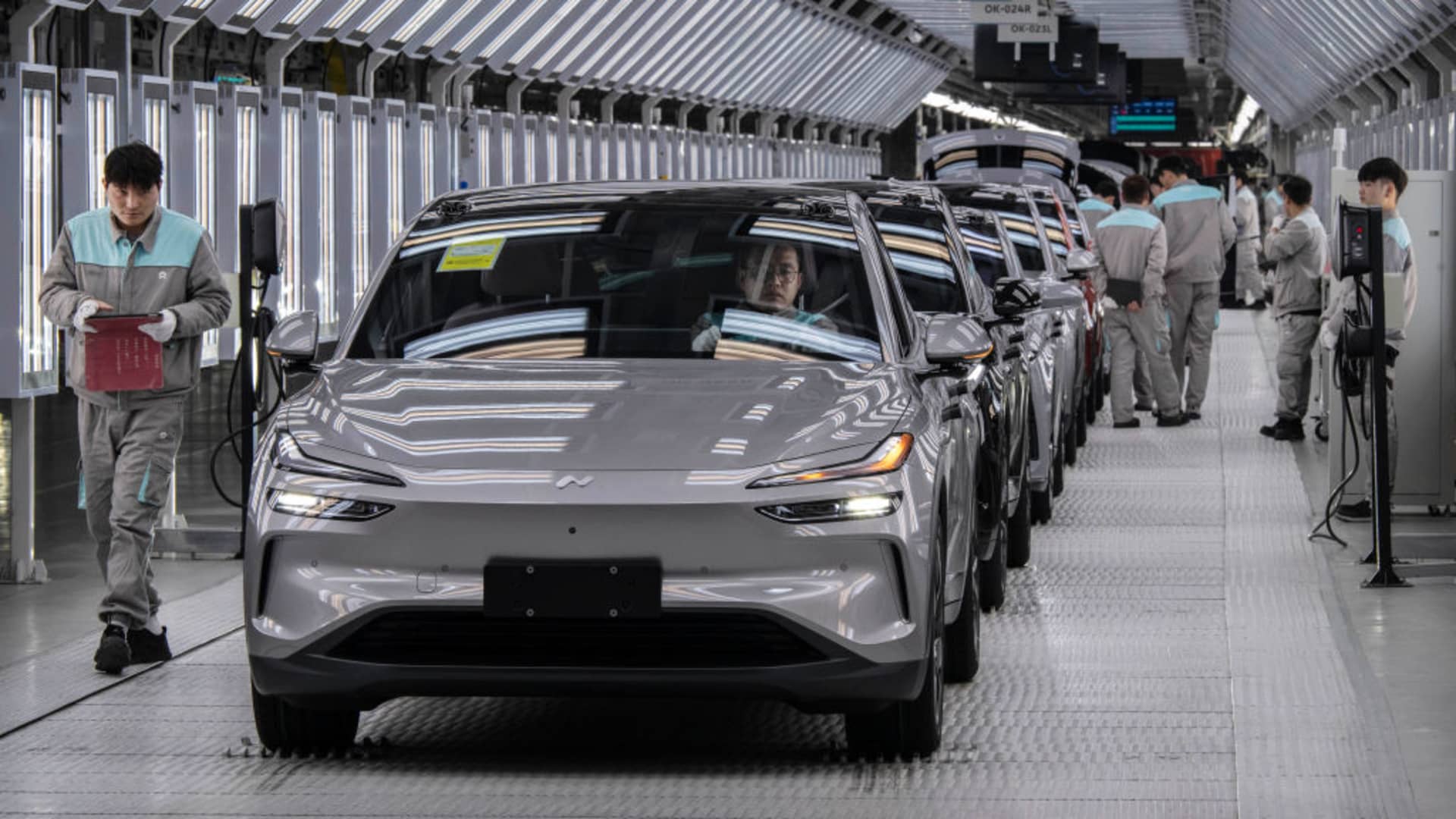

Canada’s decision to reduce barriers to Chinese electric vehicles is part of a major shift away from dependence on the United States.
Canada’s government is looking to develop joint ventures with Chinese and South Korean companies and revive its manufacturing base with tax breaks in the face of strained relations with the United States and decades of decline in Canadian auto manufacturing.
In January, the country announced that it would allow the import of 49,000 Chinese-made EVs at a tariff rate of 6.1%. This is a significant reversal of the 106% tariff imposed in October 2024. According to Canadian research and advisory firm Dansky Energy Climate Advisors, this represents about 3% of Canada’s total new car market, and about 20% of the battery EV and plug-in hybrid markets combined.
In exchange for lifting restrictions, China agreed to lower tariffs on Canadian canola oil, one of Canada’s biggest agricultural exports.
The agreement aims to make at least 50% of these Chinese EVs into affordable models within five years, meaning vehicles with an import price of less than CAD 35,000 (just under USD 26,000).
“If the vehicles coming in are more affordable models, that could have a big impact,” said Jeff Turner, Dansky’s director of clean mobility. “However, if we look forward to 2030, we expect the EV market to grow significantly. 49,000 units is quite a small number compared to what we expect the EV market to look like in just a few years.”
canadian manufacturing
The agreement also aims to establish a Sino-Canadian joint venture in Canada, create manufacturing jobs and build the country’s supply chain, according to a press release.
The Canadian government has taken several steps to promote auto manufacturing, including signing a memorandum of understanding with South Korea on clean vehicle manufacturing and announcing a new automotive strategy.
The United States has historically been Canada’s largest trading partner. Meanwhile, Canada is the second largest country after the United States. But as of February, the U.S. had imposed a 25% tariff on non-U.S. parts for cars assembled in Canada. Sources said this would effectively amount to a 10% to 12% tariff per car.
The tariffs disrupted the tightly integrated auto supply chain between Canada, the United States, and Mexico.
Detroit automakers have been located in Canada since the early days of the Detroit auto industry. Henry Ford built a factory in what is now Windsor, Ontario in 1904, a year after the company was founded. ford motorsays Graig Mordue, a professor at McMaster University in Hamilton, Ontario.
But over time, their share of Canadian manufacturing declined. Currently, they account for only about 23 per cent of Canada’s production, Mordue said. Japanese manufacturer toyota and honda It accounts for 77%.
This decline has accelerated since the tariffs.
The Detroit automaker has made some production cuts at its Ontario plant. Stellantis In December, the Brampton factory was “shut down”. general motors will discontinue production of the BrightDrop electric commercial van at its Ingersoll plant in 2025 and eliminate shifts at its Oshawa plant at the end of January.
The exit of the Detroit automaker coincides with a decline in overall Canadian auto production, which has fallen from about 3 million vehicles in 2000 to 1.3 million vehicles in 2025, Mordue said.
“Canadian media has frequently pointed out that auto industry jobs are indeed being affected by some of the uncertainty coming from south of the border,” Turner said. “So I think it’s only natural in that context that politicians would try to diversify those relationships.”
Headwind
The president of the Canadian Automobile Manufacturers Association, an industry group representing Detroit automakers GM, Ford and Stellantis, said the deal with China is an “automotive-scale irritant” for future trade negotiations with the United States. The two countries are scheduled to undergo a review of the United States-Mexico-Canada Trade Agreement (USMCA) by July 1.
Brian Kingston, president and CEO of the CVMA, said he is concerned about Chinese cars because China’s subsidies to automakers make it difficult for them to compete and could pose security threats through the hardware and software built into the products. He noted that Mexico has taken the opposite approach, raising tariffs on Chinese cars to 50%.
“So as we go into these negotiations, our other partner, our North American partner, is increasing their protection against China, and we’re moving in the opposite direction,” Kingston said.
It’s unclear whether Chinese companies want to build manufacturing facilities in Canada or whether it would be profitable.
Mr. Mordue also said Canada has had a somewhat difficult time attracting manufacturing investment compared to its two other North American neighbors. Mexico offers the lowest-cost manufacturing, with the United States as its main market, but currently has high trade barriers that encourage automakers to produce within its borders.
“It’s a big jump from “selling a few Chinese cars in Canada” to “building a full-fledged assembly plant in mass production,” Mordue said. “But due to inaction, the list of assembly plants has disappeared over the past 12 months.”
CVMA’s Kingston said the country has the resources it needs to compete with China in the electric vehicle market, including critical minerals needed for next-generation EVs and abundant zero-emission electricity from hydroelectric and nuclear power plants.
“We have these vast mineral resources, and many countries are now dependent on China for access to them,” he said. “So if we can mine and process these minerals in Canada using clean electricity and ultimately create an integrated supply chain with the U.S., we have a lot to offer not only to the U.S., but also to our Western partners who are looking to reduce their dependence on China.”
