

As a blizzard hit central Ukraine last month, Irina Vlasenko faced a dilemma.
She had to take her seriously ill seven-year-old daughter to a children’s hospital in Kiev. However, she was unable to reach the main railway station in Khmelnytsky, more than 300 kilometers from the capital.
So, in desperation, she sent a text message to the Ukrainian railway operator. Will the train stop in her village, Korzhiutsi?
After a while, I received a reply from her. “Hello! I’m stopping the train at Korzyutsi.”
Vlasenko was able to put her daughter on the train the next morning.
Her story is one of many that show how the Ukrainian national railway company Ukrzaliznytsia became an important wartime lifeline for the Ukrainian people. For soldiers returning from vacation, for the movement of supplies, for the provision of mobile medical facilities and for the connection of Kiev and other cities with the outside world.
The railway linking Kyiv to the Polish border also carried dozens of foreign leaders to the Ukrainian capital, usually at night during the war, and took Ukrainian President Volodymyr Zelenskiy and his ministers out of Ukraine while campaigning for international aid abroad. There are still no commercial flights to or from Ukraine.

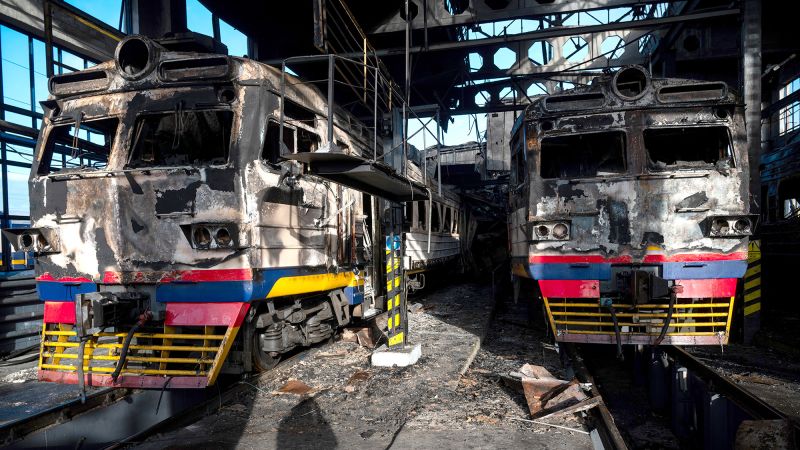
Russia has stepped up drone attacks on rail hubs, infrastructure and even trains themselves in recent months.
At the end of January, a drone attacked a passenger train in the Kharkiv region, setting three cars ablaze and killing five people. Video from the scene showed soldiers helping to rescue the woman and her baby. The woman took her child to see her father. This route transports not only military personnel returning from vacation, but also many civilians.
Ukrainian President Volodymyr Zelenskiy posted a video of one of the vehicles on fire and said: “There is no military justification for killing civilians inside a vehicle and there can be no such thing.”

According to the Ukrzaliznitsia news agency, nearly 100 railway workers have been killed since the war began.
Russia is targeting Ukraine’s extensive rail network in part because of its economic importance, but also to inflict a psychological blow. The French Foreign Ministry said last week that the repeated attacks on the railway network “demonstrate Russia’s desire to destroy Ukraine’s civilian infrastructure and are part of the same terrorist pattern as attacks on Ukraine’s energy grid.”
“Everyone understands how symbolic and important it is for Ukrainians in front-line communities that the rail connection is maintained,” Ukraine CEO Oleksandr Pertsovsky said.
Pertsovsky told CNN there were 1,195 Russian attacks on rail infrastructure last year, more than in the previous two years combined, including the targeted destruction of dozens of substations.

He said locomotive depots and junctions were also targeted, as well as railway lines in places such as Odessa, to hinder Ukraine’s exports. At times, dozens of Russian drones would target the same location, Pertsovsky said.
According to Ukrainian Prime Minister Yulia Sviridenko, on one recent day there were seven drone attacks on the same railway station. “Russia is deliberately attacking our logistics routes. This is deliberate terrorism against people and civilian logistics,” she wrote on Telegram.
The targeted station is on a busy railway line from Zaporizhia in the south to Dnipropetrovsk. Locomotives, passenger cars and even the line itself were damaged by drone attacks, forcing Ukrzaliznytsia to introduce a back-up bus service between cities. In other areas, trains come to an emergency stop if there is a warning of an impending attack.
Pertsovsky told CNN that Russia’s goal is to “cut off the entire corridor, or entire regions such as Donetsk, Sumy and Chernihiv” in the north and east.
Many soldiers fighting in the east took trains from important Donetsk strongholds of Kramatorsk and Sloviask when taking leave. However, as the front line moved closer to both cities, Ukrzaliznitsa suspended service to both cities in November.

Ukrzaliznitsa is responding to the increasing intensity and precision of Russian attacks by seeking to protect critical points on its systems and deploying rapid recovery teams.
One day in January, “four bridges were destroyed, but they were restored in 10 hours,” Perzovsky said. “It takes a lot of resources to get the materials and the right team and equipment for the restoration.”
Both railway companies and the government are determined to keep trains running as an important part of Ukraine’s resistance.
“Russia can destroy railroad tracks and vehicles, but it cannot destroy the systems that bind the country together,” Deputy Prime Minister Oleksiy Kuleba said last week.
