

Lee este artículo en español
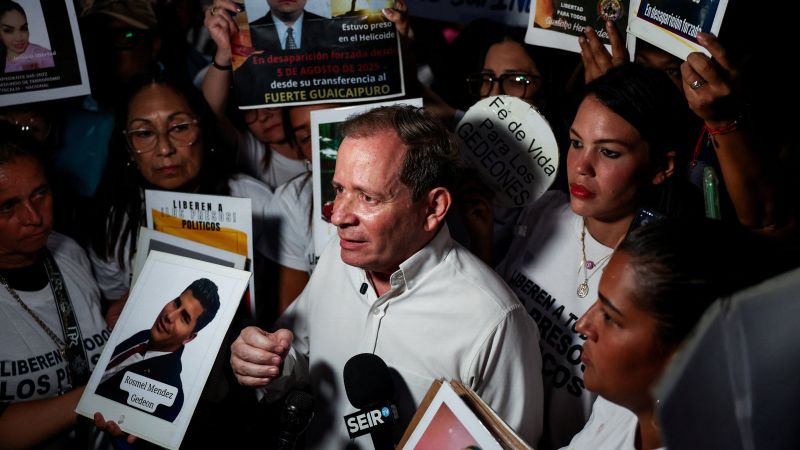
Juan Pablo Guanipa, a leading figure in Venezuela’s opposition, has been re-arrested by heavily armed men and placed under house arrest two days after being released from prison where he was being held as a political prisoner, his son announced.
“It’s comforting to know that our family will be together soon,” his son Ramon Guanipa posted on his father’s social media accounts, while also thanking U.S. President Donald Trump and Secretary of State Marco Rubio for their efforts to free political prisoners across Venezuela.
Guanipa’s son added: “My father remains unjustly imprisoned, as house arrest is still imprisonment, and we demand full freedom for him and all political prisoners.”
Venezuela’s attorney general’s office told CNN on Tuesday that it would not release any further information about the case at this time. CNN has reached out to the White House and the US State Department for comment.
Guanipa’s family and political allies announced on Sunday, just hours after his release, that he had been “kidnapped” by a group of men.
Guanipa, leader of the conservative Primero Justicia party, was one of several high-profile political prisoners released on the same day as part of Caracas’ latest effort to meet US demands following Washington’s ouster of strongman leader Nicolás Maduro.
The country’s public prosecutor’s office later announced that it had ordered Guanipa to be placed under house arrest for violating the terms of his release.
Venezuela’s Interior Minister Diosdado Cabello said Guanipa had been rearrested on charges of “calling people to the streets.”
“They were released and reunited with their families, but the enlightened stupidity of some politicians led them to believe they could do whatever they wanted and cause trouble in the country,” Cabello said.
Until now, political prisoners have been subject to restrictions upon release ranging from travel bans, regular court appearances and gag orders, said Gonzalo Himiob, a lawyer and vice president of human rights group Foro Penal. He stressed that political prisoners are not considered completely free, as legal proceedings remain open in all cases even after their release.
Venezuelan opposition leader and Nobel laureate María Colina Machado said Guanipa, 61, was snatched by a group of men in Caracas’s Los Choros neighborhood on Sunday.
“Heavily armed men in plain clothes arrived in four cars and took him away by force,” she told X.
Guanipa’s son said in the video that his father was “ambushed” at a late-night event “by about 10 operatives whose identities we had no knowledge of.”
“They pointed guns at me, heavily armed me, and took my father away,” he said, demanding to see proof that his father was still alive.
Guanipa’s Primero Justicia party also accused the Caracas government of being behind the kidnappings. “We hold (Interim President) Delcy Rodríguez, (President of the National Assembly) Jorge Rodríguez and (Interior Minister) Diosdado Cabello responsible for endangering the life of Juan Pablo,” the statement said.
After President Maduro was captured by U.S. special forces last month, former vice president Rodríguez assumed leadership with the blessing of the Trump administration, on the condition that Caracas accede to a number of U.S. demands ranging from access to oil to the release of political prisoners.
Mr. Guanipa was arrested in May 2025 following Mr. Cabello’s unsubstantiated claims that he was involved in a “terrorist” plot against local and parliamentary elections. Mr. Guanipa has repeatedly denied the accusations.
He spent more than eight months in prison before being released. Immediately after leaving the Caracas detention center, Guanipa uploaded a video to social media declaring: “There is a lot to talk about about Venezuela’s present and future, always keeping the truth at the forefront.”
Machado celebrated the news of his release on social media, saying: “Dear Juan Pablo, I’m counting down the days until I can hug you! You are a hero and history will always recognize that.”
Another Machado ally, lawyer Perkins Rocha, was also released on Sunday, but with strict restrictions, according to his wife, Maria Constanza.
The Foro Penal announced on Sunday that it had confirmed the release of at least 30 political prisoners, said the group’s director, Alfredo Romero.
Others released include Luis Somaza, a member of the Popular Will party, and Jesús Armas, an activist and former opposition lawmaker.
Venezuelan opposition groups and human rights groups have long accused the country’s dictatorial regime of using arbitrary arrests to suppress opposition. The Foro Prison Service estimates that hundreds more political prisoners remain in prison.
The government denies detaining people for political reasons and claims those in prison have committed crimes.
Sunday’s release came days after Venezuelan National Assembly Speaker Jorge Rodriguez promised relatives of political prisoners that “all detainees” would be released. Rodriguez, the younger brother of acting President Delcy Rodriguez, said the process would be completed “at the latest by Friday, February 13.”
His announcement came as the Socialist proxy government is developing an amnesty bill that could lead to the mass release of prisoners of war, some of whom have been held since 1999, when strongman Hugo Chávez took power, as a first step toward what officials call national reconciliation.
The Guanipa incident calls that process into question. “The so-called amnesty, the false pretense of dialogue, is over before it was born,” opposition party Alianza Bravo Pueblo said.
Days after the US detained Maduro, the government announced the release of “a significant number of people,” but human rights groups and families believe the pace of releases is slow.
According to Foro Penal, more than 380 people have been released from prison so far, and the government claims to have released more than 800 people.
This story has been updated with additional information.
