

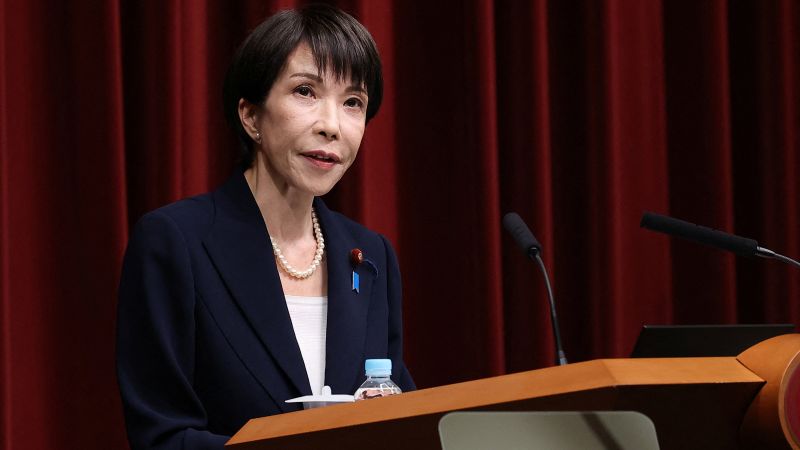
Prime Minister Sanae Takaichi’s high-stakes gamble of a snap election paid off, with voters giving his ruling Liberal Democratic Party (LDP) a majority on Sunday, according to public broadcaster NHK.
After an election designed to be a referendum on Takaichi himself, the latest tallies show that Takaichi’s ruling party has secured more than two-thirds of Japan’s 465 seats in the lower house. And her Liberal Democratic Party itself had already cleared the 233-seat threshold to win a majority on its own.
In an interview with NHK, Takaichi expressed his gratitude to those who “brave the cold and walk on snowy roads to vote.”
“I wanted voters to give me the mandate because I was advocating for responsible and proactive fiscal policy that would significantly change economic and fiscal policy,” he added.
A hard-line conservative who enjoys the support of US President Donald Trump, she has recorded high approval ratings less than four months after being elected, making her mark in history as the first woman to lead Japan.
She has captivated the public with her strong work ethic, savvy social media game, and charisma, and recently became an internet sensation for her impromptu drum session to K-pop hits with South Korean President Lee Jae-myung.
By calling for early elections, she hoped to translate her popularity into a stronger mandate for a party weakened in recent years by scandals involving the misuse of political funds. She wanted Japanese voters to take on a new mission: to push for fiscal expansion in the world’s fourth-largest economy.
Writing in X Sunday, Takaichi thanked President Trump for his support earlier this month and said the possibilities for the Japan-U.S. alliance are “limitless.”
Sunday’s notable result means Takaichi’s party and its coalition partner, Nippon Ishin no Kai, will have enough numbers to chair all committees in the House of Representatives.
The main opposition party, the Centrist Reform Alliance, was expected to lose at least a third of the 167 seats it currently holds.
The election results will give Takaichi a new mandate to tackle challenges such as Japan’s rapidly aging population, rising costs of living, weak yen and worsening relations with China.
Takaichi, a longtime member of the Diet, rose to the top of Japanese politics last fall after his predecessor, Shigeru Ishiba, resigned under pressure from his party following the Liberal Democratic Party’s crushing defeat.
She won her third attempt as president of the Liberal Democratic Party on October 4, and was elected prime minister on October 21. This was a surprising victory in Japan’s deeply patriarchal political system.

Her decision to dissolve parliament after three months was a “very heavy decision,” she said at a press conference on January 19, adding: “In doing so, I am also risking my position as prime minister.”
During his brief tenure, Takaichi enjoyed unusually high approval ratings and made headlines for his relaxed and friendly interactions with other world leaders.
In their meeting with the US president just a week into his term, Mr Trump and Mr Takaichi looked more like old friends than world leaders.
“I’m very happy for her,” Trump told business leaders after the meeting. “I got to know her pretty well in a short period of time.”
Days before the election, President Trump gave his “full support” to Takaichi, writing in a post on Truth Social that Takaichi “has already proven himself to be a strong, forceful, wise leader and a true lover of his country.” He added that he plans to welcome Takaichi to Washington in March.
Mr. Trump also had close ties with Mr. Takaichi’s mentor, the late former Prime Minister Shinzo Abe.
Ms Takaichi’s firm leadership style and support for traditional values have drawn comparisons to Margaret Thatcher, whom she cites as a source of inspiration.
However, not everything was clear for Japan’s first female leader. She has come under scrutiny for her relentless work schedule, which includes calling meetings with her aides at 3 a.m.
Her comments about Taiwan, a democratic island claimed by China, also soured relations between Japan and China.
Takaichi broke with Japan’s long tradition of ambiguity toward Taiwan in November when he told Congress that a Chinese attack on Taiwan, which is located just 60 miles (97 kilometers) from Japanese territory, could trigger a military response from Tokyo.
China retaliated by canceling flights, restricting imports of Japanese seafood, and increasing military patrols.
