

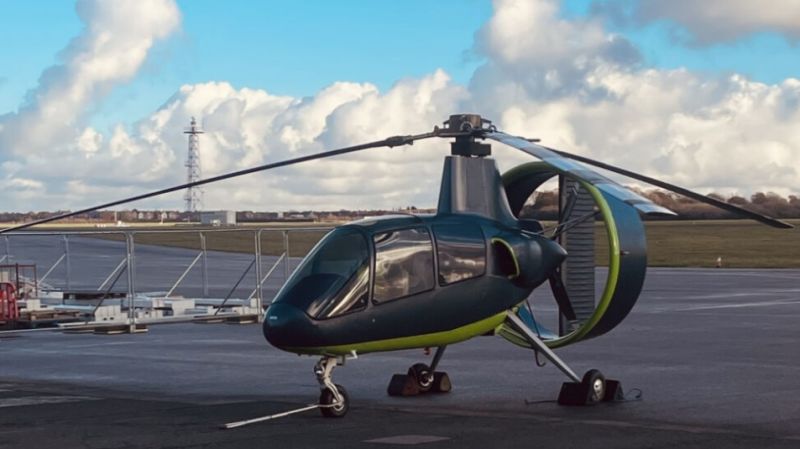
A vertical take-off and landing plane that first flew 60 years ago is making a comeback with the aim of providing a cheaper and greener alternative to modern helicopters.
“We have been looking for practical, practical solutions to advanced air mobility needs for many years,” said Dr. Seyed Mohseni, CEO and founder of UK-based ARC AeroSystems, which is developing the vehicle. “This was a well-established solution that was forgotten.”
In the 1960s, a group of former engineers from aircraft manufacturer Avro Canada were developing The Avian 2/180. It was a gyroplane, a type of aircraft that appeared in the 1920s. A gyroplane, also known as an autogyro, uses a rotor at the top for lift and a propeller at the rear for forward movement. However, unlike a helicopter, the upper rotor is not driven by the engine. Instead, it is powered by air passing through the rotor as the vehicle moves forward.
While standard gyroplanes require a runway, the Avian 2/180 was able to take off vertically with a hopping-style takeoff. Avian Aircraft developed a model that was certified airworthy by the U.S. Federal Aviation Administration (FAA), but it was never mass-produced and the design was forgotten after the company went bankrupt in the 1970s.
Arc AeroSystems’ Pegasus gyroplane is an improved version of the original Avian model, capable of vertical takeoff and landing, able to utilize existing helipad infrastructure, and equipped with a self-charging hybrid electric engine driving a rear propeller.
“There are clear advantages to using this type of aircraft. The main advantage is that there is no gearbox, as the rotors are not powered,” Mohseni said, explaining that operating and maintenance costs are reduced as a result.
Pegasus can carry one pilot and two passengers, but has a top speed of 160 km/h (100 mph), which is slower than most helicopters, but Mohseni said it could replace Pegasus in many use cases, particularly in emergency medical services.
“We offer an affordable and simple air ambulance that can cover over 90% of the missions normally performed by helicopters,” he said.
The cost of helicopter emergency medical services varies widely depending on location, situation and model, but in the UK the average cost per mission is £4,165 ($5,730), with a total of more than 130 missions per day, according to Air Ambulance UK, the UK’s leading air ambulance charity.
Mohseni said it costs about $300 an hour to operate the Pegasus, which does not include the cost of pilots or medical personnel. The purchase will cost around 750,000 pounds ($1 million).
“Helicopters are quite inefficient fuel-wise,” explains Dr. Douglas Thomson, a senior lecturer in aerospace science at the University of Glasgow, who is not affiliated with ARC AeroSystems.
“They are very complex and have a lot of safety-critical components…autogyros are much simpler mechanically,” he added.

Thomson said gyroplanes could be safer than helicopters because their rotor blades rotate automatically. “If an engine fails, the aircraft can theoretically just descend slowly toward the ground, and it can actually be very well controlled all the way to landing,” he says.
However, he added, “It was difficult to find a use for it other than pleasure flights.”
“One of the biggest problems with autogyros is that they tend to be small. Autogyros aren’t very scalable. If you want to build a four-seater, six-seater, eight-seater vehicle, the rotors can get very large very quickly,” Thomson said.
He added that gyroplanes are difficult to fly, and while Pegasus’ vertical takeoff capability “will expand the aircraft’s applicability,” pilots will need considerable training to pull it off.
“It looks pretty scary,” he said of the takeoff. “This is a tricky maneuver because it is a jump into the air and must be coordinated with increased forward speed.”
Mohseni acknowledged that jump takeoffs require skill, but said it is “not as complex as a helicopter takeoff.” To fly the Pegasus, pilots will need a commercial rotary-wing aircraft license and certain “type rating” approvals. Mohseni said the company will provide training to pilots to obtain certification.
Pegasus has received a British Civil Aviation Authority (CAA) E-condition certificate, which means it is ready for test flights, and Mohseni expects the first test flight to be in February or March this year.
He said ARC AeroSystems’ design is based on a model that received Part 27 type certification from the FAA, making the Pegasus easier to obtain airworthiness certification than a brand-new vehicle.
But Mr Thomson said any changes would require new certification, “which could be a long and very expensive process”.
ARC AeroSystems has received a combined 12 million pounds ($16.55 million) in private and British government investment, but Mohseni said it needs a further 25 million pounds ($34.5 million) to bring Pegasus to market.
He said the company is in talks with potential investors and expects funding to be secured by the first half of 2026. From that point, the company expects the aircraft to be certified in the UK and ready for commercial use within three years.
Sky Angel Air Ambulance, a charity based in Norwich, UK, has pre-ordered 10 Pegasus aircraft, with a further five to be commissioned by the Scotland-based pilot training school and aviation service operator.
ARC Aerosystems has also signed a contract to supply up to 30 gyroplanes to kidney recovery specialist 34Lives. 34Lives, based in the US state of Indiana, currently uses an expensive system that combines ground transportation and private jets to transport organs to hospitals.
“Organ transplants are time-sensitive and rely on efficient transportation to move organs over long distances,” a 34Lives spokesperson told CNN in an email.
“However, air transport is generally very expensive. For example, a chartered jet typically costs $25,000 to $30,000 to fly from an organ rescue center to a single hospital (it can cost the same amount to transport a kidney from a donor hospital to a rescue center). Helicopters are even more expensive.
“We estimate that Pegasus costs $500 to $600 per hour to operate (including pilot, fuel, maintenance, and overhead), compared to $2,500 to $5,000 per hour to operate Pegasus. This has the potential to reach more transplant hospitals at a lower cost without compromising time efficiency.”
Mohseni said that although Pegasus is slower than a jet plane, it can take off outside the 34Lives facility and transport donor kidneys directly to the hospital, reducing overall transport time.

Globally, other companies are also developing similar gyroplanes. Germany-based Autogyro is developing versions designed for vertical takeoff air taxis, air ambulances and cargo transport. US-based Skyworks Aeronautics has been working on developing manned and unmanned vertical takeoff gyroplanes for military applications and urban mobility.
A number of other companies, including China’s Yihan and US-based Joby Aviation, are working on other types of electric vertical takeoff and landing aircraft aimed at short-distance travel between urban transportation hubs.
Pegasus, which has a maximum payload of 280 kilograms (617 pounds), can be fitted with a variety of cameras and sensors and could also be used for observation and air taxi applications, Mohseni said.
Alongside Pegasus, ARC Aerosystems is also developing a nine-seater winged gyroplane, the Lynx P9, which Mohseni hopes will be commercially available by 2030.
