

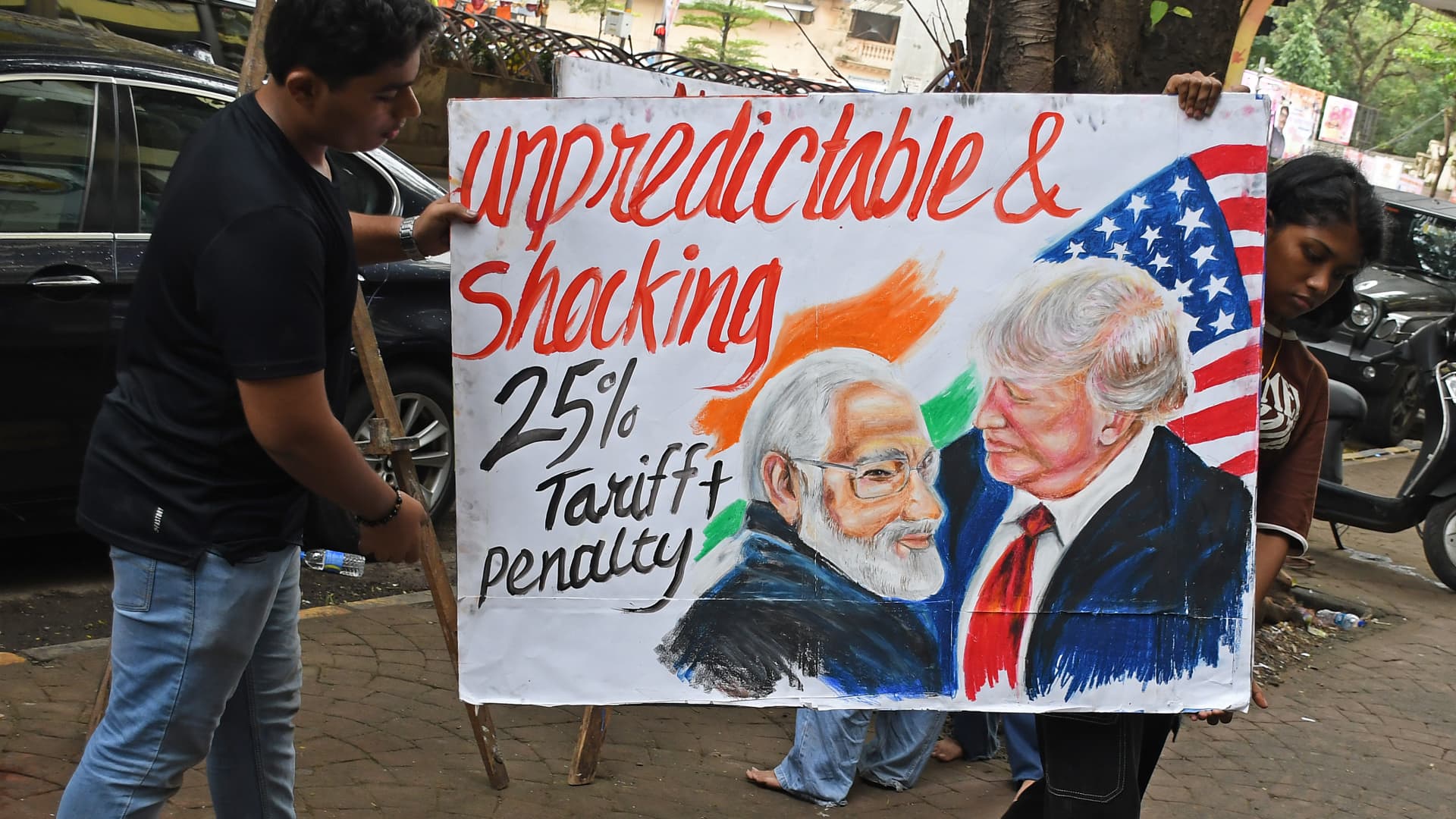
The trade deal between India and the US, which will see tariffs on Indian exports cut from 25% to 18%, comes less than a week after India reached a major free trade agreement with the European Union.
President Trump announced the agreement in a post on TruthSocial, saying India had agreed to stop purchasing Russian crude oil. He had previously imposed an additional 25% tax in retaliation. President Trump said India has pledged to buy $500 billion in agricultural, high-tech, energy and other products while switching oil to U.S. and possibly Venezuelan sources.
In contrast to last week’s comprehensive deal between the EU and India, many of the specific details of the India-US deal have yet to be fully worked out, but investors say Indian manufacturing is seen as the first major beneficiary, while IT and pharmaceuticals could also get a boost.
James Thom, senior investment director for Asian equities at Aberdeen Investments, said the country’s labor-intensive export sectors, which span textiles, clothing, leather, jewellery, toys and furniture manufacturing, now have an opportunity to regain ground lost to the region’s major manufacturing competitors.
Tom identified small and medium-sized businesses as businesses likely to benefit from the new 18% tariff. The tariff rate is lower than rival Pakistan, which has a 19% tariff, and Vietnam and Bangladesh, which each have a 20% tariff.

Nifty 50.
“Removing the overhang will also support banks, non-banking financial companies and export-oriented manufacturing, while also improving retail sentiment in small and mid-cap stocks,” Tom said in a market commentary.
Bernstein said the US is likely to accelerate the deal with India on Monday, following last week’s India-EU deal. Analysts said the deal would bring India roughly in line with the rest of the Association of Southeast Asian Nations, a “big positive over time” and strengthen India’s position vis-à-vis China.
improving relationships
Bernstein analysts Venugopal Ghar and Nikhil Arera said that while some sectors, such as autos and metals, could continue to face tariffs, information technology would benefit from improved ties between the two countries.
“While IT has the largest exposure to the United States, and the agreement primarily targets industrial products, we expect that improved U.S.-India relations, even in the short term, will reduce scrutiny of IT services and reduce the risk of further punitive actions, such as additional taxes,” Galle and Arella wrote.
They outlined a tactical “buy” trade based on a short-term rebound in Indian stocks, mainly supported by financials, IT and telecom, but said manufacturing and trade-related stocks “will also see some recovery.”
S&P Bombay Stock Exchange Sensitive Index.
Monday’s agreement comes on the heels of India’s “groundbreaking” FTA with the EU, dubbed the “mother of all agreements” by European Commission President Ursula von der Leyen, which will significantly reduce or eliminate tariffs on a range of goods and services.
Focusing on India’s pharmaceutical sector, Fitch Ratings’ research arm BMI highlighted the removal of 11% customs duties on EU drug imports, including cancer drugs, biologics and GLP-1, amounting to $1.2 billion in 2024.
growth trajectory
BMI said lower import costs and improved supply chains underpin the positive outlook for India’s pharmaceutical sector, with the market expected to grow by $31.2 billion in 2025 and $45.7 billion by 2035, representing a 10-year compound annual growth rate of 5.2% in local currency terms.
Noting the recent slowdown in India’s pharmaceutical exports, the report added, “This agreement will also help India-based companies diversify their export destinations and open new opportunities in the large EU market.”
“This recent slowdown reflects ongoing market access challenges and regulatory complexity. We believe the FTA will reverse this trend, as the agreement is expected to align regulatory compliance processes, shorten approval timelines, and reduce administrative costs associated with product registration and licensing. This will put exports back on a growth path.”
Ashoka India Investment Trust.
Russ Mold, investment director at AJ Bell, said the trade deal had boosted market sentiment and provided more transparency for investors, highlighting the 2.5 per cent rise in the Sensex after the deal. The Sensex consists of the 30 largest and most actively traded companies on the Bombay Stock Exchange.
Mold added that UK exchange-traded funds with exposure to India were also among the key gainers in the FTSE 250 index on Monday, including Ashoka India’s 5.6%.
“India has been a rich source of returns for investors for the past few decades, but President Trump’s tariff policies have stalled the Sensex index’s momentum,” Moldo said. “Investors will now wonder whether trade deals can effectively remove drag and breathe new life into markets, rather than simply providing a short-term bailout rebound.”
—CNBC’s Chloe Taylor and Michael Bloom contributed to this article.
