

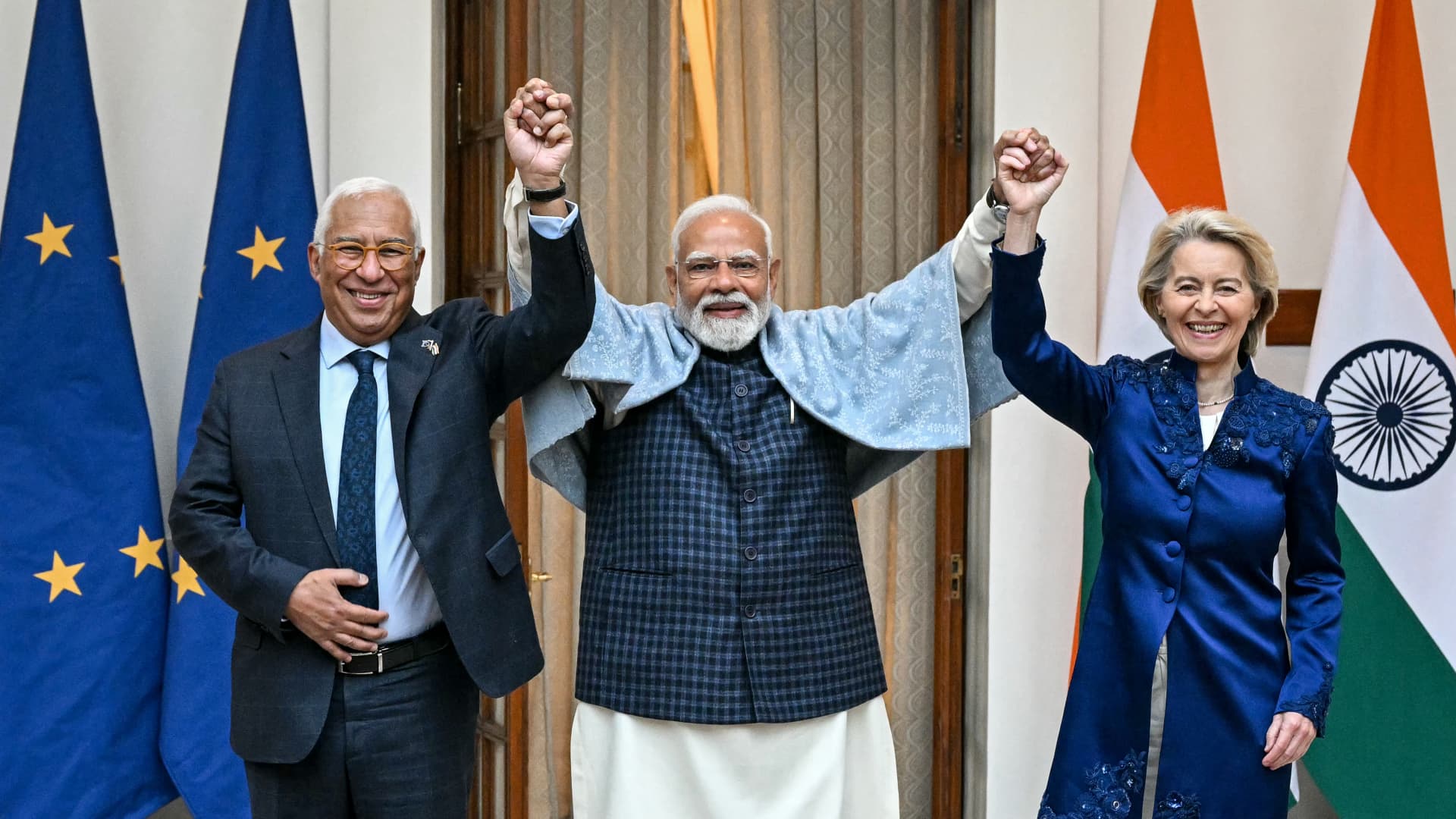
Indian Prime Minister Narendra Modi (C) poses for a photo with European Commission President Ursula von der Leyen (R) and European Council President Antonio Costa on January 27, 2026 in New Delhi, India.
Sajjad Hussain | AFP | Getty Images
If the most populous country on earth struck a trade deal with a bloc that accounts for almost 15% of global GDP, the implications would be far-reaching and not just financial.
Indian Prime Minister Narendra Modi said on Tuesday that his country and the European Union (EU) had signed a “groundbreaking” free trade agreement.
The agreement, which creates a market of about 2 billion people, comes amid a disruption in global trade relations due to the policies of US President Donald Trump.
British Prime Minister Keir Starmer’s three-day diplomatic tour of China starting Tuesday is another sign that countries are seeking to establish new trading alliances.
Meanwhile, President Trump announced on Monday that he would increase tariffs on some South Korean products, citing delays in implementing the South Korean government’s trade agreement with the United States signed in October. Tariffs on cars, medicine and timber will rise from 15% to 25%.
With these tariffs, President Trump has used tariffs for purposes including deterring drug trafficking, maintaining national security objectives, and now expediting the legislative process in other countries.
This time, at least, it seems to have gotten a response. According to domestic media, South Korea’s ruling party has announced that it will pass a special law related to the US trade agreement by the end of February.
But such bellicose moves by the United States could further alienate the United States from its allies and the global economy. us dollar indexthe lowest since September, and gold and silver prices continue to rise.
But U.S. stocks remain resilient as investors position themselves above the profits of big technology companies. Apple, Meta and Microsoft were the main drivers of Monday’s market rally, and these companies are scheduled to report their last quarter results later this week.
All eyes now turn to the US Federal Reserve, which will announce its interest rate decisions in the coming days. The central bank is expected to keep interest rates on hold, but Chairman Jerome Powell’s press conference could shed light on President Trump’s attacks on the Fed’s independence, and Trump could time his announcement of the next Fed chair on the same day.
For investors, it adds another variable to an already busy week of earnings, data and political noise.
What you need to know today
President Trump said he would raise certain tariffs on South Korea. President Trump said on Monday that this was due to delays in South Korea’s parliament approving a trade deal with the United States. In response, South Korea’s ruling party announced on Tuesday that it would pass a special law by the end of February.
China is unlikely to respond to President Trump’s tariff salvo. Chinese officials are seeking to stabilize relations with Washington, and analysts say the two countries are “trying to maintain a fragile ceasefire.”
Money is flooding into Asian stock markets. A surge in initial public offerings, increased cross-border capital flows and accelerating trading activity highlight the region’s growing importance in global capital markets, according to senior executives at JPMorgan and Goldman Sachs.
A positive day for US stocks. On Monday, major indexes rose on the back of gains. apple, Meta and microsoftahead of its earnings report later this week. Asia-Pacific markets rose on Tuesday. In Europe, China’s Anta Sports announced it would buy a stake in Puma for $1.8 billion.
(PRO) The other side of silver’s new high. The precious metal rose 5.9% on Monday, pushing the price to $109.10. Analysts say there are two main reasons behind the record-breaking.
And finally…
Despite common assumptions, spending on AI was not the biggest driver of U.S. economic growth in 2025
Students at Dublin’s Institute of Technology are reaping the unexpected benefits of artificial intelligence. Artificial intelligence is helping heat the campus.
Since 2023, Dublin Institute of Technology’s Tallaght campus is one of a growing number of buildings in the city’s south-west suburbs to be heated with waste heat from nearby Amazon Web Services data centres.
Brendan Leidenbach of the International Energy Agency told CNBC that supplying heat to district heating networks gives data centers “an additional social license.”
— April Roach and Tasmin Lockwood
