

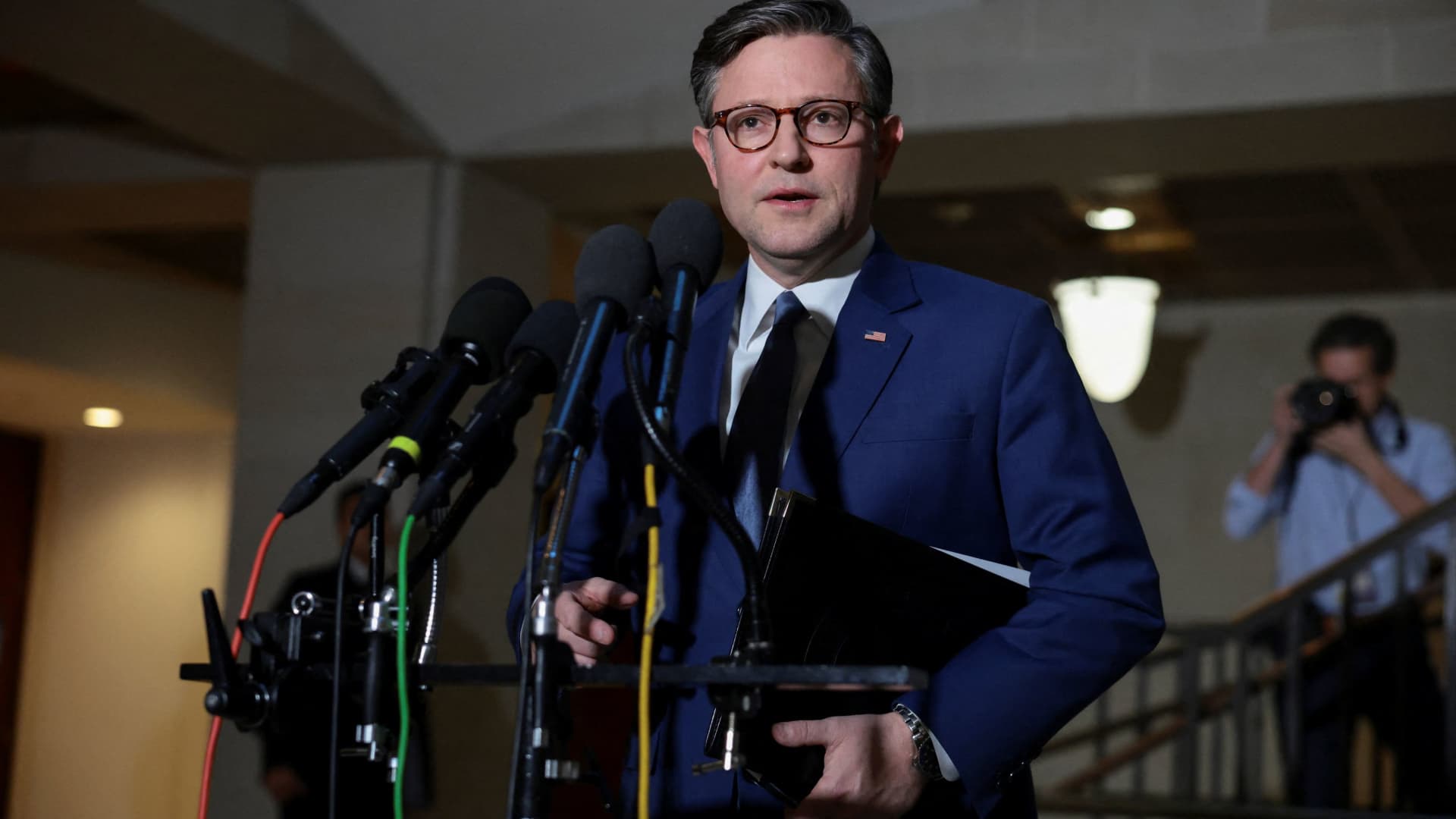
Speaker of the House Mike Johnson (R-Louisiana) speaks to the media ahead of a secure briefing on U.S. actions in Venezuela at the U.S. Capitol on January 5, 2026 in Washington, DC.
Evelyn HochsteinReuter
The Trump administration briefed congressional leaders on Monday about the U.S. military operation that captured Venezuelan President Nicolas Maduro, sharpening partisan rifts over the president’s authority to use force without Congressional approval.
Republican leaders who attended the secret conference rallied to the president’s defense, while Democrats questioned the scope of the operation and called for a halt to further military action.
The lawmakers briefed are part of a so-called “Gang of Eight” group authorized to receive classified information, and the partisan divide underscores the challenges Congress may face in trying to rein in President Donald Trump’s military efforts.
In recent days, President Donald Trump has reiterated that the United States is committed to “running” Venezuela, threatening Colombia and Cuba, and acquiring Greenland. These comments came after President Maduro was detained from Caracas following a military attack over the weekend and taken to the United States to face criminal charges without prior approval from Congress.
House Speaker Mike Johnson (R-Louisiana) called the attack in Venezuela a “firm and legitimate action” and rejected claims that President Trump exceeded his authority.
“We are not at war, there are no American troops in Venezuela, and we are not occupying the country,” Johnson said.
“The Constitution gives Congress the power to declare war, that’s true, but it also gives the president of the United States enormous powers as commander in chief,” Johnson said.
Meanwhile, Senate Minority Leader Chuck Schumer of New York said the press conference raised far more questions than it answered.
“The United States’ plan to manage Venezuela is vague, based on wishful thinking, and unsatisfactory,” Schumer said. “We have no guarantee that we won’t do the same thing in other countries.”
Senate Democrats are expected to force a vote later this week on a measure to end President Trump’s military action in Venezuela, known as the War Powers Resolution. The bill, introduced by Sen. Tim Kaine, D-Virginia, would require President Trump to halt military action in Venezuela unless Congress approves it.
Kaine introduced a similar resolution in November, but it died in the Senate after only two Republicans (Lisa Murkowski of Alaska and Rand Paul of Kentucky) supported it. Republicans hold a 53-47 majority in the Senate, and at least four Republicans would need to break ranks for Kaine’s plan to succeed.
The House must also approve the bill. In December, the country’s lawmakers narrowly rejected Venezuela’s war powers resolution 211-213.
“We have real concerns as it relates to Congressional action regarding our sole authority to declare war,” House Majority Leader Hakeem Jeffries of New York said before the news conference. “There should be no further military action in Venezuela or anywhere else without the express approval of Congress, and it needs to be legislated.”
Lawmakers received briefings from senior members of the president’s Cabinet, including Secretary of State Marco Rubio, Attorney General Pam Bondi, and CIA Director John Ratcliffe. The regime has sought to frame the use of force in Venezuela as a law enforcement measure because President Maduro had an outstanding arrest warrant in the United States.
Representative Brian Mast (R-Florida), chairman of the House Armed Services Committee, who was present at the press conference, expressed a similar view.
“This was a law enforcement operation,” Mast said. “This law enforcement operation required significant military force…as individuals who must be brought to justice can mobilize the Air Force, Navy, and Army.”
Mast said President Trump is not calling for long-term military action, but did not rule out similar operations if the president deems them necessary to “defend the homeland.”
However, leaders of the bipartisan Senate Judiciary Committee, which oversees U.S. law enforcement, were not invited to the conference. Although they are not traditionally part of the “Gang of Eight,” they issued a joint statement condemning the disrespect.
“President Trump and Secretary Rubio said this was a law enforcement operation conducted at the request of the Department of Justice (DOJ), with assistance from the Federal Bureau of Investigation (FBI) and the Drug Enforcement Administration (DEA),” said a statement from Chairman Chuck Grassley (R-Iowa) and Executive Member Dick Durbin (D-Ill.).
“The regime’s refusal to acknowledge the committee’s undisputed jurisdiction in this matter is unacceptable, and we are following up to ensure the committee receives legitimate information regarding Mr. Maduro’s arrest,” they said.
CNBC’s Emily Wilkins contributed to this report.
