

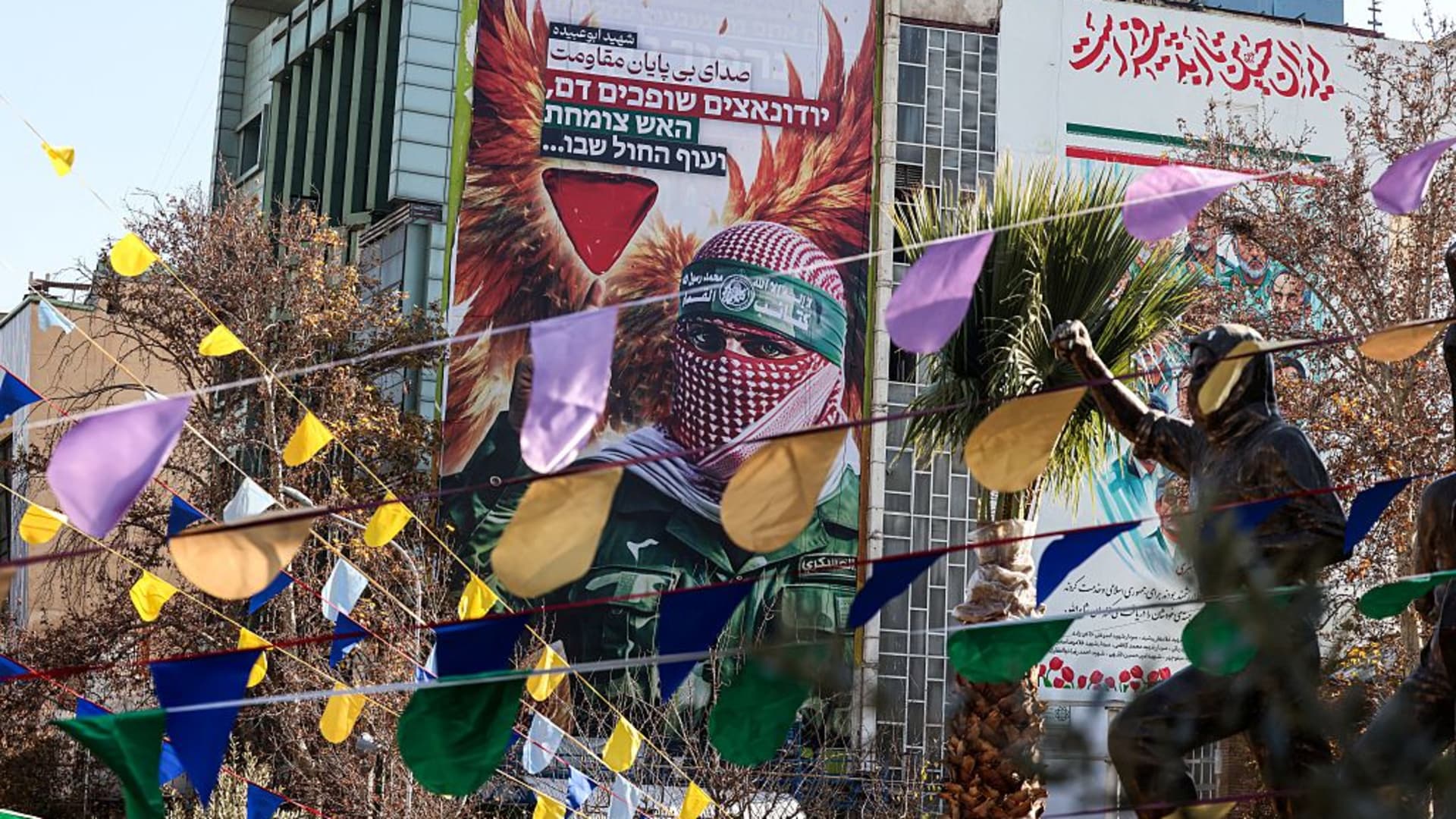
On December 31, 2025, a large anti-Israel banner depicting a Palestinian fighter and the slogan “Voice of Endless Resistance” in Persian and Hebrew will be erected in Tehran’s Palestine Square. The Israeli intelligence agency Mossad made a direct call on December 31, 2025, saying it was supporting the Iranians in the demonstrations “on the ground” and urging them to continue their protests. It spread to the capital Tehran and other Iranian cities. The protests began on December 28, 2025, with shop owners in Tehran holding rallies against the deteriorating Iranian economy, and spread to other cities, with students also joining. (Photo by ATTA KENARE/AFP via Getty Images)
Atta Kenare | AFP | Getty Images
President Donald Trump said Friday that if Iran “violently” intervenes in peaceful protests, the United States “will come to their aid.”
Unrest has been rising in Iran since last week, with protests erupting over the government’s response to a plunge in the country’s currency and soaring prices. Annual inflation reached 42.2% in December, and food prices rose 72%. Protests turned violent this week as local media reported the deaths of at least six civilians.
“If Iran follows its custom and violently shoots and kills peaceful protesters, the United States will come to their aid,” President Trump said in a post on Truth Social on Friday.
“We are locked, loaded and ready to go,” he added.
In comments reported by Reuters, Ali Larijani, an adviser to Iran’s Supreme Leader, said on Friday that US intervention in Iranian protests amounted to chaos across the region.

Suzanne Maloney, deputy director and director of foreign policy at the Brookings Institution, has previously said that Iranians not only want to rebuild the economy, but also want regime change. She added that Iran’s Supreme Leader Ayatollah Khamenei has been in power for 36 years.
“We’re hearing death cries for the dictator. We’re hearing slogans that juxtapose the regime’s support for militias across the region with the real interests and demands of the Iranian people,” Maloney said Wednesday on CNBC’s “Squawk Box.”
Iran’s economy has struggled since President Trump withdrew the United States from the Iran nuclear deal in 2018 and reimposed sanctions on Iran. Tensions escalated last June after a U.S. attack on Iran’s nuclear facilities drew the United States into Israel’s war with its longtime regional rival.
Earlier this week, President Trump threatened to take additional military action against Iran if it tries to build up its ballistic weapons stockpile and restart its nuclear program.
“Now we’re hearing that Iran is going to rise again. If that happens, we’re going to have to defeat them. We’re going to defeat them. We’re going to crush them once and for all. But I hope that doesn’t happen,” Trump said on Monday.
Iranian President Masoud Pezeshkian responded in a post on X on Tuesday, saying that the Islamic Republic of Iran’s response to any oppressive aggression is harsh and regrettable.
Foreign policy has dominated President Trump’s schedule in recent weeks. The United States on Tuesday announced sanctions against 10 individuals and entities based in Iran and Venezuela and allegedly involved in arms trade between the two countries.
—CNBC’s Justin Papp contributed to this report.
