

This report is from CNBC’s The China Connection newsletter this week, delivering insights and analysis on the powerhouse of the world’s second-largest economy. You can subscribe here.
big story
Chris Miller, author of The Chip Wars, warned three years ago that the modern balance of power rests on semiconductor supply chains that cross geopolitical fault lines. Now, historians at Tufts University are raising a new concern: The United States risks losing its edge over China in terms of artificial intelligence talent.
When it comes to brainpower, “America’s advantage has deteriorated dangerously,” Miller told the U.S. Senate Foreign Relations Subcommittee last week. This is a “fragile and much smaller” lead than the benefits of AI chips, he said.
Carnegie Endowment researchers echoed those concerns the next day, noting that while China has produced more top AI researchers in the past few years, fewer researchers are heading to the United States.
Part of the difference is due to their sheer size, especially as China’s education level rises.
It has four times the population of the United States and a similar number of science, technology, engineering, and mathematics (STEM) graduates. In 2020, China produced 3.57 million STEM graduates, more than any other country and far more than the 820,000 in the United States.
China’s growth in higher education graduates has been dramatic, increasing ninefold in just one generation. The percentage of adults with at least a master’s degree has risen from just 0.1% at the beginning of this century to nearly 0.9% two decades later.
In the United States, starting from a much higher base, the same ratio rose much more steadily over this period, from 8.7% to 14.1%.
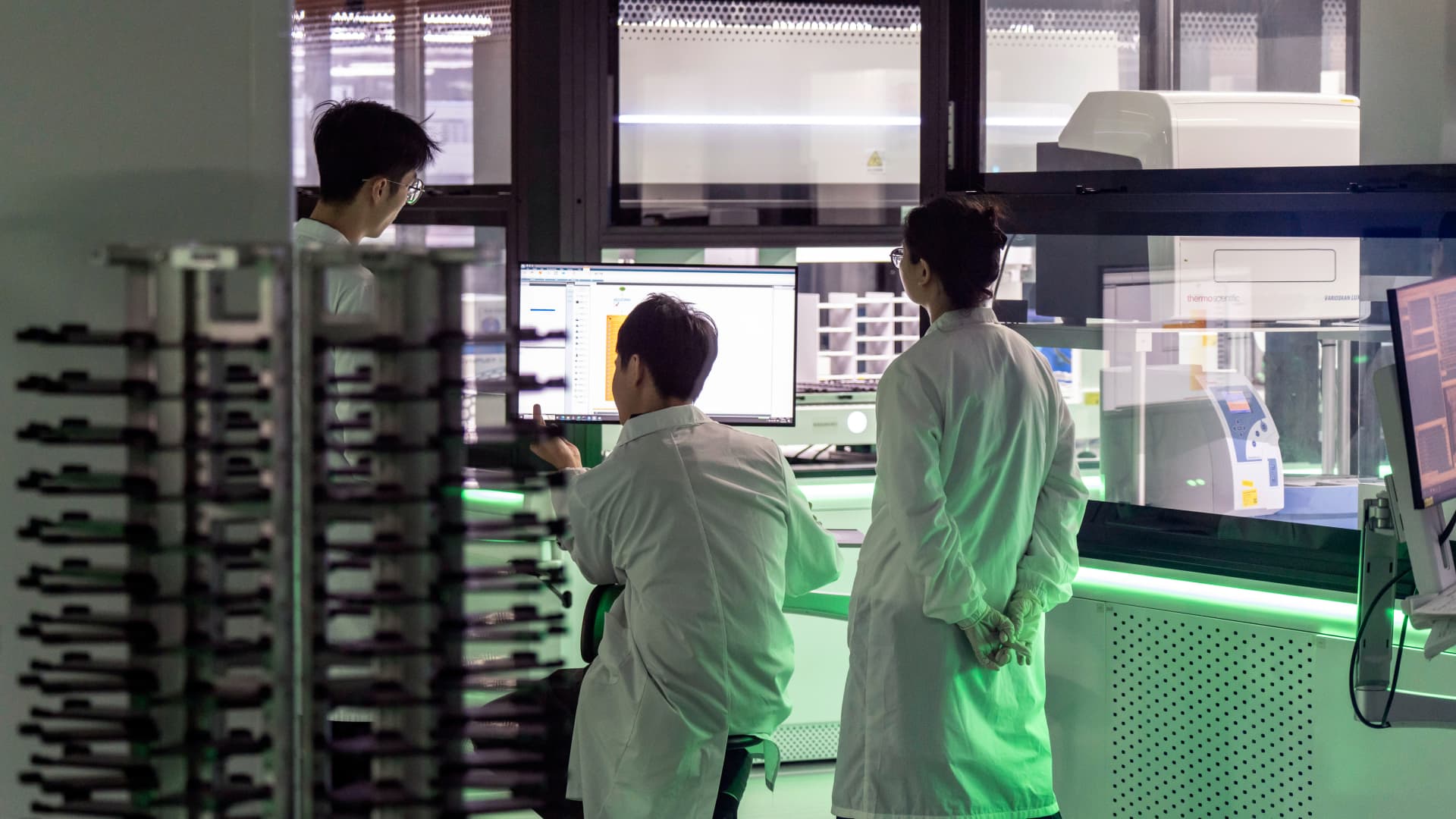
Researchers inside a laboratory at the Shenzhen Synthetic Biology Infrastructure Facility in Shenzhen, China, Wednesday, November 26, 2025.
Bloomberg | Bloomberg | Getty Images
This surge is reshaping company pipelines. Most of Xpeng’s new employees are recent graduates, CEO He Xiaopeng told reporters last month.
He claimed that the electric car maker was able to hire 10 experts in driver assistance technology this year, despite the relative scarcity of AI talent in both the US and China.
The company’s former vice president of autonomous driving now heads Nvidia’s automotive division.
The Chinese government is looking to build on this momentum, aiming for technology self-sufficiency. In August, the Department of Education announced that over the past two years, one-fifth of the nation’s higher education programs have been revamped, with major cuts or additions, in an effort to draw more students into AI and integrated circuit fields.
While China isn’t necessarily far better at attracting the world’s AI talent, being able to keep more AI experts at home “could have a significant impact on talent flows,” Tufts University’s Miller told me in an email.
Meanwhile, U.S. immigration rules could make it difficult for AI researchers to work in the U.S., he said.
quantity and quality
There is still debate as to whether volume can consistently create value.
US-based OpenAI sparked a generative AI boom in 2022 with the release of ChatGPT-3.5, and other US companies such as Anthropic have also released models that are considered global benchmarks.
China’s DeepSeek just made a similar splash earlier this year, claiming to have defeated OpenAI at a fraction of the cost. Google raised the bar even further last month with its Gemini 3 model.
U.S. AI models are no longer officially available in China, and Washington has restricted exports of Nvidia’s cutting-edge chips.
Despite the limitations, Chinese companies are increasingly finding ways to leverage scale to gradually build domestic AI capabilities, whether it’s engineers, less advanced chips or data. This is evidenced by the fact that Chinese AI models are comparable to OpenAI at a fraction of the cost.
Chinese developers are also doing more with less.
Wei Xiong, China internet analyst at UBS Securities, said in a report last week that China’s internet industry leaders spent about 400 billion yuan ($56.58 billion) on capital investment this year, about one-tenth of their U.S. peers, yet achieved “comparable” AI model performance.
And while analysts sometimes warn of “circular financing” in the U.S. AI industry (backed by investor funds circulating within the same funding ecosystem rather than genuine commercial revenues), by contrast, large Chinese development companies primarily rely on internal cash flow.
Advantages of big data
The abundance of data is also an advantage. The popularity of short videos in China has given local companies access to a large amount of training material. Apart from Google’s two models, the rest of the world’s top 15 image-to-video AI-generated models are from Chinese companies, according to AI benchmarking firm Artificial Analysis.
Chinese companies also recorded the fastest growth in U.S. patent grants last year, with telecom giant Huawei ranking fifth among commercial companies overall.
Huawei’s global patent licensing revenue reached a record $630 million last year, with further growth expected in 2025, said Alan Huang, vice president and head of Huawei’s intellectual property division. He said customers are increasingly asking for 5G and WiFi-related patents, as well as audio and visual technologies.
At home, Huawei also partners with universities for AI-related research and training.
All these initiatives will further accelerate the growth trend.
China has ranked first in the U.S. index measuring student performance in STEM-related Olympic competitions for several years. China’s contribution to scientific research, tracked by the publishers of the journal Nature, surpassed that of the United States in 2023 and quadrupled its lead the following year.
But talent still flows both ways. Lu Zhang, founder and managing partner of locally-based Fusion Fund, said many Chinese founders are still moving to Silicon Valley to launch startups. She pointed to the benefits of operating within “one of the best corporate ecosystems.”
Her bigger concern for the industry is power shortages, especially in the U.S. “I think we’re going to run out of energy before we run out of GPUs,” she said.
And analysts are increasingly pointing to China’s dominance in the energy sector.
In his Senate testimony, Miller identified three elements for maintaining AI leadership (computing power, brainpower, and power), but human capital is not the only thing he’s concerned about. “The United States has a significant lead in computing power, but China has the lead in electricity.”
Popular TV Shows on CNBC

Kevin Liu, chief offshore China and overseas strategist at CICC, said there is still a way to go before AI demand, investment and valuations reach the levels seen at the peak of the dot-com era bubble.

Eswar Prasad, a professor at Cornell University and former head of the IMF’s China division, sees “no clear opportunity” for the U.S. and China to increase direct trade.

Paul Triolo, partner at DGA-Albright Stonebridge Group, spoke about U.S. chip policy and the possibility of passage of the SAFE CHIPS Act amid intense chip competition with China.
need to know
Quote of the week
China is rapidly catching up (in AI) with chips and applications. If you look at the numbers from a top-down macro perspective, China is not far behind the United States. For example, total technology-related investment (by China) accounts for 70% of that of the United States.
— Kevin Liu, CICC Equity Strategist
at the market
Chinese markets fell on Wednesday as investors analyzed the latest inflation data. hong kong Hang Seng Index The mainland CSI300 index fell 0.56%, falling 0.78%, as China’s consumer prices rose 0.7% year-on-year, the highest level since February last year.
Both benchmarks are expected to extend their two-week winning streaks. The Hang Seng Index has fallen more than 2% since Monday, and the CSI300 has fallen 0.5% over the same period. Year-to-date, the Hang Seng Index is up over 26% and the CSI 300 Index is up over 15%.
The offshore yuan last traded at 7.0605 yuan against the dollar, its highest level since October 2024.
— Li Yingshan

Shanghai Composite performance over the past year.
very soon
Later this week: Central Economic Work Conference (scheduled)
December 15: China releases November retail sales, industrial production and investment statistics
December 16: TikTok sale deadline
