

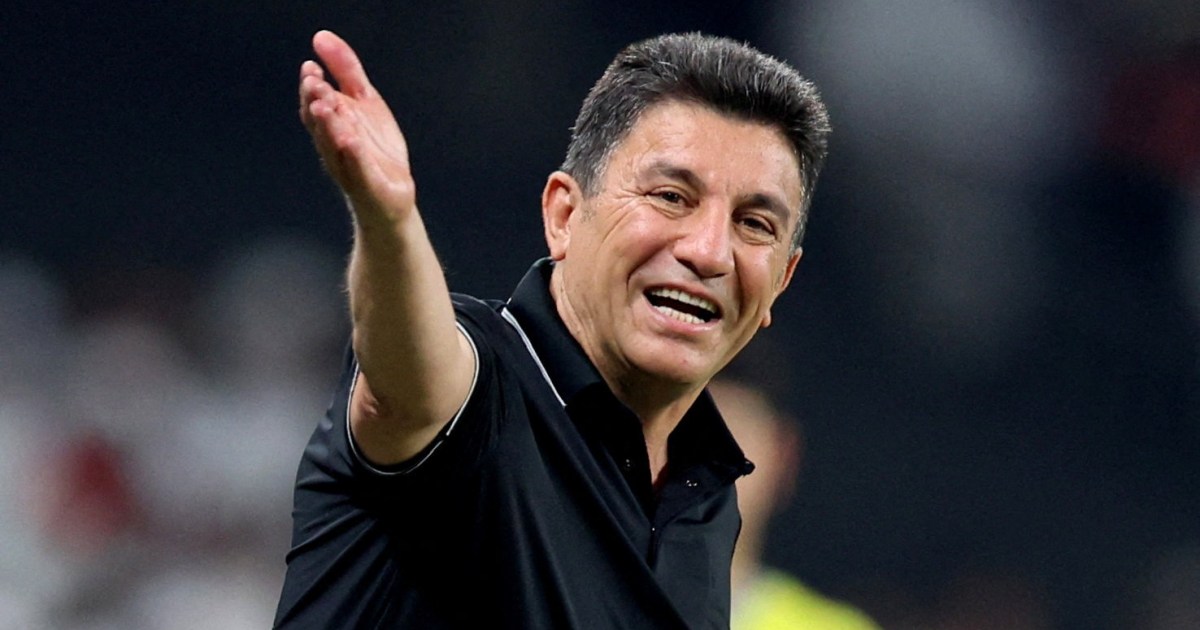
Head coach Galenoei is part of the delegation taking part in the draw, despite saying he would boycott the draw due to visa issues.
Published December 5, 2025
Iranian soccer team coach Ardeshir Amir Ghalenoei arrived in Washington DC with a delegation from the Islamic Republic of Iran Football Federation ahead of the 2026 FIFA World Cup draw.
FIFA confirmed on Friday that a delegation will be in the U.S. capital as preparations continue for next summer’s expanded 48-team tournament to be hosted by the United States, Canada and Mexico.
Iran initially announced it would boycott the ceremony in the US capital due to visa issues.
Iran had applied for nine visas for the delegation, but Football Federation of Iran (FFIRI) spokesman Amir Mehdi Alavi was quoted as saying that the United States had granted four visas, including for coach Galenoei.
FFIRI president Mehdi Taj was not granted a visa and denounced the decision as political.
“We have told FIFA that the decision taken has nothing to do with sport and that members of the Iranian delegation will not take part in the World Cup draw,” he said on state television last week.
“We told FIFA President (Gianni) Infantino that this is a purely political position and that FIFA must tell (the United States) to stop this behavior,” Taj added.
The United States has long-standing strict visa restrictions on Iranians for political and security reasons.
“FIFA welcomed the arrival of the Islamic Republic of Iran Football Federation delegation, including coach Ardeshir Galenoei, in Washington DC to attend the 2026 FIFA World Cup final draw and team seminar,” the international organization said in a statement.
“FIFA looks forward to continuing to work with federations and host country authorities to ensure preparations for participation in the 2026 FIFA World Cup next summer.”
Iran qualified through the Asian Qualifiers earlier this year and will reveal their group stage opponents in a draw later Friday at the John F. Kennedy Center for the Performing Arts.
The United States and Iran have been at odds for more than 40 years.
However, the two countries have been engaged in high-level nuclear talks between Iran and the United States that began in April, during which the two countries were at odds over Iran’s right to enrich uranium, which Tehran defends as an “inalienable” right.
But they ended in mid-June when Israel launched an unprecedented bombing campaign against Iran, sparking a 12-day war in which the United States briefly joined and attacked Iran’s main nuclear facilities.
