

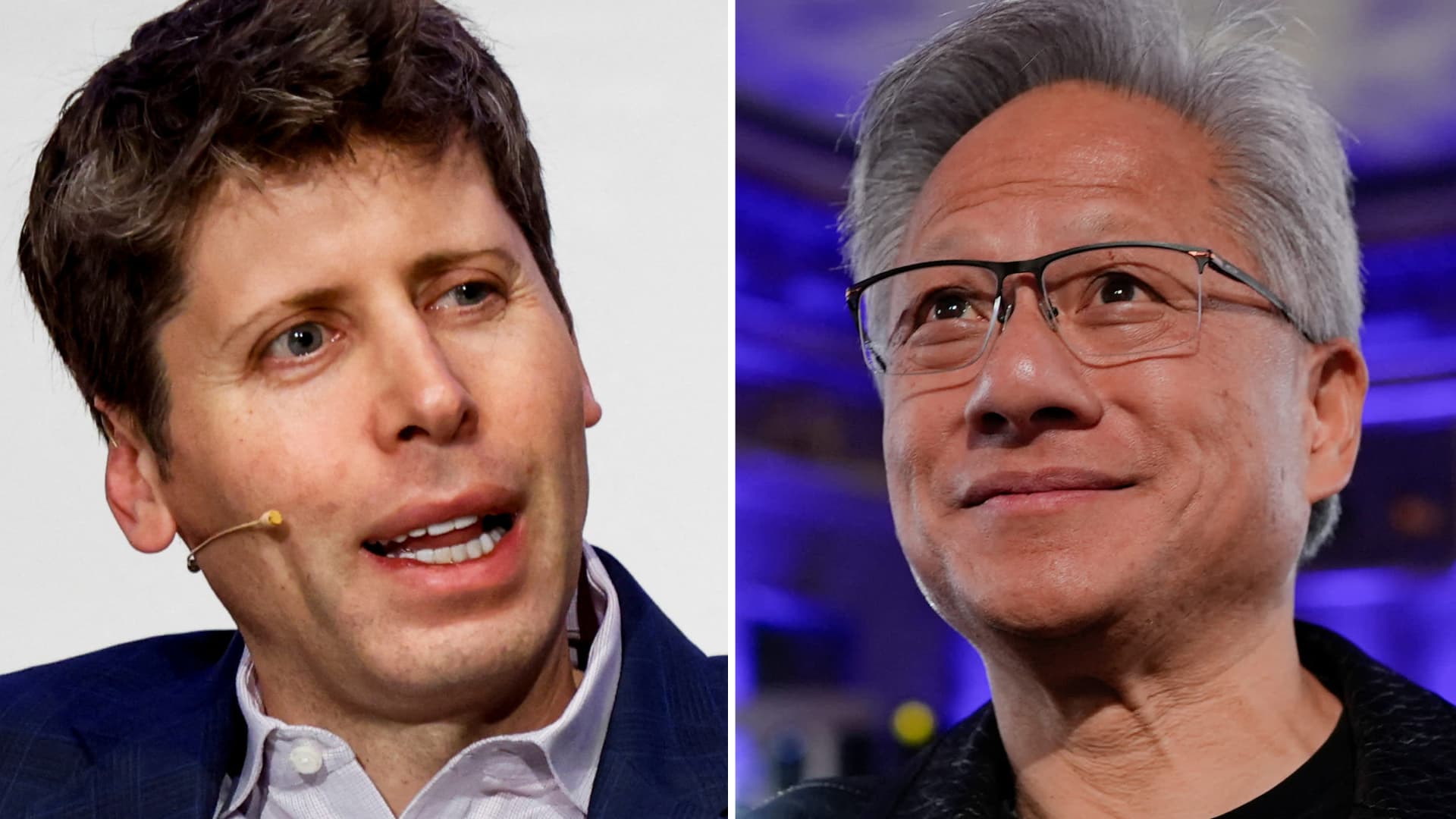
2 months ago Nvidia CEO Jensen Huang and OpenAI CEO Sam Altman stood side by side in San Jose, California, announcing a historic agreement between the two leaders in the field of artificial intelligence.
NVIDIA plans to invest $100 billion over several years starting in 2026 as OpenAI’s AI supercomputing facility becomes operational, the pair said. The timing and cost of expanding each data center have not been disclosed.
But in NVIDIA’s quarterly financial report on Wednesday, the chip maker reminded investors that there’s a big difference between an announcement and a deal.
“There can be no assurance that we will enter into a definitive agreement regarding the OpenAI opportunity or any other potential investment, nor can there be any assurance that any investment will be completed as expected,” Nvidia said in the risk factors section of its quarterly report.
Nvidia has been on an investing frenzy lately, using its ever-expanding cash reserves to financially back companies that buy its graphics processing units (GPUs). In addition to the OpenAI deal, NVIDIA announced Wednesday that intel It agreed this week to invest up to $10 billion in Anthropic during the quarter.
An OpenAI spokesperson had no comment, but noted that Huang’s comments on the conference call included describing OpenAI as a “once-in-a-generation company” and expecting the investment to “result in extraordinary returns.”
“There is no guarantee that any investment will be completed as expected, if at all,” NVIDIA said.
The main difference with OpenAI is the scale of the planned investment and the benchmarks that need to be met in order to be fully funded. Officials told CNBC at the time of the announcement that the first $10 billion would soon be available to support OpenAI’s efforts to deploy its first gigawatts of capacity.
Altman recently said that OpenAI’s annual revenue run rate will be $20 billion. This is a huge number considering the company’s flagship ChatGPT product is only three years old. Altman said he expects the company’s revenue to reach hundreds of billions of dollars by 2030, but that number is far from covering the company’s expenses.
OpenAI announced approximately $1.4 trillion in combined infrastructure spending with a number of partners to continue building AI models and services. To get there, the company relies on outside capital.
Despite the uncertainty surrounding the September deal, NVIDIA executives remain bullish on the company’s work with OpenAI. During Nvidia’s earnings call, Chief Financial Officer Colette Kress highlighted OpenAI’s growth after the chipmaker reported solid revenue and profit growth that beat expectations.
“OpenAI recently shared that its weekly user base has grown to 800 million, enterprise customers have grown to 1 million, and gross margins are healthy,” Kress said. He said the two companies are “committed to a strategic partnership,” adding that NVIDIA is “focused on helping build and deploy at least 10 gigawatts of AI data centers.”
And Huang said, “Everything OpenAI does today runs on Nvidia.”
An OpenAI spokesperson had no comment, but pointed to Huang’s comments on the call, including describing OpenAI as a “once-in-a-generation company” and expecting the investment to “result in extraordinary returns.”
There’s no question that OpenAI will continue to pour money into Nvidia’s chips as it builds out its data centers. But OpenAI also partners with Nvidia rivals advanced micro devicelast month agreed to deploy 6 gigawatts of AMD’s Instinct GPUs over multiple generations of hardware over multiple years starting in the second half of next year.
The AMD deal has one key element that Nvidia doesn’t have. That’s a signature.
As part of the agreement, the company is issuing stock acquisition rights to OpenAI for up to 160 million shares of the chipmaker’s common stock, with vesting milestones tied to installation volume and AMD’s stock price. The agreement was signed on October 5th by AMD CFO Jean Hu and OpenAI CFO Sarah Friar.
—CNBC’s MacKenzie Sigalos and Ashley Capoot contributed to this report.
WATCH: Nvidia’s revenue will be a bigger story than its gross profit going forward
