

It all started with him playing with Google Earth.
Aaron Jackson was at a crossroads. He was living in New York City and working for a nonprofit when Superstorm Sandy devastated the city in 2012. Trapped in his small apartment in Queens, the self-proclaimed “news junkie” spent so much time online that he fell into an Internet wormhole.
At some point, he says, he came across Westboro Baptist Church (WBC).
The church, considered a hate group by the Southern Poverty Law Center, is best known for organizing pickets at soldiers’ funerals and posting anti-LGBT slogans on protest signs and billboards.
“The first thing that caught my eye was that[the church]was in the neighborhood. I was walking around and decided to take a 360-degree view, and on Google Earth I saw a ‘for sale’ sign in front of the house. I thought it would be really interesting to buy that house.”
That particular house in Topeka, Kansas, was no longer for sale when Jackson inquired, but another house down the street was for sale. Jackson bought it without anyone seeing. Even though he had never been there, he was ready for a change, so he moved to a new dig in Topeka, the state capital.
But becoming a neighbor to the WBC was only the first step in his plan.
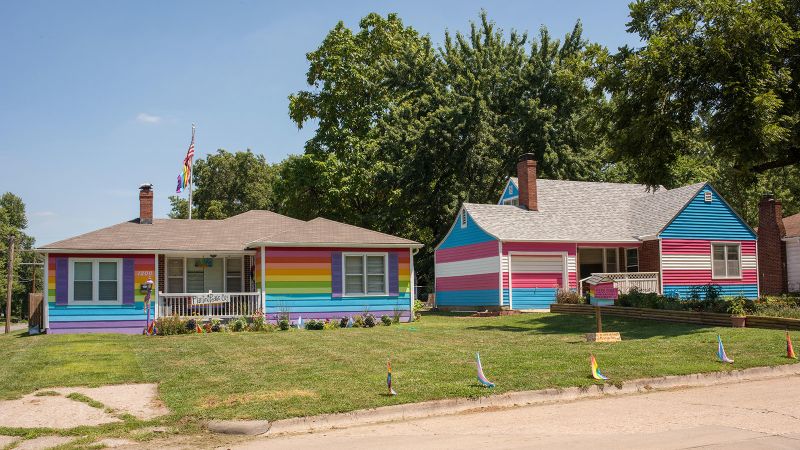
Next, he painted the exterior of the house with rainbow stripes to make it look like a pride flag. This act was intentional and an agitprop in the age of social media. It was a response to the church’s anti-gay rhetoric, and it was right in front of my living room window and impossible to ignore.
He named it “House of Equality.”
Photos of the house went viral, and Jackson thought people would look at them, laugh, and move on.
Instead, they showed up for a visit.
Topeka has a population of approximately 125,000 people, and its location on Interstate 70, the major east-west highway that crosses the United States, makes it a convenient stop on road trips. Westboro Baptist Church and Equality House are located just off the highway.
A few years later, Jackson bought a cottage down the street and painted it pink, white and blue stripes to resemble the transgender pride flag.
Mr Jackson does not call Equality House a “malicious” house, although he knows many people disagree. The house is part of a broader nonprofit he founded, Planting Peace, which has also launched other initiatives, including an orphanage and an elephant rescue.
“Equality House is a symbol of compassion, peace and positive change,” the group’s website says. However, its location facing a notorious church gives it a claim to its “bad” house label.
Nevertheless, the architecture has a short but colorful history, most of which is American.
Sometimes they are mistakenly associated with “peg” homes, where owners refuse to sell to developers and remain orphaned in new construction. In some cases, the owner is holding out for a higher salary. Some people shy away from stubbornness. Remember the little house at the beginning of the movie “Up”?
But home is different. These are made to resist developers, but as the name suggests, they are intentionally designed with some degree of malicious intent to annoy someone in particular.
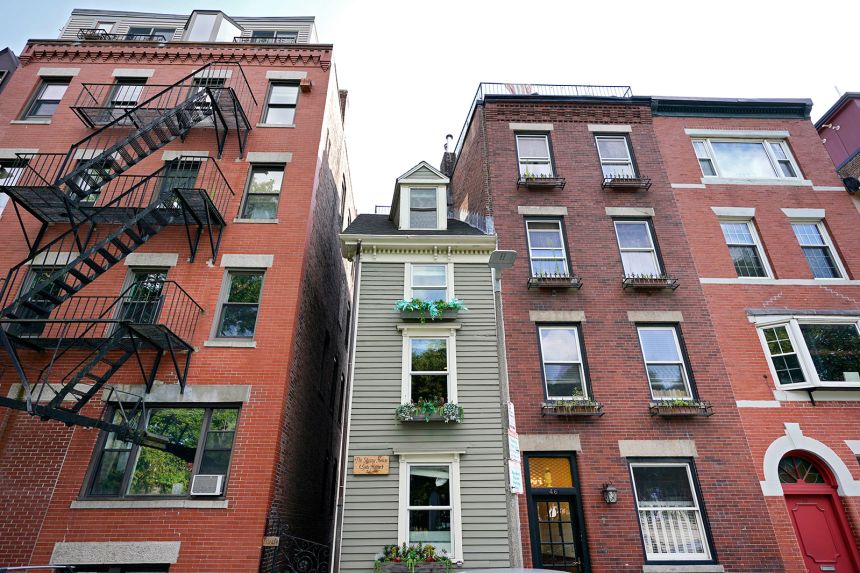
Boston’s “Skinny House” may be the most famous example.
Ten feet wide and four stories tall, it towers over the city’s historic North End. According to the real estate agent who previously sold the property, it was previously owned by two brothers. One was building a grand home for himself, and the other was fighting in the Civil War. When the soldier returned, furious that his brother had left him a smaller portion of the estate, he built a narrow tower to block the view and sunlight of the mansion.
Today, a plaque outside the small premises at 44 Hull Street reads ‘Skinny House’, with ‘Speight House’ in parentheses. Although still a private residence, it is home to Old North Church, Boston’s oldest church, and a statue of Paul Revere, making it a tourist attraction in the tony Boston neighborhood.
Google Maps shows it as “Boston Witch House.” Instagram is full of photos of tourists visiting the house, and by far the most popular pose is “stretching your arms between this house and the next door”.
Being mean is one thing. The best location is another. Despite its size and the regular line of visitors outside, the home sold for $1.25 million in 2021.
Whithouse isn’t just an American phenomenon, but it’s thriving there. The mix of a culture of private property, individualism, and this country’s fragmented zoning laws creates ideal conditions for personal grudges to solidify in real estate.
“Hostile architecture is very American,” says Paavo Monkonen, assistant professor of urban planning at the University of California, Los Angeles. “The house symbolizes more here than in other countries. It’s a home-owning society, so the house is a more personal symbol. There’s more conflict between neighbors.”
Spite houses are a type of hostile architecture, usually built on a regional scale and to the annoyance of specific individuals or families. Wider “hostile structures” include things like obnoxious park benches that homeless people are meant to prevent from sleeping on them.
“The approach to urban design in the United States is often not human-centered,” Monkonen says. “It means we want to build an empty square in a certain part of the city, a place where no one goes, because we want to protect our own peace and tranquility.”
There are other malicious houses outside of America.
Sarajevo’s Inat Kuća, or House of Wrath, offers a Balkan version of this genre.
In the 1800s, the Austro-Hungarian government wanted to demolish the houses along the Miljadka River to make room for the construction of a new town hall. One homeowner refused to sell. In a final compromise, the government would move his house brick by brick and rebuild it on the opposite bank of the river.
Today, the building houses a traditional Bosnian restaurant, but for locals it has always been a house of malice or contempt, a David-defeating-Goliath moment and a symbol of Bosnian pride.
And your home doesn’t have to be sinister to entice visitors to stop by.
In New York City’s West Village, one of the most attractive neighborhoods in the United States, a small corner of an often overlooked sidewalk has become an unlikely tourist attraction.
This isn’t just any old Manhattan asphalt.
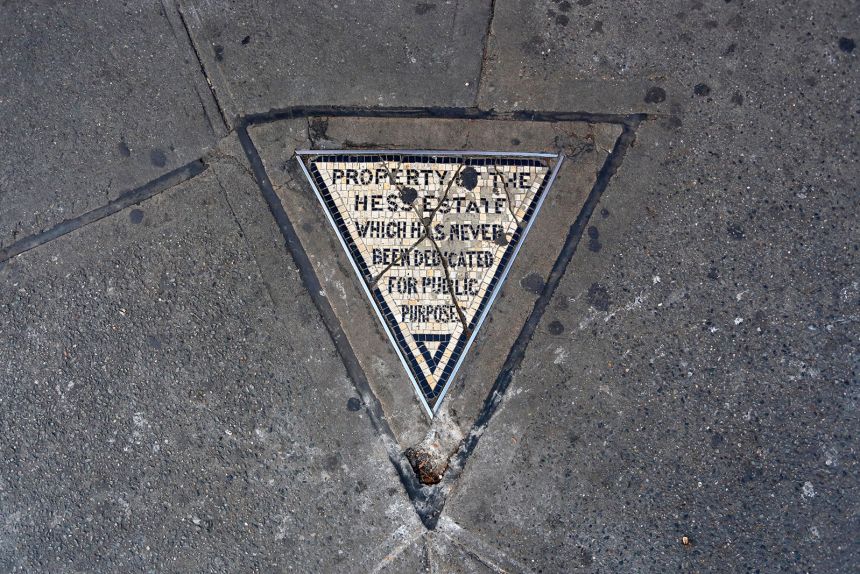
The 500-square-inch triangle is engraved with an all-caps message: “Hess Estate Property Never Previously Dedicated to a Public Purpose.”
It is officially called the Hess Triangle. Unofficially, it is the “Speight Triangle”.
Its existence began as a conflict between the Hess family, German immigrants who owned large tracts of land in this part of Manhattan, and the city, which seized most of their land in the early 1900s to build the subway.
When an investigation revealed that the city’s land measurements were slightly off, the family refused to hand over the remaining two feet of land. Instead, they pounded their voices into the ground in protest.
The arrival of the Malicious Triangle made headlines in July 1922, and the New York Times appropriately granted it a small amount of newspaper rights.
In the case of Aaron Jackson’s Equality House project, going viral had its pros and cons. He was happy that this wave of attention led people to learn about Westboro Baptist Church and learn about LGBT issues.
But he reached a point where he no longer wanted to live in the house every day. Instead, Jackson plans to turn the house into a museum and library, where visitors can do more than take photos.
Jackson said some guests want to show their support when they visit Equality House. Others want to discuss. Some consider this a malicious house, others an activist experiment.
“At the end of the day, this is an art project. I don’t tell people how I feel,” Jackson says.
