

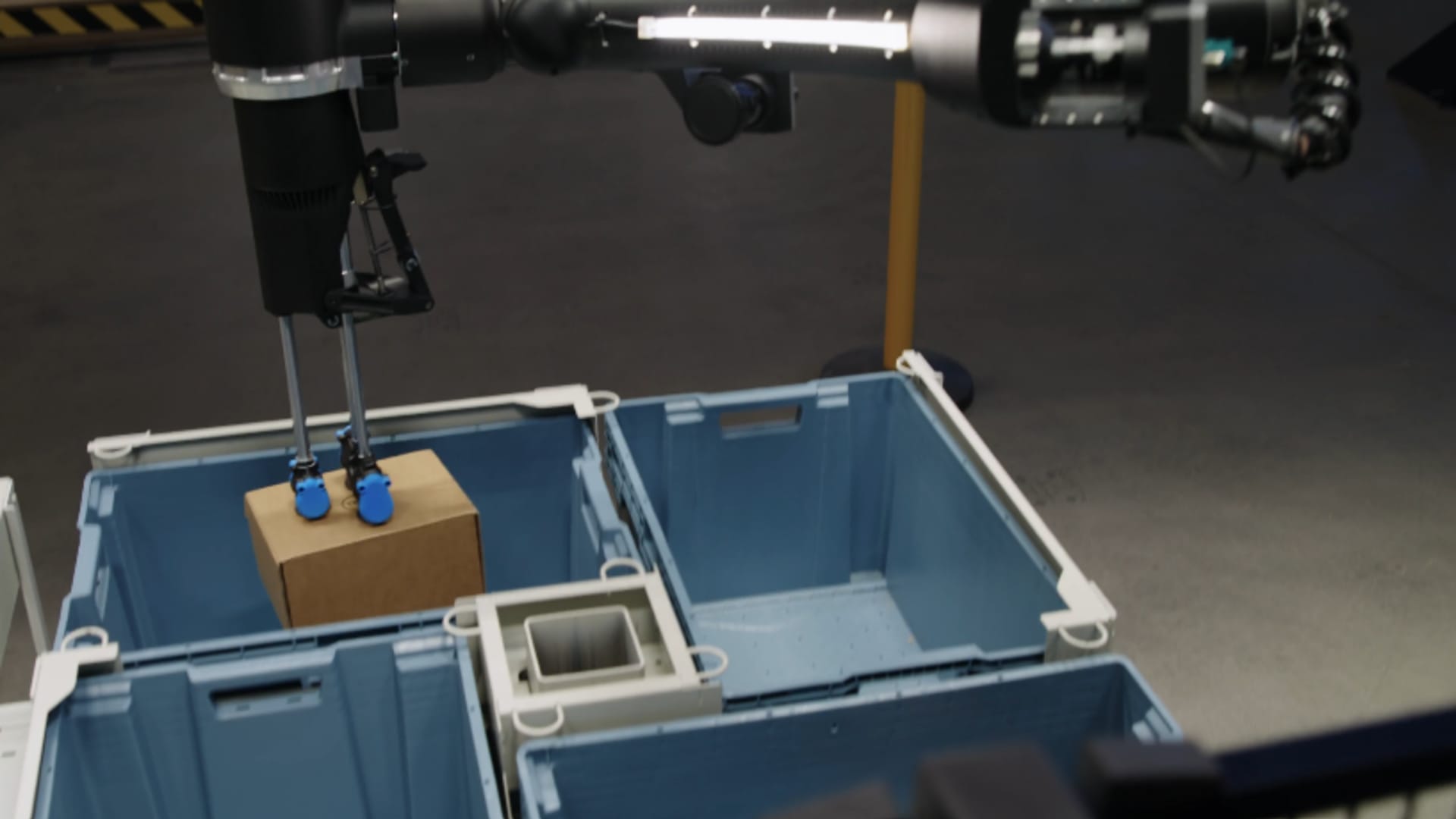
Amazon on Wednesday unveiled a new robotic system that can perform multiple tasks simultaneously in its warehouses.
The system, called Blue Jay, consists of a series of robotic arms suspended from a conveyor belt-like track. These arms have suction cup devices at the end that allow them to grasp and sort items of various shapes and sizes.
Blue Jay has “combined what were previously three separate robotic stations into one streamlined workplace with picking, sorting, and consolidation in one location,” Amazon said in a blog post.
The goal of the robotic system is to assist employees in performing typically arduous tasks “while creating greater efficiency in less physical space,” the company said.
Amazon is testing blue jays at one of its warehouses in South Carolina. The company has so far confirmed that the system can pick, pack, load and consolidate “approximately 75% of the items we store on our sites.”
Blue Jay joins a growing fleet of robotic machines in Amazon’s many warehouses. Over the past few years, Amazon has debuted robots that can handle a variety of tasks, from picking products off shelves to sorting boxes. In May, they debuted the tactile robot system “Vulcan”.
Amazon’s warehouse automation efforts got a big start in 2012 with its $775 million acquisition of Kiva Systems.
The announcement comes amid increased scrutiny of Amazon’s warehouse automation, particularly how the technology is impacting its sprawling front-line workforce.
The New York Times published research on Tuesday showing that Amazon’s automation team expects to avoid more than 160,000 jobs in the U.S. by 2027, equating to a savings of about 30 cents for every item Amazon packs and ships. The paper said the report was based on interviews and internal strategy documents.
In response to the report, an Amazon spokesperson told CNBC that the document provides an “incomplete and misleading picture of our plans.”
“This document appears to reflect the perspective of just one team and does not represent our overall recruiting strategy across our various business units, now or in the future,” a spokesperson said in an email.
Amazon says further automation in its warehouses could improve worker safety and reduce injuries, but that outlook is controversial. A report published by Reveal in 2020 from its Center for Investigative Reporting found that its warehouses equipped with robots had higher injury rates than non-automated facilities.
Amazon announced last week that it plans to hire 250,000 full- and part-time employees during this year’s holiday season. This is the same number as the past two years.
As the nation’s second-largest private employer, Amazon’s automation strategy could serve as a bellwether for the broader job market and other companies. At the end of the second quarter, the company had more than 1.54 million employees worldwide. This figure does not include delivery drivers contracted through third-party companies.
Morgan Stanley analysts estimated in a note Wednesday that Amazon could save up to $4 billion by 2027 as it deploys automated warehouses and reduces labor and shipping costs.
The company said Wednesday that its employees remain “at the heart” of robot development. Amazon said its goal is to “reduce physically demanding jobs, simplify decision-making, and open new career opportunities” for workers.
Amazon is trying to make the point that as its facilities become more automated, its employees will have “more challenging” roles within the company. We offer apprenticeship programs in mechatronics and robotics to develop skills in maintaining and monitoring robotic machinery.
smart glasses for drivers
Amazon on Wednesday also announced augmented reality glasses for delivery drivers that can assist with daily tasks.
The glasses are equipped with artificial intelligence, sensors and cameras that can scan your luggage. The glasses can also show turn-by-turn directions, hazards and reminders to the driver via a display that overlays the information into the driver’s field of vision. The device can also generate audio alerts that alert drivers if a dog is on a customer’s property.
The system comes with a small controller attached to the delivery driver’s vest, which has a “dedicated emergency button” that can be used to contact emergency services during a delivery.
Amazon said it tested versions of the glasses with hundreds of drivers to help design the device.
The company relies on thousands of delivery companies contracted to deliver packages to shoppers’ doorsteps. Over the past few years, more and more technology has been introduced into workflows, including video cameras, smartphone apps that track and score driving behavior, and AI tools that help drivers identify the correct packages to deliver at each stop.
Featured: Introducing Vulcan, Amazon’s new storage robot that can feel what you touch

