

islamabad
—
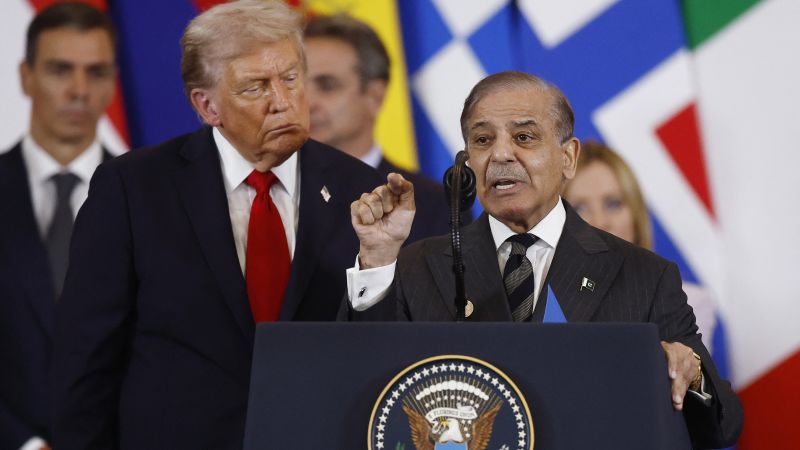
US President Donald Trump gave a shout-out to Pakistan’s top soldier, calling him his “favorite marshal” as he took a victory lap in front of world leaders after the Gaza ceasefire on Monday.
He then abandoned the podium to allow Pakistan’s civilian leader, Prime Minister Shehbaz Sharif, to praise Trump’s ceasefire efforts in front of cameras. Sharif announced on the same day that he would once again nominate Trump for the Nobel Peace Prize.
A year ago, such a scene would have been unthinkable.
The US government has long kept Pakistan at a distance due to the country’s chronic political instability and suspected ties to US-sanctioned Islamist terrorist organizations. The fact that it is one of China’s closest allies didn’t help either.
President Trump’s predecessor, Joe Biden, never called either of the two Pakistani prime ministers he served during his term. After the United States pulled out of Afghanistan in 2021 in turmoil, he infuriated neighboring Pakistan by calling it “one of the most dangerous countries in the world.”
But Trump 2.0 has shaken up the mixer of U.S. diplomacy, upended friendly relations and brought enemies into the fold of the presidency if he can offer them something.
And so far, Pakistan has given a master class on how to respond.
Its leaders are frequent guests of the White House and have been spared tongue-lashings against other heads of state. The Chinese military is awaiting new shipments of U.S.-made Raytheon missiles. And its diplomats have negotiated tariffs that are significantly smaller than those imposed on India, its neighbor and arch-rival.
It appears to have achieved this by promising preferential access to important rare earths not controlled by China and by wisely flattering President Trump.
So far, Pakistan’s diplomatic game has been met with cheers at home. India is also furious, as it continues to buy cheap crude oil from Russia, leaving it stranded in the cold and facing huge tariffs.

At the center of the increasingly close relationship is Pakistan’s powerful military chief, Field Marshal Asim Munir, who has long played an outsized role in the country’s chaotic politics, analysts said.
Munir, 57, the son of a schoolteacher, ran Pakistan’s powerful intelligence agency, ISI, before becoming top general in 2022. Insiders say he is a deliberately mysterious figure, a dark horse who meticulously controls his public persona.
But he was thrust into the spotlight in May when Pakistan engaged in a four-day conflict with India that killed dozens of soldiers and civilians, raising international alarm that the conflagration could spill over into a full-scale war between the nuclear-armed neighbors.
It didn’t take long for President Trump to intervene and call on both sides to cease fighting. When they did, he claimed credit for himself. This claim was quickly publicly supported by Pakistan, which subsequently nominated President Trump for the Nobel Peace Prize, making him the first country to win the Nobel Peace Prize during a president’s second term.
India, on the other hand, vehemently denied that the US president had any role in the gun silencing, insisting that the issue was only between India and Pakistan.
Pakistan claims to have shot down seven Indian Air Force planes during the conflict in May, a figure Trump has repeated many times in public. India has never confirmed the number and initially vociferously denied that any of its jets had been shot down.
A few days later, Munir, who had recently been promoted to field marshal for leading the crisis, went to Washington. It was the first time a Pakistani military commander visited a U.S. president at the White House without Pakistani civilian officials, where he had lunch with President Trump.
Shuja Nawaz, a Washington, D.C.-based author and political and strategic analyst, told CNN that Trump “likes winners.”
“He’s always said that… He doesn’t like losers. So he clearly saw Field Marshal Asim Munir as a winner who would make a quick decision… They must have been on the same page when Trump told him about the ceasefire.”

US recognition of Pakistan’s close ties with the Gulf and the Islamic world was on full display during President Trump’s speech at the Gaza summit on Monday.
“The current global moment is benefiting Pakistan,” said Michael Kugelman, senior fellow at the Asia Pacific Foundation.
Kugelman also noted the “pretty smooth relationship” between Islamabad and Iran, adding that for the Trump administration, Pakistan is a country that “could play a role… in terms of conveying the message from Washington to Iran.”
Pakistan has a history of helping the United States engage in difficult conversations. In 1971, he helped arrange Henry Kissinger’s secret trip from Islamabad to Beijing, which led to Washington normalizing relations with Mao Zedong’s communist China.
But analysts say Pakistan’s biggest card is access to rare earths not controlled by China, which are needed to power everything from iPhones to MRI machines to cutting-edge fighter jets and military weapons.
China has a near monopoly on the world’s supply of 17 mineral groups, particularly its processing and refining. This is an advantage that Beijing is increasingly keen to exploit as it continues talks with the United States over tariffs, technology and economic issues.
Pakistan has about $8 trillion in untapped mineral resources, according to the government, and is actively marketing itself as an important mineral hub, which is why it caught the attention of President Trump.
During a meeting in the Oval Office in September, a photo released by the White House showed General Munir proudly presenting President Trump with a wooden box gleaming with examples of minerals from Pakistan.
That same month, Missouri-based company US Strategic Metals announced it had received its first shipment of “enriched rare earth elements and critical minerals” from Missouri as part of a $500 million “partnership framework.” The company did not disclose the quantities in the batch, but said it contained antimony, which is often used as a flame retardant in plastics and alloying agents, copper concentrate and “rare earth elements including neodymium and praseodymium.”
Most of Pakistan’s rare earths are believed to be in Balochistan, which has long been rocked by separatist insurgency seeking greater political autonomy and economic development in the strategically important, mineral-rich region.
In August, the United States formally designated the Balochistan Liberation Army (BLA), one of the main separatist groups that Pakistan has long accused of being funded by India, as a terrorist organization.
The following month, the United States announced it had approved the sale of Raytheon Advance Medium-Range Air-to-Air Missiles (AMRAAM) to Pakistan.

Munir’s prominent role in deepening ties with the United States has led some to resurface concerns about the military’s influence on Pakistan’s political landscape.
Since independence in 1947, Pakistan has been led by four different military regimes and has seen three coups. Since the current constitution came into effect in 1973, no prime minister has served a full five-year term.
Munir’s critics say he has tightened control over the military and exerts significant influence over government decisions and even the Supreme Court.
An Amnesty International report last month said the country “continues to repress local rights activists and opposition politicians for dissent or criticism of the state, particularly the Pakistani military.”
The Pakistani side of the “partnership” signed by U.S. Strategic Metals of Missouri is the military-run Frontier Works Organization, which would ensure the military gets a share of the profits and influence if the partnership is successful.
“Our bilateral partnership is built on a foundation of common interests, including regional stability, security and economic cooperation,” Pakistan’s Foreign Ministry spokesperson told CNN when asked to comment on relations with the United States.
But analysts said there were limits to how far this severance could go.
Hussain Haqqani, former Pakistani ambassador to the US, said the relationship between the two countries will always be at the mercy of President Trump.
“President Trump is an unconventional president,” said Haqqani, now a scholar at the Hudson Institute in Washington, D.C., and the Anwar Gargash Academy of Diplomacy in Abu Dhabi.
“He now likes Pakistan because Pakistan likes him and has showered him with accolades, including a nomination for the Nobel Peace Prize.”
