

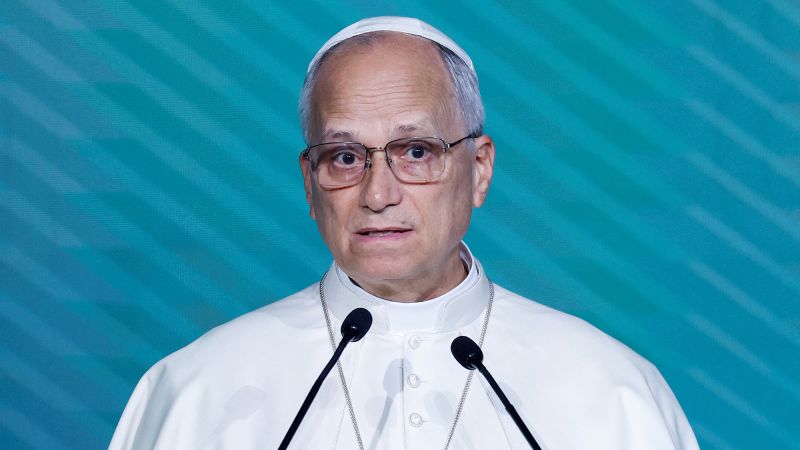
In a scathing report released Thursday, the Vatican’s Commission for the Protection of Children said Catholic Church leaders’ mishandling of allegations of sexual abuse by clergymen was causing “continued harm” to victims.
The report also accused Italy and some regions of Africa of failing to take strong anti-abuse measures.
The Pontifical Commission for the Protection of Minors, which published its second annual report on October 16, called on the Vatican to increase transparency and noted with “concern” that survivors often perceived the church’s central administration as “lacking sensitivity.”
The report, the first to be released since the election of Pope Leo His predecessor, Pope Francis, took some important steps to address the abuse crisis, but experts and survivors say he could have gone further.
“We must re-emphasize that the Church’s decades-long pattern of mishandling of reports, including abandoning, ignoring, shaming, blaming and stigmatizing victims and survivors, perpetuates trauma as ongoing harm,” the report states.
Instead, the report calls on the church to provide “reparations” for the harm caused by abuse, including psychological and financial support, respectful listening to survivors, public and private apologies, and reform in the way it responds to abuse.
It includes scathing statements from survivors who describe “denials and dismissals” from church authorities and even “disturbing accounts of retaliation” by bishops and other leaders when victims came forward. Survivors also spoke of the “lack of psychological care” for those affected and the church’s “strong resistance to upholding reforms” at the grassroots level. A “lack of accountability” from hierarchical structures was frequently cited as a problem.
“Authorities within the church who perpetrate or enable abuse likely consider themselves too essential and important to be held accountable, and the church’s response to abuse must avoid repeating the same mistakes,” the report said.
Regarding accountability, the commission called on the Vatican to start communicating the reasons for the resignation or removal of bishops when they relate to “cases of abuse or negligence.” Under current practice, the Vatican simply announces when a bishop resigns, without providing further details.
The commission is led by French Archbishop Thibault Verny and includes a number of church leaders and experts, including Maud de Bourg-Bucicchio, a Dutch lawyer and former United Nations special rapporteur on child trafficking and sexual exploitation who led the report’s compilation.
The 200-page document provides an assessment of how churches around the world deal with abuse, including on the doorstep of the Pope in Italy. Catholic groups and victims have long argued that Italy’s Catholic Church has not yet confronted the abuse scandal and that it should be referred to an independent body.
Speaking at a Vatican press conference to announce the report, de Boer-Bucicchio thanked the media for “lifting up the voices of victims and survivors when the institutional church did not listen.” She emphasized that victims and survivors have repeatedly said they want to feel heard and acknowledged for their experiences.
The commission’s secretary, Bishop Luis Manuel Ali Herrera, said that although Pope Leo had an “analytical” style, he had the same “strong determination” to fight abuse as his predecessor. The Colombian prelate also acknowledged calls for the church to address abuse sooner.
In its report, the Pontifical Commission highlights the failures of the Italian Church. While the report cited “significant progress” in child protection, it warned that “substantial cultural resistance in Italy to addressing abuse” remains. The church said it “regrets” that a significant portion of the church’s leadership has not even met with the Vatican Abuse Commission and that some dioceses have failed to provide the commission with information about their protection efforts.
The Italian Bishops’ Conference said the abuse commission’s report contained “partial data” and claimed there were protective services in “all regions and dioceses of Italy.”
“The report does not account for all these efforts,” the Bishops’ Conference said in a statement.
Meanwhile, procedures to deal with abuse were frequently found to be severely lacking in Africa, the committee said. The report said it found “no mention of procedures for receiving complaints” in Equatorial Guinea, and cited leaders’ “reluctance” to take “direct responsibility” for abuses in Ethiopia. The Kenyan bishops added: “Cultural taboos make reporting extremely difficult for victims and survivors.”
The commission also called on the Vatican’s Evangelization Office, which is in charge of the church in developing countries, to invest more in developing anti-abuse policies, saying it “lack sufficient resources” when it comes to vetting the protection records of bishop candidates.
The Pontifical Commission for the Protection of Minors was established by Pope Francis in 2014, and in 2022 the pope asked it to produce an annual report on how the church deals with abuse and protection. The first report was published last year.
Since his election on May 8, Pope Leo XIV has said: “There is an urgent need to instill throughout the Church a culture of prevention that does not tolerate abuse in any form,” while praising journalists who uncovered abuse scandals.
This story has been updated with additional developments.
