

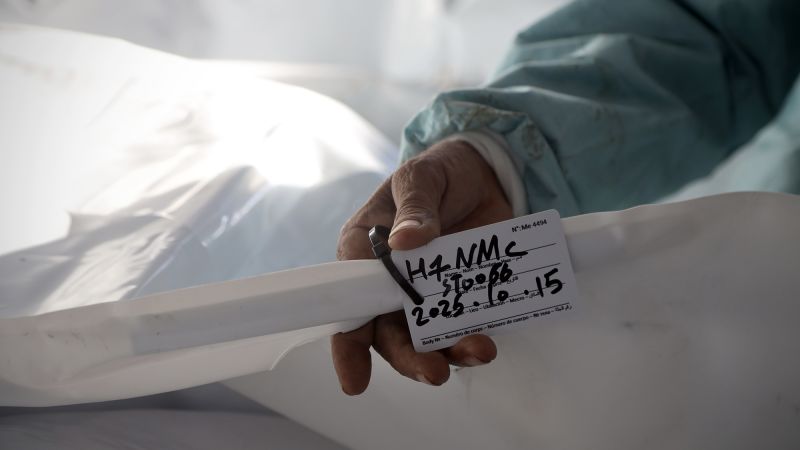
Palestinian forensic experts are working to identify 120 bodies returned to Gaza from Israel, some of which are marked only by number and some blindfolded, their hands and feet bound, and some with gunshot wounds.
Under a ceasefire agreement reached with Hamas last week, Israel agreed to transfer the bodies of 360 people it calls “Gaza terrorists” to the enclave. Israel has not provided information about their identities or how they died.
It is unclear whether the 120 bodies returned this week died in Israeli custody in Gaza during the war, or were killed in Israel after taking part in the October 7, 2023, terrorist attack.
CNN has reached out to the Israeli Prime Minister’s Office, Ministry of Health, Ministry of Foreign Affairs, Ministry of Justice, and Israeli Prisons for comment, but has not received a response.
Of the 120 bodies, only a handful have been identified so far. The two were publicized on social media by their families as having taken part in the October 7 attack on Israel in which thousands of Palestinians breached the border fence.
Many of them were extremists, killing 1,200 people and kidnapping 251 others, mostly civilians, in communities across southern Israel. Others were ordinary Gazans who crossed into Israel but did not take part in the attack.
The unidentified body was handed over from Israel to the International Committee of the Red Cross (ICRC) and then to the Nasser Medical Complex in Khan Younis, Gaza Strip, where forensic experts began examining it.
A Gaza health ministry official told CNN that each body had documentation showing that at some point they had been detained at the military base Sde Teyman in the Negev desert, where DNA tests were conducted.
The base is used as a detention center by Israel, and numerous incidents of mistreatment of Palestinian detainees were reported during the Gaza War.
After the October 7 attack, Israeli first responders were overwhelmed by the number of bodies found at multiple attack sites.
At the time, members of Israel’s volunteer search and rescue organization ZAKA, which was called in to retrieve bodies near the Israel-Gaza border, told CNN that the victims were taken to the Shura army base, and the attacker’s bodies were stored at another base in the Negev desert.
Doctors from the Forensic Department of Nasser Hospital in Gaza explained to CNN the circumstances in which the bodies handed over this week were found, saying they showed “signs of abuse and torture.”
“Each martyr has been given a number and all have their hands and feet bound. Some are blindfolded and there are marks of gunshot wounds,” the doctors said.
Ministry of Health officials said the body had broken bones and appeared to have been “crushed by a large vehicle.”
CNN has seen photos that include close-up shots of some of the bodies. Zip ties, blindfolds, and gunshot wounds are clearly visible in some. Most of the bodies appear to be those of young men, and those who were found appeared to be wearing civilian clothes. Some of the bodies had dirt on them. One still has what looks like an IV cannula in his arm.
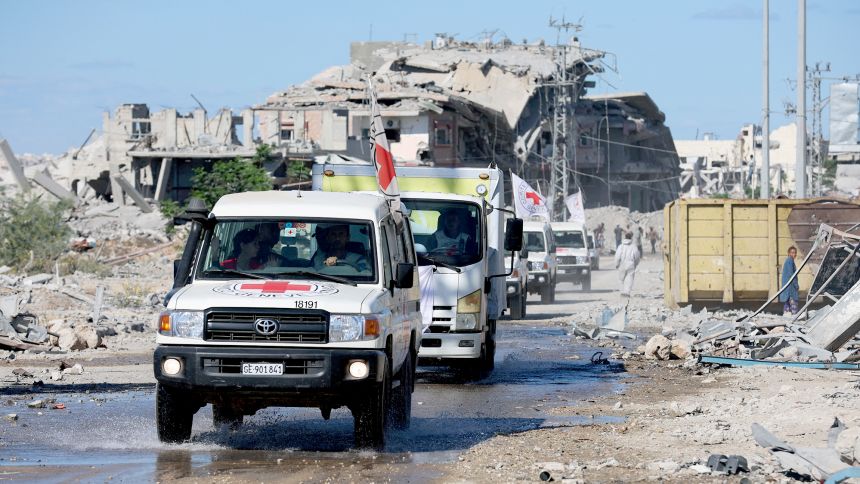
A Ministry of Health official told CNN that some of the bodies appeared to have been exhumed after burial.
Dr. Lawrence Owens, an independent forensic pathologist who examined a photo of one of the bodies, said the person in the photo was almost certainly restrained and blindfolded before death, noting that fingertips appeared to be missing.
Owens, a researcher at the University of Winchester, said there were marks on the car that appeared to be track marks, but the damage was not as bad as would be expected in a large vehicle that had overturned. However, he said there is a possibility that the body was buried when the car was run over.
Another expert who examined the same photo said the deceased was bound and the blindfold was likely done before he died, but the footprints appeared to have been made after death.
The Ministry of Health has set up a website with images of the bodies in the hope that family and friends will be able to identify them. Many of the photos are extremely graphic, showing details of wounds and partially decomposed bodies.
The ministry said some of the bodies have already been identified through its website.
Rasmiya Mohammed Khairi Khdei, who lives in the southern Gaza town of Khuza, is among those looking for information about her family.
In an interview with CNN at the Nasser medical complex in Khan Younis on Wednesday, she said six of her sons were killed during the war, one was taken prisoner by Israel, and one has been missing since the day Hamas and its allies in Gaza launched an attack on Israel.
Kudei said she did not know if her son, who went missing on October 7, was alive or dead. She said he did not take part in the attack, but went to Israel to see what was happening when the fence was breached.
“I heard the news that they had brought in a prisoner’s body, so I ran (to the hospital) to see if he was among them,” she told CNN. “Every time a prisoner’s body is brought in, I come here and search among them. Yesterday we searched over 30 bodies.”
The Palestinian Center for Missing and Enforced Disappeared Persons (PCMFD) said in a statement on Tuesday that Israel’s omission from the official list of the dead “raises suspicions and strengthens suspicions about the practice of enforced disappearances and falsification of victim files.”
“We emphasize the need to provide complete information about the bodies to be handed over, to publish all available information on arrival, including the names of the victims and details of the circumstances of death, and to notify families immediately, respecting their right to know and human dignity,” it said in a statement.
It is unclear how many more Palestinian bodies Israel is holding. An Israeli official familiar with the matter told CNN last month that the bodies of Hamas leader Yahya Sinwar, believed to be one of the masterminds of the October 7 attack, and his brother Mohammed will not be returned to Gaza.
