

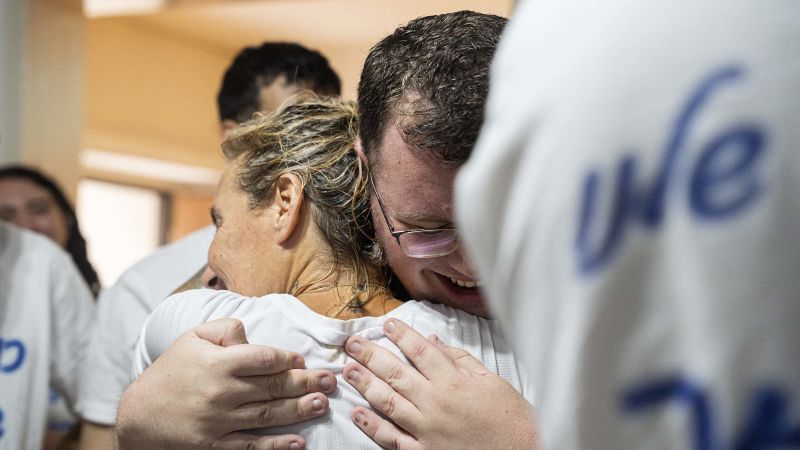
Kiryat Gat, Israel
—
Two years ago, few Israelis could point out Nir Oz on a map.
It is now synonymous with October 7, 2023.
Just 3 kilometers (1.9 miles) from the Gaza border, this small agricultural kibbutz was home to around 400 people who lived peacefully in quiet tree-lined streets before the war.
That all changed in the first hours of the terrorist attack. At that time, the kibbutz was nearly reduced to ashes, and more than a quarter of its inhabitants (including young children, elderly people, and entire families) were killed or kidnapped.
That day, many members of their community were kidnapped by Hamas and its affiliates and held captive in Gaza. Nine of the members remained there for 737 days.
Those who lived here before the war have not yet returned. On Monday, local residents gathered in the city of Kiryat Ghat, a temporary residence in the region, hoping for the return of their loved ones and waiting for the remaining hostages to return to Israel as part of a cease-fire agreement.
For them, the U.S.-brokered deal marks the end of a living nightmare and allows the community to begin the process of healing and rebuilding.
Early Monday morning inside the community hall, Rita Lifshitz diligently prepared refreshments for the gathering. Yocheved Lifshitz was taken hostage on October 7th. Yocheved Lifshitz was returned after 17 days in captivity, but her husband Oded was killed and his body was brought back in February as part of a final deal to release hostages and prisoners.
She pointed proudly to an array of wine bottles on the table. I can happily drink it now. Like many Israelis, she turned to the bracelet she wears on her right wrist to support hostages. “I hope everyone comes back so we can eventually remove it,” she said.
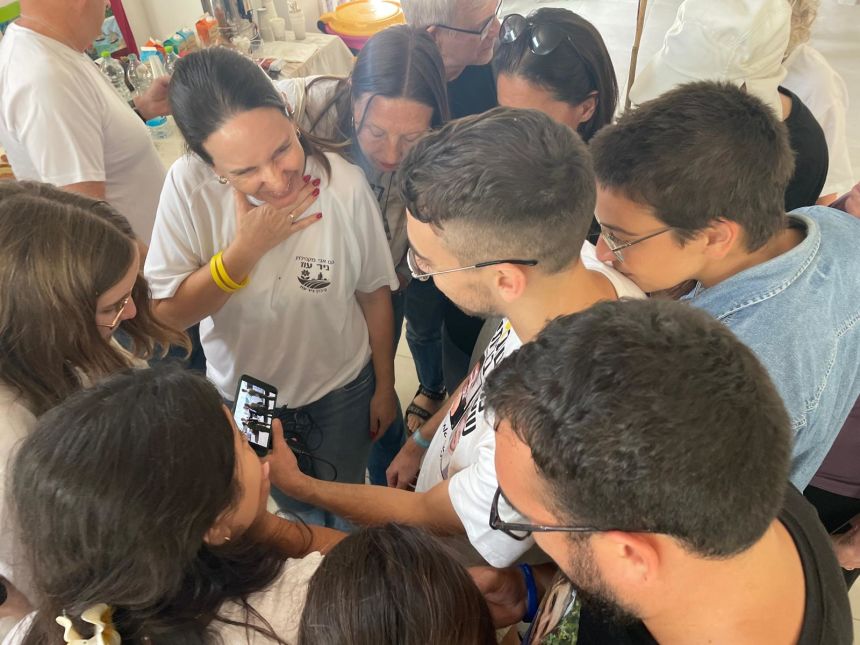
In the center of the room was a large screen showing the day’s events, and the people of the kibbutz stood at attention as they searched for the faces of the four living hostages from the community who were to be released: Matan Zangaukar, Ariel, David Kunio, and Eitan Horn.
A few hours later, Rita suddenly raised her arm and excitedly announced that she had the first photo of her two sons that Sylvia Cunio had shared with her. “I’m here,” she shouted as the first group of hostages was freed by Hamas.
The audience was surrounded by cheers and tears.
“I’m so glad they’re back,” Dalit Ram Aharon said, standing next to a box of freshly printed T-shirts made for the occasion and decorated with pictures of returnees. She took off her shirt demanding the release of the hostages and put on a new one.
“There were moments where we couldn’t believe it was going to happen. We couldn’t focus on anything else while they were still there,” she said.
“Soon we will be able to put aside our conflicts.”
However, the atmosphere changed as the group began preparing to free the second group of hostages. The news was no longer just about hostages.
The arrival of U.S. President Donald Trump interrupted television coverage in a way they hadn’t expected.
It may have been the shortest visit ever by a sitting U.S. president, but while he was there, President Trump dominated news coverage and took over the story of the day in a way only he can. Trump has made it clear that he was responsible for ending the longest war in Israel’s history, and his country watched his every move for several hours while he was on the ground.
As President Trump’s motorcade made its way from Ben-Gurion Airport to the Knesset in Jerusalem, the broadcast gradually evolved to split-screen.
Audiences clamored for more footage of the hostages, desperate for even a fleeting glimpse of their loved ones. But those images suddenly disappeared from news broadcasts, and instead were shown a motorcade carrying President Trump on an Israeli highway.
The sudden change caused confusion in Kiryat Ghat, with the crowd wanting to see more of the long-awaited reunion than the unfolding political spectacle.
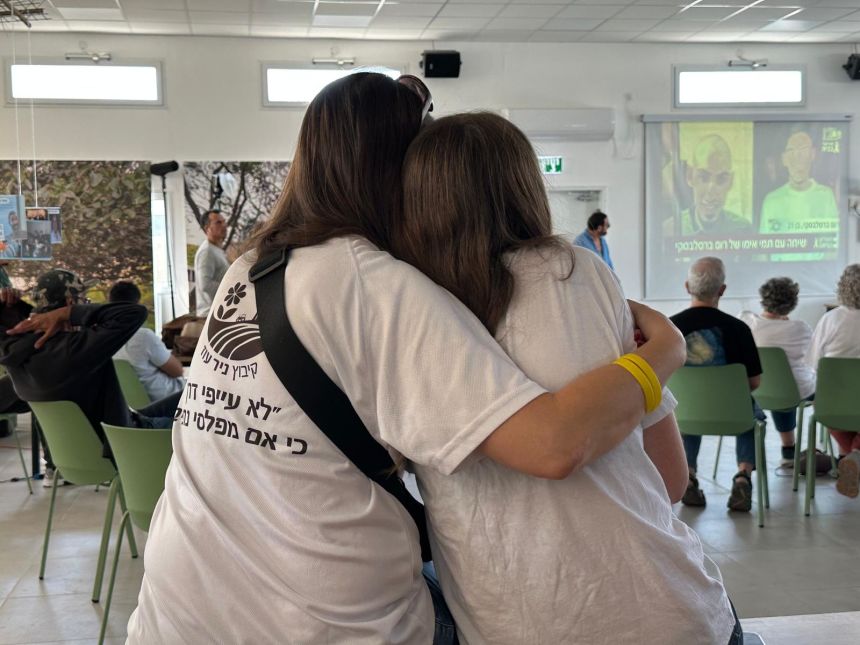
“There are so many things happening at the same time,” said Shlomo Margalit, a veteran kibbutz member.
“I feel like saying, wait a minute, it’s not over yet. My family isn’t home yet.”
Another kibbutz member approached a local TV correspondent and urged him not to stop showing footage of the returned hostages even after high-level speeches in parliament began.
President Trump, speaking to a cheering crowd of members of Congress, said that in Israel’s halls of political power, “a new historic dawn for the Middle East” had begun. President Trump declared the end of a painful chapter for Israelis and Palestinians, even though the ceasefire agreement lacks key details on next steps.
Israeli Prime Minister Benjamin Netanyahu praised the US president as “the best friend Israel has ever had in the White House.”
“You were strong when others were weak. You were bold when others were afraid. You stood by us when others abandoned us,” Netanyahu said.
President Trump responded by calling him a courageous leader and crediting him with what he defined as Israel’s victory.
“Israel, with our support, has won as much as it can by force of arms. You have won. I mean, you have won,” he said.
The American president was in his element, often deviating from his prepared remarks during an hour-long speech before a crowd that applauded happily at every stop. In one stunning moment, President Trump turned to Israeli President Isaac Herzog and asked for a pardon for Prime Minister Benjamin Netanyahu, who is facing a lengthy corruption trial on charges of bribery, fraud and breach of trust.
Mr. Trump, who is no expert on legal issues himself, scoffed at the altercation, saying, “Who cares about cigars and champagne?”
Prime Minister Netanyahu watched with a smile. At that moment, President Trump had the entire nation’s attention, and Prime Minister Netanyahu was happy to follow Trump’s lead.
President Trump also touched on his future thoughts on the region, although he did not provide specific details.
He expressed “firm hopes and dreams” that the Abraham Accords, which normalized Israel’s relations with the United Arab Emirates, Bahrain and Morocco during the Trump administration’s first term, would be expanded and “work out exactly as we expected.”
Trump’s dream of peace between Israel and Iran, which waged a 12-day war in June, was little more than a diplomatic fantasy.
“Wouldn’t that be a good thing?” Trump said as Netanyahu hesitantly responded with a laugh.
But Trump dodged pressing questions about what Gaza would look like after the war and how an international security force would be formed. This was a moment for Trump, and he wasn’t going to let it distract him from winning.
Trump sought to continue the diplomatic festivities by luring Netanyahu to accompany him to a glitzy summit in Sharm el-Sheikh, Egypt, to discuss the future of Gaza with world dignitaries, including Palestinian Authority President Mahmoud Abbas.
Israeli leaders initially accepted the invitation, but withdrew it two hours later. The official reason is that it is close to a Jewish holiday. But officials said Netanyahu did not want to risk being photographed with Abbas, whom he has long attacked and sought to undermine behind closed doors.
Despite this minor diplomatic failure, Trump and Netanyahu remained unfazed. They were thrust into the spotlight of history.
Back in Kiryat Ghat, disgruntled members of Nir Oz’s community wait for the interview to return to their own historical moment — the reason they came together in the first place. Although they rejoiced at the end of the war and the return of the hostages, they mourned the dead hostages who had not yet returned home. After two years of war, Israel needed to not only celebrate its future, but also begin to heal from its past.
“I came here to feel a little bit of a sense of belonging,” Amir Al-Fassa said. “This day fills the soul. When you finally see this, even if it’s too late, it brings solace and incredible energy.”
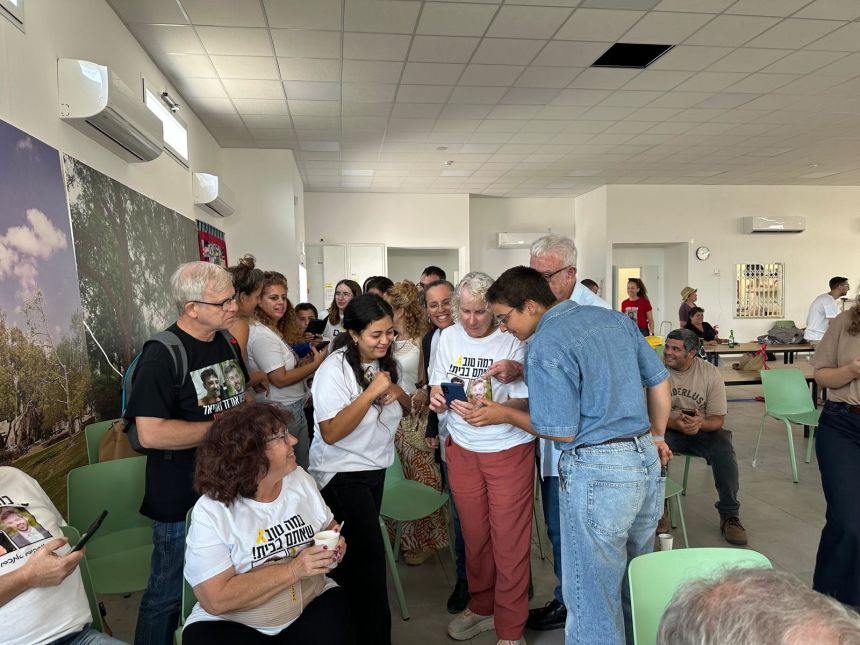
Eventually, the Nir Oz community turned its attention to mobile devices. Within minutes, close friends and family could be seen crying around a phone as the remaining hostages, many of them from the community, regained their freedom.
As interviews continued, the news that only four of the 28 dead hostages would be returned remained a sore point. Five of them were still within the enclave. Even after two years of war, closure is still not for everyone.
