

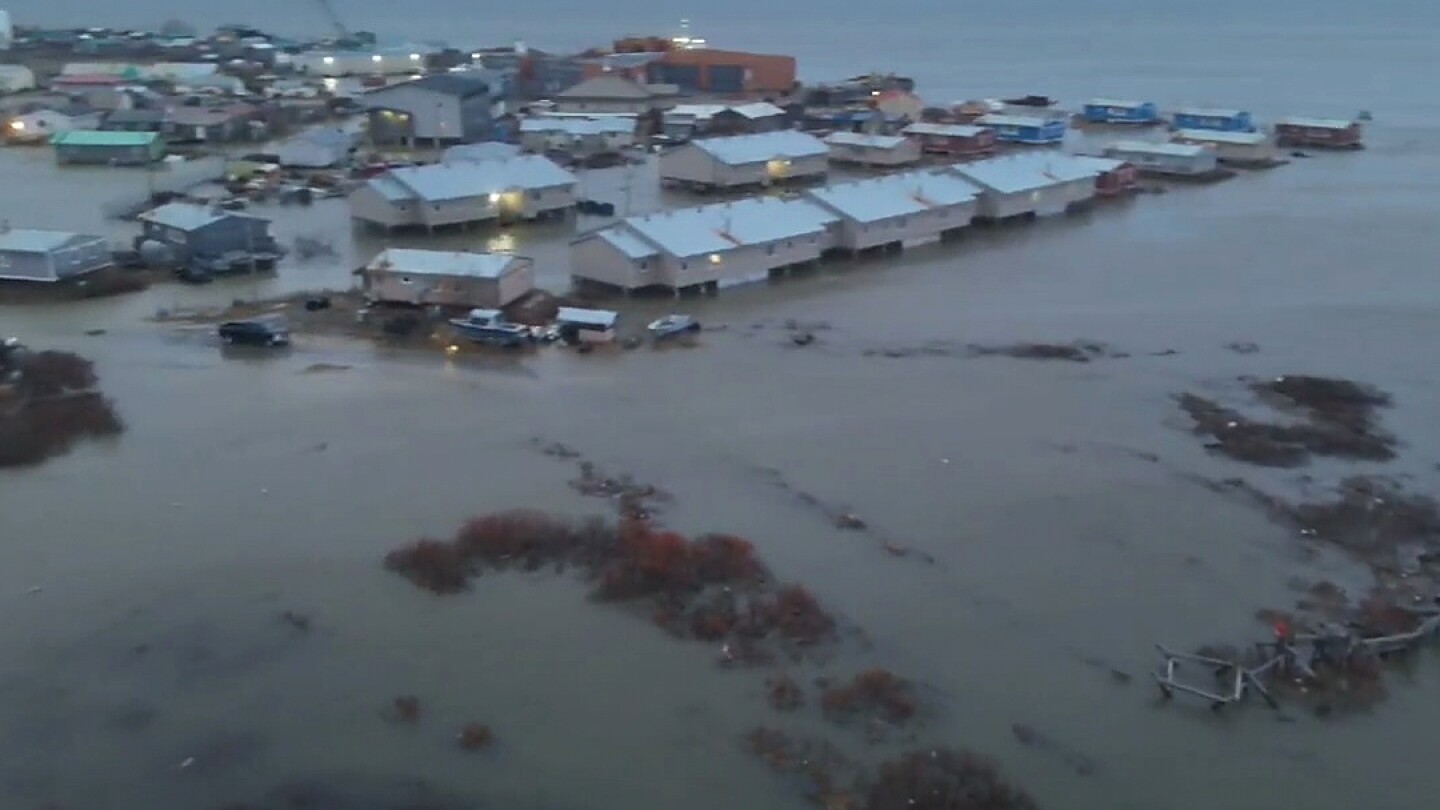
JUNEAU, Alaska (AP) – Alaska authorities on Tuesday rushed to evacuate and find housing for people in a small coastal village destroyed by a major disaster. Remnants of typhoon Halong. But the remote location and severe damage limit their options to combat another impending storm and the onset of winter.
High winds and storm surge devastated isolated, low-lying Alaska Native communities along the Yukon-Kuskokwim Delta in southwest Alaska, about 500 miles from Anchorage, over the weekend. Coast Guard storms the structure and takes 24 people from their homes floating in the sea Officials said three people were missing or died in the high waters and hundreds were evacuated to school evacuation centers, including some without access to toilets.
The system was installed following a storm that hit parts of western Alaska several days ago.
More than 1,300 people were evacuated across the region. Dozens of people have been flown to a shelter set up at the National Guard Armory in Bethel, a regional hub of 6,000 people, and officials are considering flying evacuees to long-term shelters and emergency housing in Fairbanks and Anchorage, where room is running out.
Fuel depots intended to support communities in the area were clearly damaged and threatened with contamination that could harm the fish and game that Alaska Natives depend on for their livelihood. Some people in the area may have lost freezers full of salmon, elk and other food to survive the winter.
The worst-affected communities include Kipunuk, population 715, and Kwigilingok, population 380. These areas are off the state’s highway system and can only be reached by water or air at this time of year.
“It’s a catastrophic situation in Kipnuk. Let’s not paint a better picture,” Mark Roberts, incident commander for the state Division of Emergency Management, said at a news conference Tuesday. “We’re doing everything we can to continue to support that community, but this is about as bad as you can imagine.”
Among those waiting to be evacuated to Bethel on Tuesday was Kipnuk resident Blair Paul, who said in a text message that she saw about 20 houses floating in the moonlight Saturday night.
“Some homes flashed their cell phone lights at us as if asking for help, but we couldn’t even do anything,” she wrote.
The next morning, she recorded a video of the house, which was submerged near the roof line, flowing past her home.
Paul and her neighbors held a long meeting Monday night in a local school gymnasium, singing songs of praise and trying to figure out what to do next, she said. Neither she nor most of the others know where they will end up.
“It is with a heavy heart that we say goodbye to our community members, not knowing when we will see them again,” she said.
The school was the only facility in Kwigilingok that was at full power, with staff working to repair toilets. According to the Emergency Management Agency, a preliminary investigation shows that all the homes in the village were damaged in the storm, and about 30 were washed off their foundations.
Power systems were flooded in Napakiak, and severe erosion was reported in Toksuk Bay. Authorities sent in the National Guard to assist with the emergency response, and crews took advantage of the break in the weather to try to fly out with food, water, generators and communications equipment.
Officials warned of the long road to recovery and the need for continued support for the hardest-hit communities as winter looms.
Rick Thoman, an Alaska climate expert at the University of Alaska Fairbanks, said even if supplies could be brought in quickly, it would be too late this year to rebuild.
“Alaska Native communities are resilient,” Thoman said. “But, as you know, there is only so much an individual or a small community can do when you have an entire community where virtually every home is damaged and many of them are rendered uninhabitable because winter comes knocking on the door.”
__
Johnson and Attanasio reported from Seattle.
