

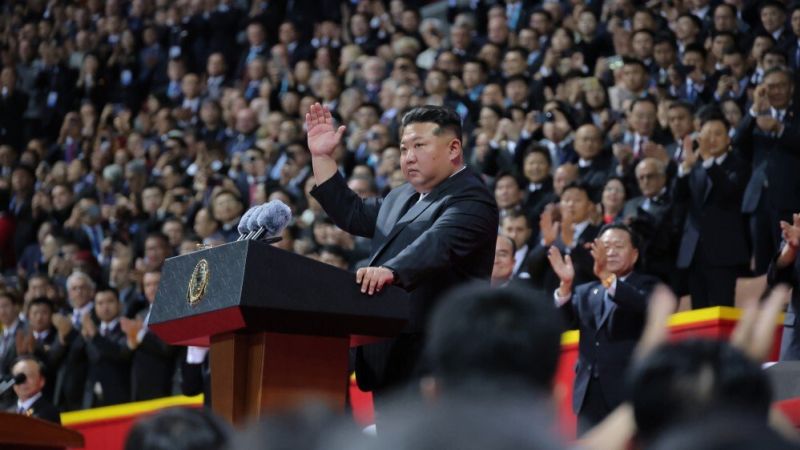
All signs suggest that North Korean leader Kim Jong Un will roll out the red carpet for a crowd of foreign dignitaries, perform colorful spectacle and dance, and also show off his country’s latest military equipment in a glitzy parade.
North Korea has kept its plans for celebrating the 80th anniversary of the Workers’ Party of Korea a closely guarded secret, just as the secretive and isolated state has set important dates in the past.
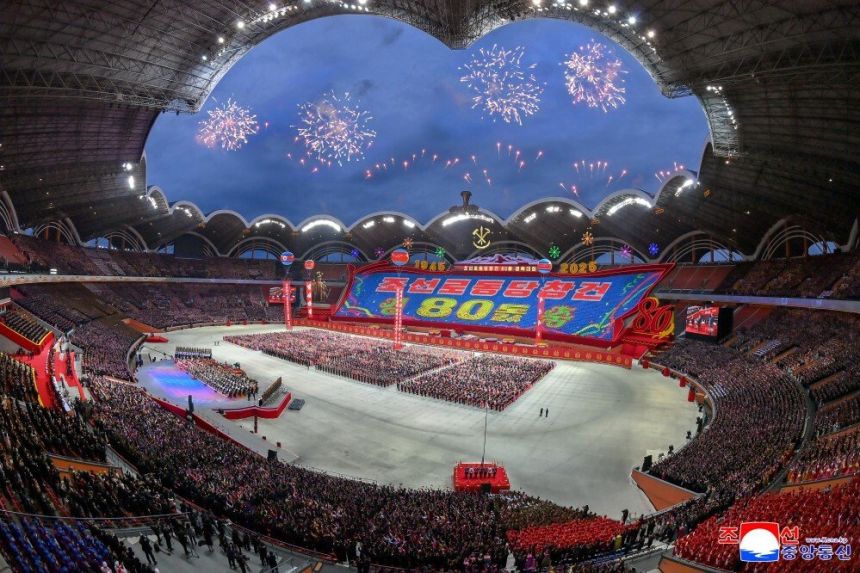
Images released by North Korean state media showed a large celebration at Pyongyang’s giant May Stadium on Thursday, but South Korea’s military predicts the main event could be a parade attended by tens of thousands of people in the capital Pyongyang on Friday night.
The commemoration comes a month after Kim, who is under severe sanctions, scored a major diplomatic victory when he visited Beijing to attend China’s massive military parade. There, Kim had a rare opportunity to stand alongside political heavyweights on the world stage, including Chinese leader Xi Jinping and Russian President Vladimir Putin.
Kim ended his visit with a deeper strategic relationship and renewed friendship with China, North Korea’s long-time political and economic patron, and a growing desire to advance its missile and nuclear weapons programs.
North Korea and new military ally Russia have repeatedly affirmed close ties since signing a mutual defense pact last year, with Kim sending thousands of troops, missiles and ammunition to support Russia’s war in Ukraine.
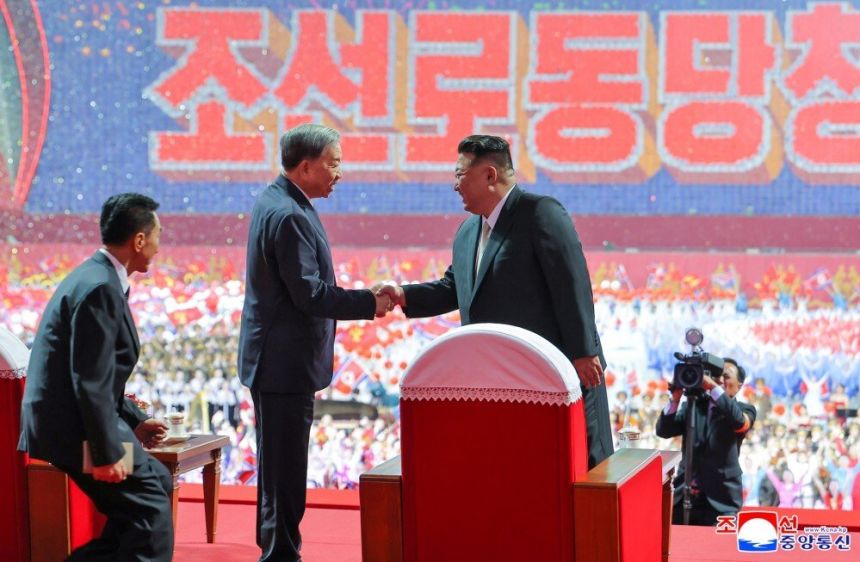
To demonstrate the continuation of these good relations, China and Russia sent a delegation led by number two, among others, to a celebratory event in Pyongyang.
Chinese Premier Li Qiang, former Russian President Dmitry Medvedev and Vietnam Communist Party Chairman Lam Lin took front-row seats as Kim kicked off the celebrations Thursday with mass games and artistic performances.
Along with enthusiastic flag-waving, North Korea performed a medley of traditional and patriotic songs and a harmonious dance attended by thousands of people, including well-dressed children. An impressive display of martial arts featuring soldiers smashing cinder blocks over their bare bellies culminated in a huge display of fireworks and pyrotechnics.
“Today, our people stand before the world as a powerful entity that knows neither insurmountable difficulties nor unachievable causes,” Kim said in his speech, according to North Korea’s state-run Korean Central News Agency.
Kim told an audience of tens of thousands of people that North Korea had responded to the “growing threat of nuclear war posed by U.S. imperialism” by simultaneously developing its “nuclear forces” and “economic construction.”
“Our party and government continue to respond to the hostile country’s intense political and military pressure moves by pursuing hard-line policies, adhering to firm principles, and taking courageous and unflinching countermeasures,” Kim said, according to KCNA.
Large-scale, carefully choreographed propaganda displays involving large audiences and carefully rehearsed performances have long been a hallmark of the North Korean regime, especially around important anniversaries.
The Workers’ Party of Korea is North Korea’s only ruling party, blending communism with the words, maxims and ideals of the Kim dynasty, which imposed authoritarian rule on the country for three generations.
North Korea’s military parades have traditionally been used to showcase the latest developments in advanced weapons and missiles that could, in theory, threaten the United States. Military observers pay close attention to what North Korea plans to showcase at these events.
Analysts have pointed to the possibility that North Korea’s next-generation intercontinental ballistic missile (ICBM), the Hwasong-20, a new hypersonic glide vehicle, the Hwasong-11 Horse, and other advanced weapon systems will be on display.
Col. Lee Sung-jun, a spokesman for South Korea’s Joint Chiefs of Staff (JCS), said last week that the military had detected movement of vehicles and military equipment ahead of a scheduled parade.
Last month, Kim observed the testing of a new high-thrust solid-fuel rocket engine for the latest intercontinental ballistic missile, the Hwasong-20.
Experts say solid-fuel rockets are more stable than liquid-fueled missiles, can be moved more easily to avoid detection before launch, and can begin firing within minutes.
Kim attended an exhibition over the weekend showcasing some of the country’s latest weapons, including a short-range ballistic missile (SRBM) with hypersonic warhead capabilities, dubbed the Hwasong-11Ma, according to photos published by the Korean Central News Agency.
The Hwasong-11 series, North Korea’s variant of Russia’s Iskander missile, has an estimated maximum range of about 800 kilometers (497 miles).
Hong Min, a senior researcher at the Korea Institute for National Unification in Seoul, said North Korea could also unveil advanced weapons during the parade, including AI-powered systems and various unmanned vehicles.
“The weapons displayed at the parade will probably be on an unprecedented scale,” Hong said. “Rather than simply focusing on large numbers, North Korea appears to be prioritizing revealing systems that are capable of impact.”
However, Hong added that it is uncertain whether the highly anticipated Hwasong-20 will be unveiled as full launch tests have not yet been conducted.
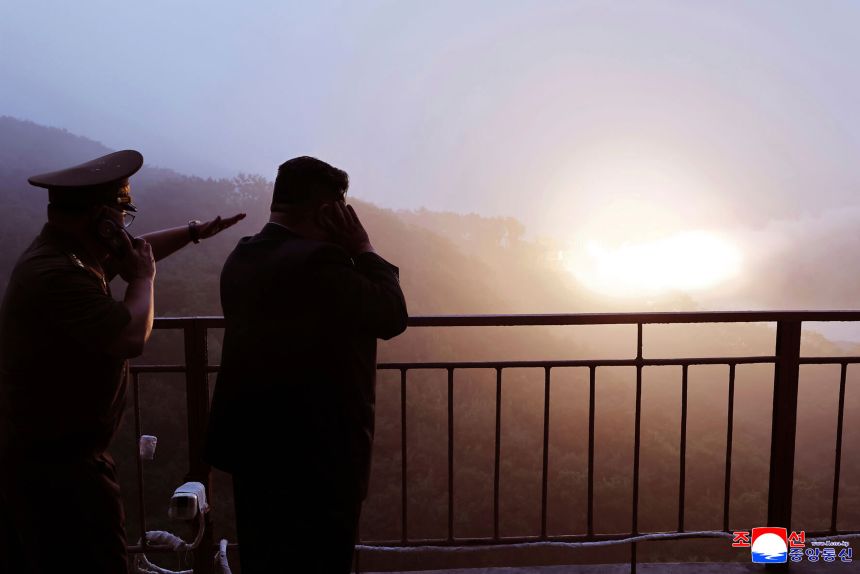
Observers are looking at the possibility of test firings of new next-generation weapons around the October celebrations, Hong added.
Kim’s illegal nuclear weapons program has turned North Korea into the world’s most heavily sanctioned nation.
In the past few years, the country has sought to strengthen its nuclear capabilities, including ramping up its weapons program and building secret missile bases near its northern border with China, which could pose a “potential nuclear threat” to much of East Asia and the United States.
secrecy and security
Secrecy is essential at North Korean parades, especially when Kim is present.
Exactly 10 years ago, CNN correspondent Will Ripley attended the 70th anniversary of the ruling Labor Party.
“No one seemed to know when it was actually going to start, not even the government monitors. That’s how things work in North Korea. You end up waiting hours and hours until someone finally tells you to move,” he said.
Foreigners were quarantined at the Yanggakdo Hotel, located on an island in the middle reaches of the Taedong River in Pyongyang.
“This location is no coincidence. The island makes it easier for the authorities to control access, so guests like us can’t wander around the city alone. When we look out the window, we can see Pyongyang in all directions, and it can be like a different world,” Ripley said.
When journalists were finally assembled at the parade ground, they passed through multiple layers of security checks. I had to leave my phone and laptop behind.
“When the parade began, tens of thousands of people filled the vast plaza,” Ripley said. “The columns of soldiers marched in perfect gait, their shoes hitting the pavement with a sharp, rhythmic thud. This was the famous goose step.”
North Korea has a long history of relations with the United States and South Korea, but relations are currently particularly strained, with Mr. Kim frequently criticizing both countries.
The North Korean leader said over the weekend that he had allocated “special assets to key targets that we are concerned about” and pledged to take additional military measures to respond to the United States’ expansion of military assets in South Korea.
“…As the U.S. military builds up in (South Korea), our strategic concerns for the region are also increasing,” Kim said. “I think adversaries need to be concerned about which direction their security environment is going to go.”
Lim Eul-cheol, a professor at South Korea’s Kyungnam University who specializes in North Korea studies, said “special assets” are likely to refer to “advanced strategic weapons systems, including tactical nuclear weapons and their delivery platforms, hypersonic missiles, and potentially AI-based drones and cyber capabilities.”
Kim’s speech, which referred to South Korea’s security and criticized the “buildup” of the US military, suggested that “these weapons are aimed at directly threatening South Korean and US assets in the region,” Lim said.
He viewed Kim’s comments as “a clear warning that US military bases and major facilities in South Korea could become potential targets for North Korean attack.”
But in contrast to his usual anti-American rhetoric, Kim recently said he had “good memories” of President Donald Trump and said there was no reason to avoid dialogue with the United States if it stopped insisting it abandon its nuclear weapons.
South Korea is scheduled to host a major summit of regional leaders later this month, and Trump is expected to attend.
The Asia-Pacific Economic Cooperation (APEC) is seen as an important opportunity for President Trump to meet with Chinese President Xi Jinping.
But his presence in the region could bring him closer to Kim again, six years after talks with North Korea broke down during the previous Trump administration.
Mr. Trump expressed his desire to meet with Mr. Kim last month, but some believe that such a meeting is unlikely.
President Trump insisted, “I’m going to do that. And we’re going to have a conversation. He wants to meet with me.” “We are looking forward to meeting him and looking forward to continuing our relationship.”
