

When Amanda Ralton picked up a cheap coloring book and felt-tip pens, she didn’t expect the project to last long.
It happened when she was in the midst of a health crisis. Eighteen months ago, she contracted an infection that required two emergency surgeries and a number of subsequent hospitalizations.
“My mental health has completely collapsed,” said Ralton, 28, from Liverpool, England. “Now that I can no longer do the hobbies I once enjoyed, the time to sit and be present with something that doesn’t force me or cause me harm has been really helpful. Just five minutes away from everything.”
Coloring has become a daily routine for Ralton. She started posting videos of her sessions on the TikTok account @gremlinsafari and discovered ColorTok, a growing community of adult colorers on TikTok.
On her account, she shares “color with me” videos (quiet, cozy clips of people filling out pages), as well as updates on her recovery, coping strategies, and the coloring tools she’s testing.
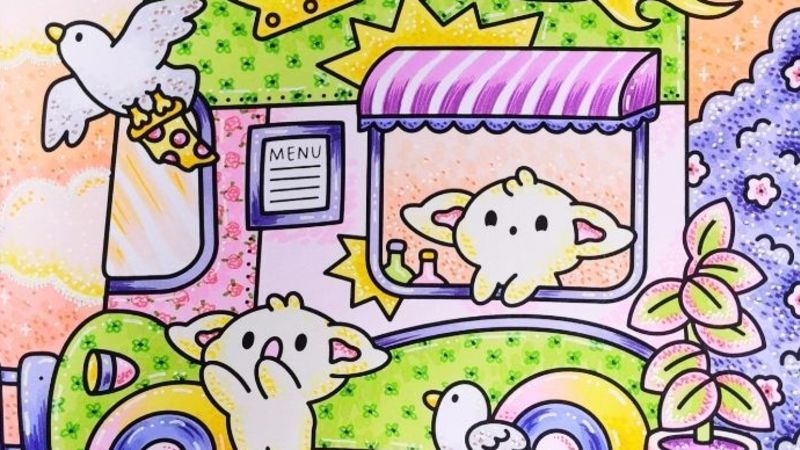
Much of what fills her feed is what TikTok users call “cozy coloring,” pages with bold outlines and soft themes, designed for slow, low-pressure nights. This is the same bold, easy style that currently dominates ColorTok.
Coloring books for adults are not a new phenomenon. As historian Catherine Ott points out in Public Domain Review, early “paintbooks” were sold to adults in the late 18th century and were often framed as educational or moral tools.
Satirical adult coloring books first appeared in the 1960s, but adult coloring books really took off around 2015, when the intricate illustrations in Joanna Basford’s books The Secret Garden and The Enchanted Forest caused a sensation. According to Nielsen BookScan data from the 2015 US Book Industry Year Review, sales of adult coloring books in the United States jumped from about 1 million copies to more than 12 million copies that year.
They seem to be making good progress. According to a report by TechSci Research, the global adult coloring book market was worth $151 million in 2024 and is projected to reach $320 million by 2030.
But these days, the “cozy coloring” aesthetic is dominating the adult coloring charts. This is a simple line drawing with large shapes intended for quick, relaxing coloring. Coco Wyo, a leading publisher that tops bestseller lists, sells the Bold & Easy series for adults. Among Amazon’s October 2025 bestsellers, nearly half of the top adult coloring books emphasized a “bold and easy” style, a style that emphasizes accessibility over complexity, aimed at soothing tired minds.
The London-based independent illustrator, who posts on TikTok under the alias Miss Kitsch and didn’t want her real name used in this article, has seen the market change firsthand.
Her books blend bold outlines with soft, whimsical scenes that evoke nostalgia and tranquility. Reflecting the growing demand for simplicity in adult coloring books, she said her books are designed to feel “comfortable” without being complex.

“When I first started, my focus was children and teens,” she said. “But I quickly realized that coloring books were very popular among adults. Today, the majority of my readers are adults, so I like to think of my books as a way to nurture the inner child that is inside all of us.”
“Many of our customers tell us that coloring makes them feel like they were a child again. For adults, coloring is not only a way to relax after a busy day, but also an opportunity to reconnect with creativity that you may not have explored since childhood,” she said of nostalgia.
Her inbox is filled with articles about health benefits. “Some of the most memorable messages are from people with chronic illnesses who use coloring books as a positive distraction during treatment,” she noted.
Meg, who is based in South Wales, started coloring independently less than a year ago under the name Susie Slug, creating fantasy-themed images at home filled with goblins, strange creatures and wry humour.
“I’ve always loved goblins, but I realized there wasn’t a goblin coloring book, so I created one,” she said.
“I tried to add a little bit of whimsy to it, something that would not only please the kids but also give adults a little chuckle,” she added. For her fans, the appeal goes far beyond aesthetics. “Many of my Slug Club members use coloring as an escape or a time to switch off. It’s great to relax and do something, and at the end you’re like, Wow, I made this.”

From friends coloring sessions on Discord to independent creators publishing their own books, online communities have formed around calm, creativity, and compassion.
Ciara McCabe, a professor of neuroscience at the University of Reading in the UK, said research was catching up to what enthusiasts were already sensing. “We know that people who engage in hobbies and leisure activities have lower rates of depression,” she says. “If you have a good social network, you’re less likely to develop disorders like depression. We know hobbies work.”
Coloring is effective because it is low risk, she suggested. “All you have to do is stay between the lines. It’s actually quite relaxing because it takes away all the other things we have to worry about on a daily basis.”
And it not only has a calming effect, but also a protective effect. “Hobbies, social connections, things that are fun, motivating, and give you purpose in life are protective factors. They can help prevent depression in the first place.”
For Girija Kaimal, professor of creative arts therapy at Drexel University in Philadelphia and author of The Expressive Instinct: How Imagination and Creative Works Help Us Survive and Thrive, the appeal of coloring goes deeper than nostalgia.
Kaimal’s insight stems from a small 2019 study of 39 adults, which found that just 45 minutes of art-making reduced negative emotions and increased self-efficacy, even for those with no art-making experience.
“I think of ourselves as hunter-gatherers in the 21st century. Our bodies and minds are tens of thousands of years old. We used our hands and all our senses. Coloring takes us back there,” she explained. She explains why it’s so rewarding because, “By the end, we’ve created something colorful, and colorful colors signal to us good health.” “When you see color in nature, it usually means abundance, a fertile landscape.”
Kaimal said the move to simpler, more structured pages reflects “all of us looking for a break from stress.”
“Coloring takes the pressure off of a blank slate,” she explained. “It has structure and sets you up for success,” she said, adding that this type of activity “allows people to play again” and provides a safe way to create without fear of failure.
And skill doesn’t matter. “Just doing the act activates the reward pathway; thinking about it deepens the effect even more. But either way, you have to allow yourself a certain amount of ridiculousness and fun,” Kaimal added. “No matter how stupid it is, we are allowed to play as adults.”
While critics may dismiss coloring as a passing fad, the ColorTok community believes otherwise.
“Coloring has outgrown a passing trend because it taps into something timeless,” said Miss Kitsch. “We need to slow down, express ourselves and share our creativity with others.”
