

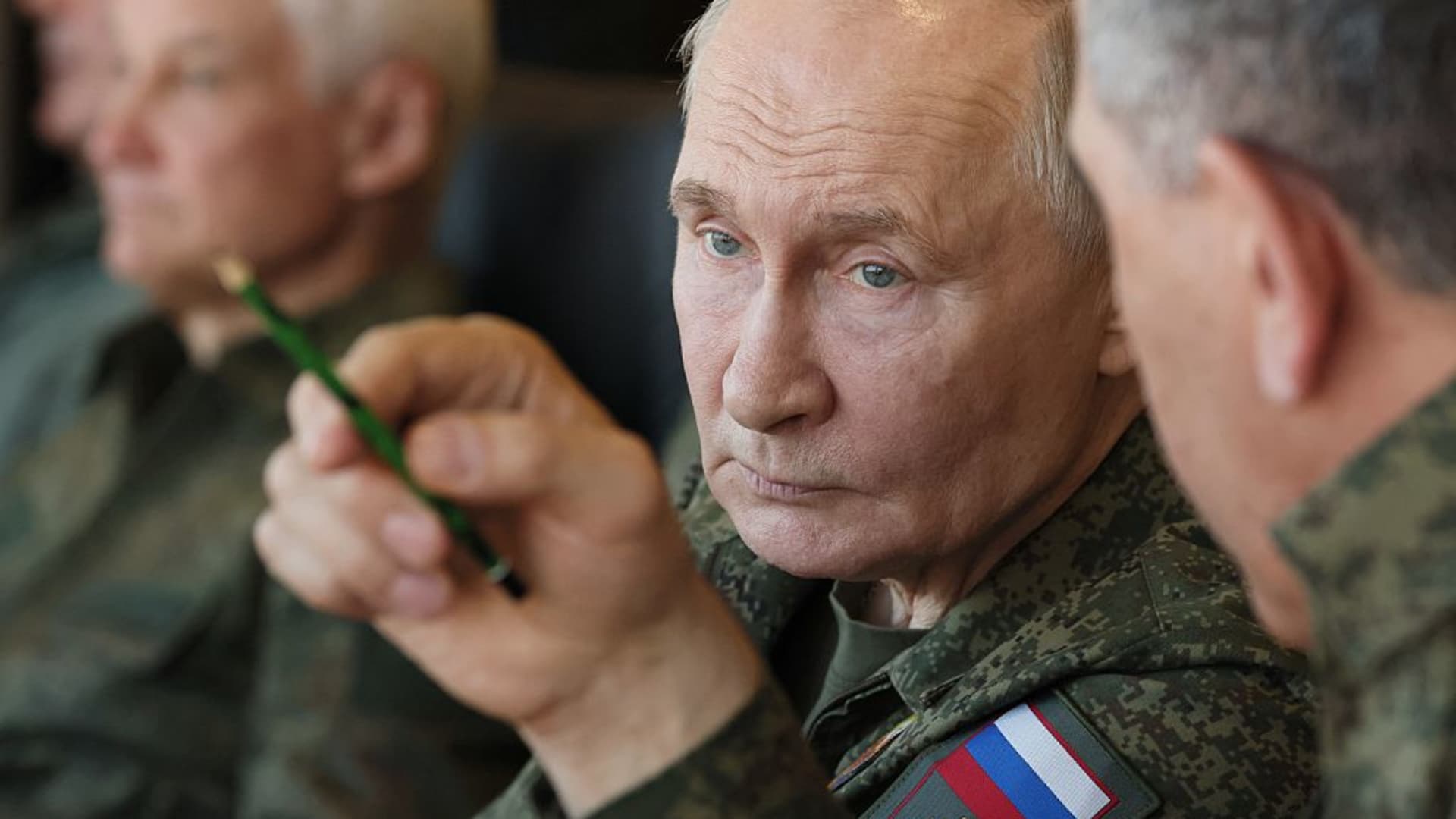
In this pool photo distributed by Russian state agency Sputnik, Russian President Vladimir Putin is seen attending the flag-raising ceremony of the latest Project 955A (Borey A) strategic nuclear submarine Knyaz Pozharsky in Severodvinsk on July 24, 2025.
Alexander Kazakov AFP | Getty Images
European Commission President Ursula von der Leyen told EU lawmakers that Europe needed to face the reality of a “hybrid war” being waged against it and that the incidents were not “random harassment” but part of a concerted operation to destabilize and weaken the bloc.
Recent incidents of drones, airspace violations, cyberattacks, and election interference are just a few of the incidents that von der Leyen cited as examples of a hybrid war against Europe.
“In just the past two weeks, MiG jets have violated Estonian airspace and drones have flown over key locations in Belgium, Poland, Romania, Denmark and Germany. Aircraft have been grounded, jets have been scrambled and countermeasures have been taken to ensure the safety of our citizens,” von der Leyen said in a speech to the European Parliament in Strasbourg, France, on Wednesday.
“Make no mistake about it. This is part of an alarming pattern of growing threats. We’ve had undersea cables cut across the Union, airports and logistics hubs paralyzed by cyberattacks, and elections targeted by campaigns of negative influence,” von der Leyen said, stressing that “this is a hybrid war and we must take it very seriously.”
Von der Leyen did not directly blame Moscow for all these incidents, but said: “It is clear that Russia is trying to sow the seeds of division.”
Russia has long been accused of being behind numerous “hybrid” attacks against its European neighbors, but has repeatedly denied those accusations. CNBC has reached out to the Kremlin for a response to von der Leyen’s recent comments and is awaiting a response.
What is hybrid warfare?
So what is hybrid warfare, or war? Simply put, it is a way of waging a kind of war without appearing to be doing so.
Although there is no clear definition of hybrid warfare, defense, military, and security experts agree that it essentially combines traditional military techniques with more destructive or irregular tactics aimed at disrupting, distracting, and weakening the enemy.
U.S. Marines look on from aboard the USS Mesa Verde during Exercise Northern Coast 2023 in the Baltic Sea, Sept. 18, 2023.
Janice Raisance | Reuters
European countries on the periphery of the EU or on the border with Russia, such as the Baltic states Estonia, Latvia, and Lithuania, or Eastern European countries, such as Romania and Poland, are increasingly exposed to hybrid warfare attacks.
These incidents range from sabotage of energy and communications infrastructure, such as undersea cables, to brief incursions into NATO airspace and territorial waters by Russian jets and submarines.
Russia denies involvement in many of these incidents, but tends not to comment on its jets invading NATO airspace or the drone incident that closed Denmark’s airport and disrupted flights. Many European officials have blamed Russia for being behind the chaos, but national authorities often say hard evidence of Russian involvement is difficult to find.
The EU’s von der Leyen said this is one of the characteristics of hybrid warfare, and that such incidents are “calculated to remain in the twilight of denial.”
A sign warning of a no-fly zone in Copenhagen, Denmark, September 29, 2025. In connection with the EU summit, all commercial drone flights will be prohibited in Danish airspace from Monday, September 29th to Friday, October 3rd.
Null Photo | Null Photo | Getty Images
According to a report released earlier this year by the geopolitical and security intelligence agency Dragonfly, Russia’s campaign of hybrid activities in Europe has expanded significantly since Russia’s full-scale invasion of Ukraine began more than three years ago.
The report documented 219 incidents of suspected Russian hybrid warfare in Europe since 2014, including sabotage, assassinations, and electromagnetic attacks such as GPS jamming. Of these incidents, 86% have occurred since the beginning of 2022, and almost half (46%) occurred in 2024 alone.
The report notes that the Baltic states, Finland, Germany, Norway, Poland and the United Kingdom, are likely to remain the main targets due to their strong support for Ukraine.
Europe says it is ready to act
European officials do not believe now is the time to act to strengthen regional security and defenses against malign activity.
As Luxembourg’s Prime Minister Luc Frieden told CNBC last week, NATO members pledged earlier this year to increase defense spending to 5% of gross domestic product (GDP) and Europe vowed to mobilize its defense sector to counter the “persistent threat to European security” posed by Russia.
Last week, member states discussed the creation of “flagship” defense projects, including the Eastern Flank Surveillance Initiative, which proposes creating a “drone wall” network to prevent airspace violations by unmanned aerial vehicles (UAVs). However, the idea of a drone wall is controversial, with Germany’s defense minister apparently throwing cold water on the idea.

Luxembourg’s Frieden said the EU did not want a conflict with Russia but needed to protect itself.
“Hybrid attacks obviously can happen anywhere,” Frieden told CNBC’s Sylvia Amaro. “We don’t want to go to war with Russia…but we need to take the threat seriously, whether it’s cables in the Baltic Sea, attacks on our IT systems, drones flying over parts of our country. It shows there are certain provocations that we have to take seriously.”
“We say to Russia, don’t try, stop trying, go back.[And Russia]has no chance of conquering Europe.”
