

Chonburi, Thailand
AP
—
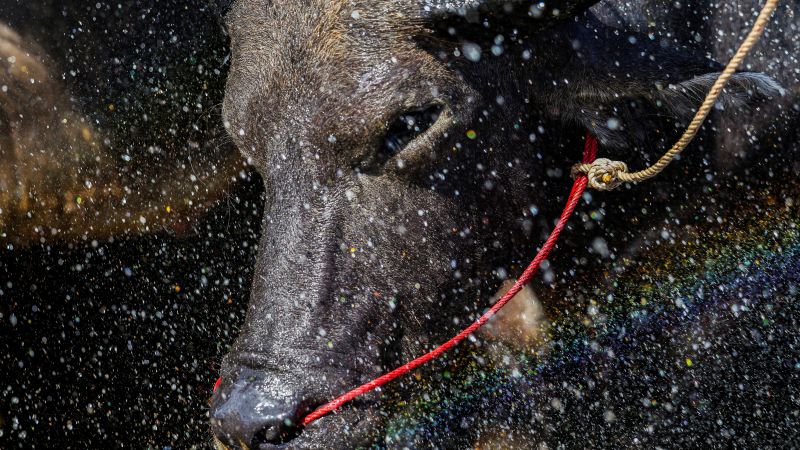
It was 5-year-old Todd’s first time competing in a beauty pageant, and the insides of his ears were bright red, which stood out against his black fur.
Todd, the main stallion of his owner, food vendor and farmer Tawachai Daengam, was one of the competitors on Monday at the annual buffalo racing festival in Chonburi, a city about an hour’s drive from Bangkok.
Once considered a humble draft animal, buffalo have become a prized show animal in Thailand. It is celebrated with a festival held at the end of November of the lunar month to mark the beginning of the harvest season and spotlight the animals that were once essential to Thailand’s agriculture.
In recent years, tractors have replaced water buffalo, once prized for their strength and ability to plow fields and carry heavy loads. If an animal does not compete in a show, it is sold as meat.
The highlight of the Chonburi expo was the water buffalo, which opened with a parade of students performing traditional Thai dances. There were also water buffaloes wearing flower crowns, pulling traditional wooden carriages with 2-meter (6.5-foot) high wheels, carrying their owners and women in traditional Thai costumes.
The festival also featured races in which buffalo with jockeys raced around a 100-meter (328-foot) track.
Pithun Rasamy came to compete with the white-furred 3-year-old buffalo. The albino had already won a local competition and was hoping Lukao, which means marble in Thai, would finish in the top five.
There was good reason to be hopeful. Another albino Thai buffalo was sold in 2024 for 18 million baht ($672,000) after winning multiple contests.
The transition from livestock to valuable symbols occurred gradually with the mechanization of agriculture. Thailand’s buffalo population was in decline for a while.
But the contest sparked new interest in the animals and spawned a new government-supported industry. The Thai government has established Thai Buffalo Protection Day since 2017, and local governments are currently providing breeding assistance to farmers.
Tawachai, a food vendor who owns Tod, said raising competitive buffalo was just a hobby. He lets it roam free on his family’s farm and attended the festival just to see how Todd would rate against the other animals.

On large farms, the animals are bathed daily and fed a special diet of corn, soybeans, bran and vitamins, said Kichai Ankanawin, who works as a caretaker for the precious water buffalo.
He poured water on the buffalo he was overseeing at the festival. Buffaloes were at least a head taller and larger than many other animals. They are judged by the size of their horns, the smoothness of their hooves, and their overall physique.
Events centered around buffalo are not new in Chonburi, said Papada Srisophon, assistant village chief near the livestock center where farmers learn buffalo husbandry techniques.
“Every year it gets bigger and bigger,” Papada said, explaining that the contest is an incentive for farmers to keep raising their animals. “Without this activity, they would not know what to do with the buffalo and would not have the desire to keep it.”
At the Chonburi beauty pageant, the buffalo was kept in a shaded enclosure by its owner and caretaker. As fire trucks brought water to the animals, festival goers posed for photos with some of the biggest animals and families with young children gathered in the stands.
Caretakers then confined the large animals in designated enclosures, and judges wearing bolo ties and cowboy hats inspected the contestants.
Many of the buffalo owners participating in the contest said they grew up with their gentle buffaloes and still cherish them, even if their animals are no longer useful on their farms.
“Buffaloes can still work in the fields, but they can’t compete with machines,” Tawachai says. The family still has 30 buffalo, including Todd. “The buffalo is still very important to me. It’s like they say, ‘People raise buffalo, and buffalo raise people.'” It’s like a member of the family. ”
