

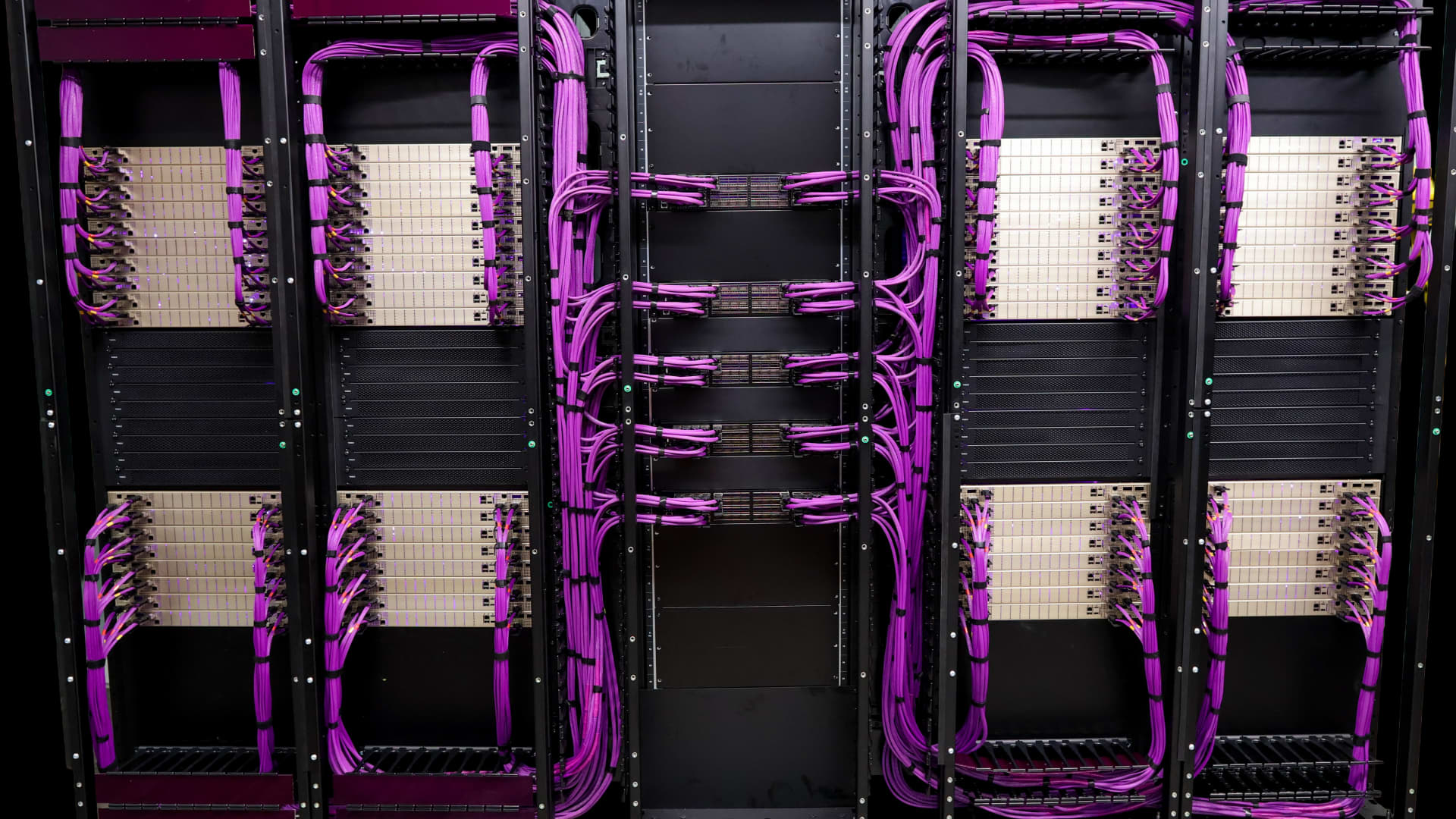
A demo setup of a rack of AI servers connected with Credo cables on display at the Open Compute Summit in San Jose, California.
creed
In July, Elon Musk posted a photo of the inside of an xAI data center called Colossus 2. The artificial intelligence startup aims to turn its Memphis, Tennessee, location into a large-scale supercomputing facility.
Musk’s photo posted on X Feed wasn’t showing off anything expensive. Nvidia A rack packed with powerful graphics processing units. Rather, he focused on the wires behind the servers and included one image with thousands of neatly organized purple cables connecting the computers to each other.
These purple cables are creeda 17-year-old semiconductor company based in Silicon Valley, whose name is rarely mentioned alongside the leaders of the AI boom.
But Wall Street took notice.
Credo stock has more than doubled to $143.61 this year after soaring 245% in 2024. The company’s market capitalization is now close to $25 billion, up from about $1.4 billion at its 2022 IPO. Credo is seeking to position itself as a key supplier in the multitrillion-dollar AI infrastructure expansion, and it’s benefiting from the money flowing downstream.
Shares rose 5% on Friday, following analysts’ expectations. JP Morgan Chase We initiated coverage with a buy rating and a stock price of $165. They say the active electrical cable (AEC) market pioneered by Credo is on pace to reach $4 billion by 2028 as major hyperscalers invest in data center expansion.
“The industry outlook is supported by increased adoption by major players such as Amazon, Microsoft, and xAI, as well as expanded adoption including by Meta and others,” the analysts wrote. They predict that Credo’s annual revenue will grow at least 50% through 2028.

Revenue more than doubled to $436.8 million for the 2025 fiscal year, which ended in early May. The company also returned to profit, posting a net income of $52.2 million, compared to a loss of $28.4 million in the same period last year. Analysts expect fiscal 2026 sales to more than double again to nearly $1 billion, according to LSEG.
Industry research firm 650 Group estimates that Credo’s purple AECs cost between $300 and $500 each, depending on bulk discounts and other negotiations. These are durable, moderately thick copper cables wrapped in a braided cover with large connectors containing chips on each side.
Much of the excitement around Credo is driven by the AI boom, which so far has been driven by a small number of hyperscalers that are rapidly building out data centers for the expected workloads of the future. Analysts expect spending on AI data centers to reach $1 trillion by 2030, but any exit from a major cloud provider or a planned reduction in OpenAI’s plans could hurt many suppliers, including Credo.
So far, the forecast is pretty positive.
Expanding opportunities
Previous servers typically had one or two processors on the motherboard. Today, individual servers can have up to eight, and the most powerful AI models can require millions of GPUs all working together as one.
Each GPU requires its own connection to the switch. A switch is a term used to refer to a computer that routes data within a cluster, often mounted at the top of a server rack.
Nvidia’s latest product combines several of these boards into slots to form a system with 72 GPUs. Next year’s fastest racks will have twice that number, and next year, Nvidia says, Kyber racks will have 572 GPUs.
“Previously Credo’s opportunity was one cable per server, now Credo’s opportunity is nine cables per server,” said Alan Weckel, an analyst at 650 Group. He estimates that Credo has 88% of the AEC market. AEC is manufactured similarly. Astera Research Institute and marvel.
Many GPUs are connected by fiber optic cables with components manufactured by companies such as: broadcom and coherent. AEC provides an alternative to fiber optic cables. It has a chip called a digital signal processor on each side that uses advanced algorithms to pull data out of the cable, allowing it to run much longer than traditional copper cables. Credo’s longest AEC is 7 meters.
Credo CEO Bill Brennan, who joined the company in 2013, told CNBC that hyperscalers are choosing Credo’s cables because they are more reliable than fiber optic cables. He said customers are trying to avoid so-called “link flaps.” This phenomenon occurs when the optical cables connecting the AI clusters fail, causing parts of the AI cluster to go offline, costing hours of expensive GPU time.
“You could literally shut down your entire data center,” Brennan said.
He said Credo is increasingly working with hyperscalers in the early stages of large-scale AI cluster plans, especially as some designs become denser and more servers can be connected with shorter cables.
“When you connect with these hyperscalers, the numbers are huge,” Brennan said.
Credo’s AEC leadership team, Hal Hawthorne, Don Barnetson, Ameet Suri, and Ryan Cai.
Corey Bentley, Creed
The company did not disclose the names of its hyperscaler customers, but analysts said: Amazon and microsoft As a customer. Amazon Web Services CEO Matt Garman posted on LinkedIn on Friday an image of the company’s Trainium AI chip rack, which appears to show Credo’s purple cables.
Credo said three to four customers are expected to each account for more than 10% of its revenue in the coming quarters, including two new hyperscale customers this year.
Amazon and Microsoft declined to comment. Meta and xAI did not respond to requests for comment.
Credo spoke alongside representatives from Oracle Cloud at a conference for data center professionals in San Jose this week. A sample rack of Meta-designed Nvidia GPUs on display at the show featured Credo’s purple cables.
“Rest assured that every time we see another gigawatt data center announcement, we see it as an opportunity,” Brennan told investors during a September earnings call.
This is the market everyone is targeting for AI networking.
Analysts at TD Cowen estimated earlier this month that the market for AI networking chips could reach a value of $75 billion annually by 2030. Major players include Nvidia; advanced micro deviceboth have their own networking businesses and have the power to decide which technologies are part of their broader systems.
“Insatiable demand”
Credo was founded in 2008 by a group of former Marvell engineers who developed chips for a relatively esoteric technology called SerDes, which is used for high-speed chip-to-chip connections.
Brennan, who joined the company in 2013, was tasked with commercializing this technology. The company raised its first round of venture funding in 2015 from investors including Walden International, run by Lip Vu Tan, now Intel’s CEO.
Brennan said AEC’s business didn’t take off until the AI boom in the early 2020s because data centers didn’t need the technology yet.
But when Musk’s car company entered the picture in 2017, there was early excitement in the air. tesla needed help with its Dojo AI supercomputer, and needed a chip with more bandwidth than was available at the time.
Now, Credo wants to take advantage of its active copper cable scaffolding and expand into additional product lines, including in-rack connectivity, or so-called “scale-up” networking. The company announced new transceivers and software for optical cables this week.
“We have market traction like we’ve never seen before,” Brennan said. “Even if we could deliver the next generation right now, it would be consumed. The generations after that would be consumed. There is this insatiable demand in the world of AI clusters.”
Watch: OpenAI in Abilene, Texas

